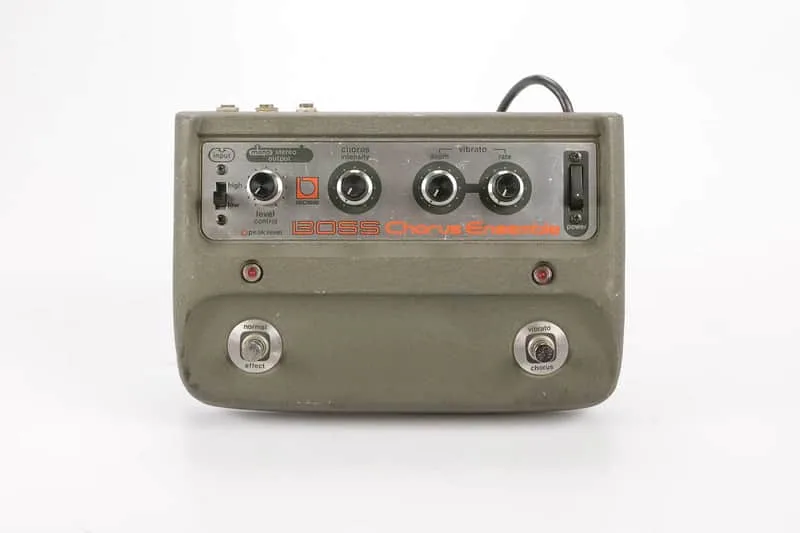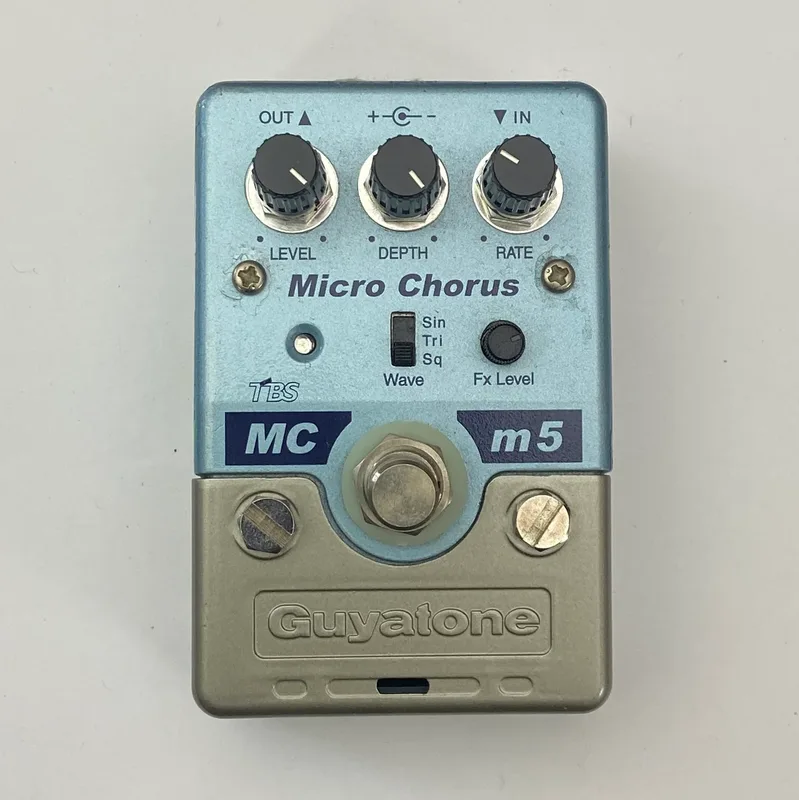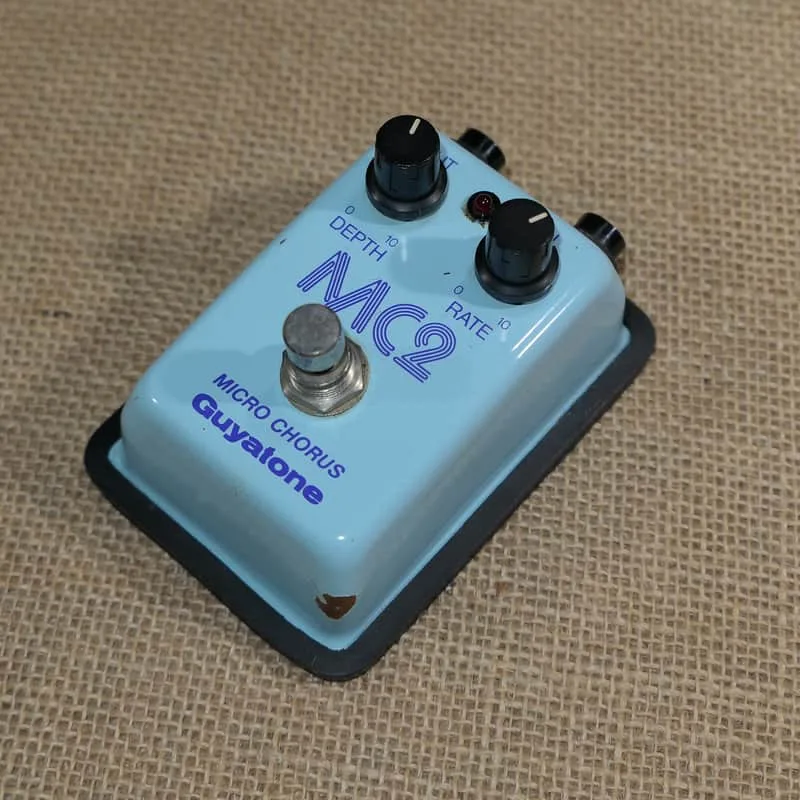
The Guyatone chorus pedal is a chorus effect made by Guyatone, a Japanese company, released in 1983. Writing for JHS Pedals, an unbylined writer described it as "almost a part for part replica of the CE-1", referring to the Boss CE-1, one of the best-known chorus circuits. For players, that places it firmly in the classic CE-1 school of chorus: the same family of sound as the pedal that defined the effect.1
What it does
The pedal produces chorus, the effect that doubles a guitar's signal and detunes the copy slightly for a shimmering, widened sound. Its pedigree is the notable part: JHS Pedals says it "uses that old original chipset that the MN3OO2 did", meaning the same MN3002 chip as the CE-1 it copies. The same writer called it "really versatile", adding that "every range of every knob is really useful".1
"It's from a Japanese company called Guyatone and it is almost a part for part replica of the CE-1."
Power
The pedal runs on 18 volts, which the presenter notes alongside its knob ranges: "Every range of every knob is really useful and runs on 18 volts, which means it's better."1
Guyatone chorus pedals later on
Guyatone went on to make chorus pedals in later years, and those models are covered on their own pages elsewhere on the site. For how this 1983 pedal sits among others of its kind, see Chorus Pedals1.
Questions
What chipset does the Guyatone chorus pedal use?
According to JHS Pedals, the Guyatone chorus uses the original MN3002 chipset, the same one found in the Boss CE-1, whose circuit it closely replicates. That shared chipset is a big part of why the two pedals are described as near part-for-part equivalents.
How is the Guyatone chorus pedal powered?
JHS Pedals notes that the pedal runs on 18 volts. That is higher than the 9 volts many compact pedals use, so it is worth checking your power supply before adding one to a board.
Sources (1)
- 12 LEGENDARY CHORUS PEDALS, JHS Pedals