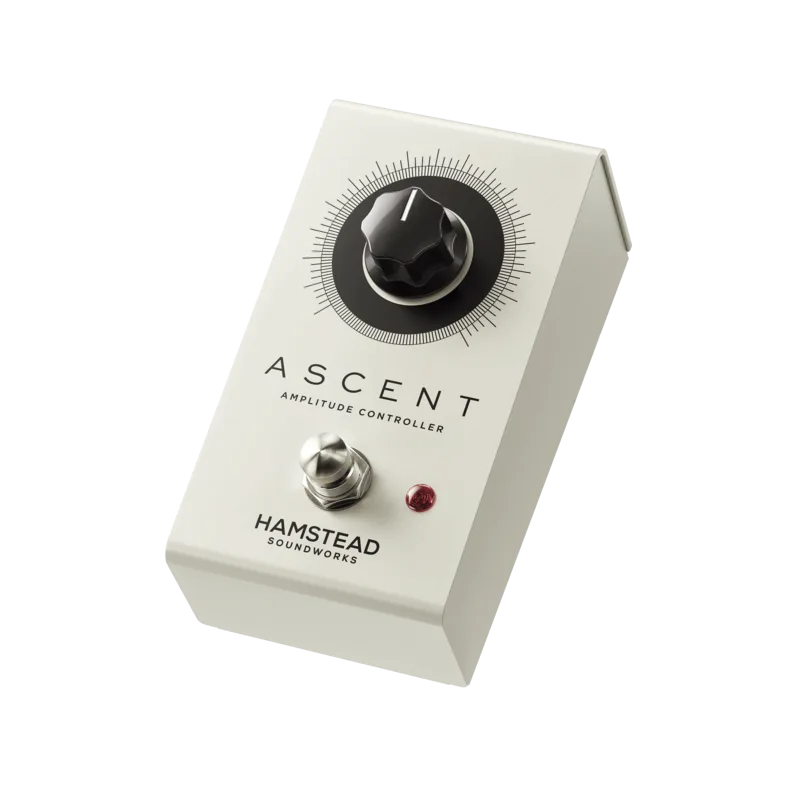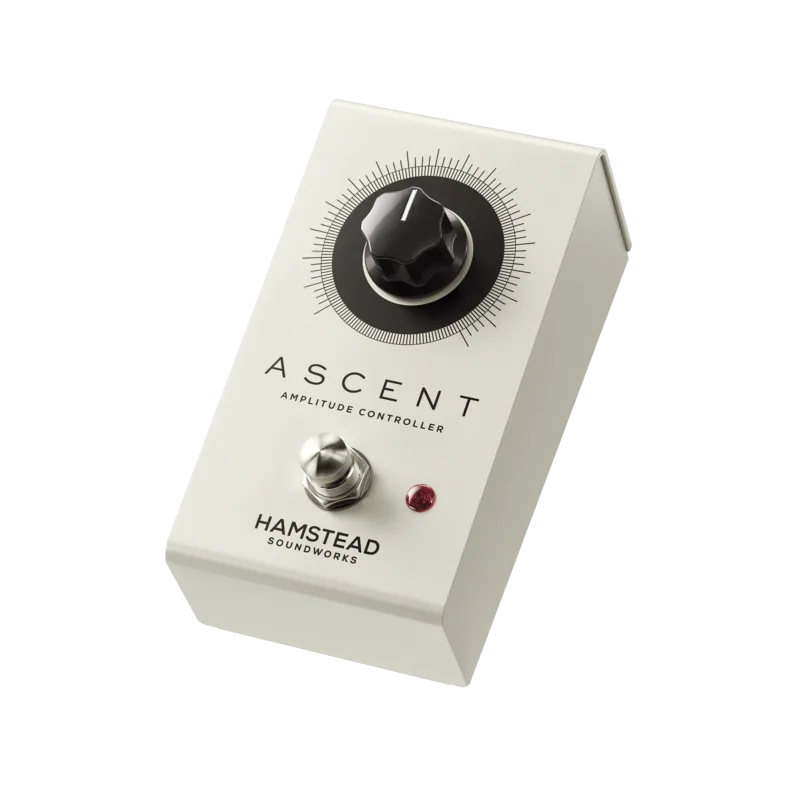


The Hamstead Soundworks Ascent is a clean boost pedal with a single control: one knob that delivers up to 20 dB of transparent gain12. Where an overdrive or fuzz pedal reshapes your tone, a clean boost like this one simply makes your signal louder, which players use to push an amp harder, cut through a mix for a solo, or drive the front end of other pedals. Hamstead describes the Ascent as "a pure clean boost pedal, offering a huge 20dB of gain with near-zero tonal colouration across the whole frequency range"1.
The circuit is all-analog, with a 100% analog signal path, and it uses a VCA (voltage-controlled amplifier) design that Gearnews reported gives "a linear and transparent boost"12. Each pedal is hand-soldered, signed and dated by the technician who built it3.
A clean boost with one knob
The Ascent's front panel is a single-knob affair: turn it up and your guitar signal gets louder, up to 20 dB, with the maker promising the tone stays essentially unchanged as the level rises12. That simplicity is the point. A boost with no tone stack, no EQ and no extra modes leaves the character of your guitar and amp intact, and the Ascent's high input impedance of 600K Ohms means it loads the pickups lightly, which helps preserve that character1.
The transparency comes from two design choices reported at launch. First, the VCA-based circuit keeps the boost linear rather than coloring the signal as it amplifies2. Second, the internal power arrangement gives the circuit far more voltage to work with than a standard 9V pedal, which is where the headroom comes in.
Power: ±15V internal rail
Inside the Ascent, the power supply generates ±15V internally isolated rails, for what Gearnews called "super-high 30 V headroom"2. GuitarPlayer reported the same spec as "±15v internally isolated power for 30v headroom"4. In practice, headroom is the amount of signal a circuit can pass before it clips: with 30 volts of internal swing, a hot signal boosted by 20 dB stays clean instead of distorting, which is exactly what a clean boost is supposed to do.
You feed it from a standard pedalboard supply, center negative, at any of three voltages1:
| Supply voltage | Current draw |
|---|---|
| 9V DC | 165 mA |
| 12V DC | 140 mA |
| 18V DC | 115 mA |
At 115 to 165 mA depending on voltage, the Ascent draws more current than many small boosts, and it has no battery option. Plan a dedicated output on your power supply rather than a daisy chain shared with low-draw analog pedals.
The switching is handled by the OptoKick footswitch, developed by Daniel Steinhardt and the team at TheGigRig, which Hamstead fits as its standard footswitch12.
Design and release
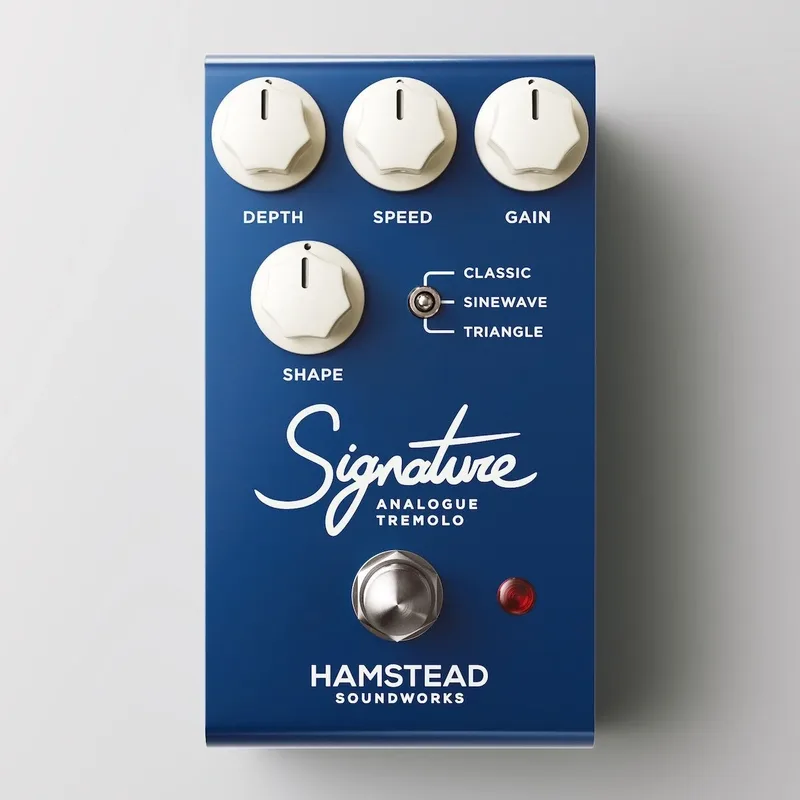
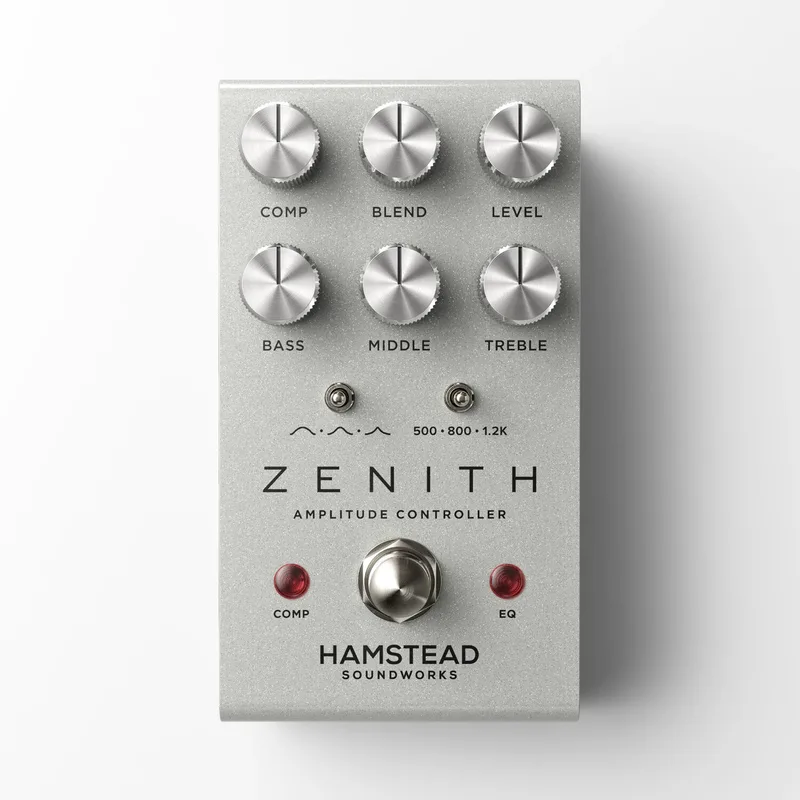
The Ascent was designed by Peter Hamstead of Hamstead Soundworks, a British builder whose earlier pedals include the Signature Tremolo/Boost and, later, the Zenith boost/EQ/compressor15. The Ascent is designed and built in Great Britain, and each unit is hand-soldered, signed and dated by the technician who assembled it13.
The pedal was offered for preorder exclusively through Reverb, with the first batch shipping from July 24, 2020234. Each unit is hand-soldered, signed and dated by the tech that built it, and the Ascent is designed and built in Great Britain31.
Price and availability
At launch in July 2020 the Ascent carried a recommended price of $199 in the US, £159 in the UK23. On the maker's current page the pricing has come down: US, EU and worldwide orders are listed at £107.50 plus local taxes, against an original price of £159.00, with UK buyers paying £129 including 20% VAT1.
The maker's page also lists B-stock Ascents at a sale price of £112.63, over 20% off, described as having light cosmetic damage. A limited number are available1.
Videos
AndyDemos
Mike Bradley
Eirik Stordrange
Questions
How much gain does the Hamstead Ascent add?
Up to 20 dB of clean boost. Hamstead describes it as a pure clean boost with near-zero tonal coloration across the whole frequency range, and the single knob controls the amount of gain from zero up to that 20 dB maximum.
Is the Hamstead Ascent analog?
Yes. The Ascent has an all-analogue design with a 100% analogue signal path, and it uses a VCA-based circuit for a linear and transparent boost rather than digital processing.
Who designed the Hamstead Ascent?
Peter Hamstead of Hamstead Soundworks. The pedal carries what the maker calls his usual design refinements, and it was developed alongside backline technicians who have worked with major touring acts.
How much does the Hamstead Ascent cost in the US?
At launch in July 2020 it sold for $199, exclusively through Reverb. On the maker's current page, US, EU and worldwide orders are priced at £107.50 plus local taxes, down from an original price of £159.00.
What footswitch does the Hamstead Ascent use?
The OptoKick footswitch, developed by Daniel Steinhardt and the team at TheGigRig. Hamstead calls it the company's standard footswitch, so it appears across other pedals in the range as well.
Sources (5)
- Ascent | Hamstead Soundworks, Hamstead Soundworks
- Hamstead Ascent boost pedal by techs working with Queen, AC/DC and Iggy Pop, gearnews.com, 2020-07-03
- Hamstead Soundworks' Ascent is a pure clean boost pedal built by techs for AC/DC, Guns N' Roses, Queen and more, Guitar World, 2020-07-06
- Hamstead Soundworks Unveils New Ascent Clean Boost Pedal, GuitarPlayer, 2020-07-14
- Preorder Now: Hamstead Zenith Boost/Compressor, Delicious Audio, 2020-11-05