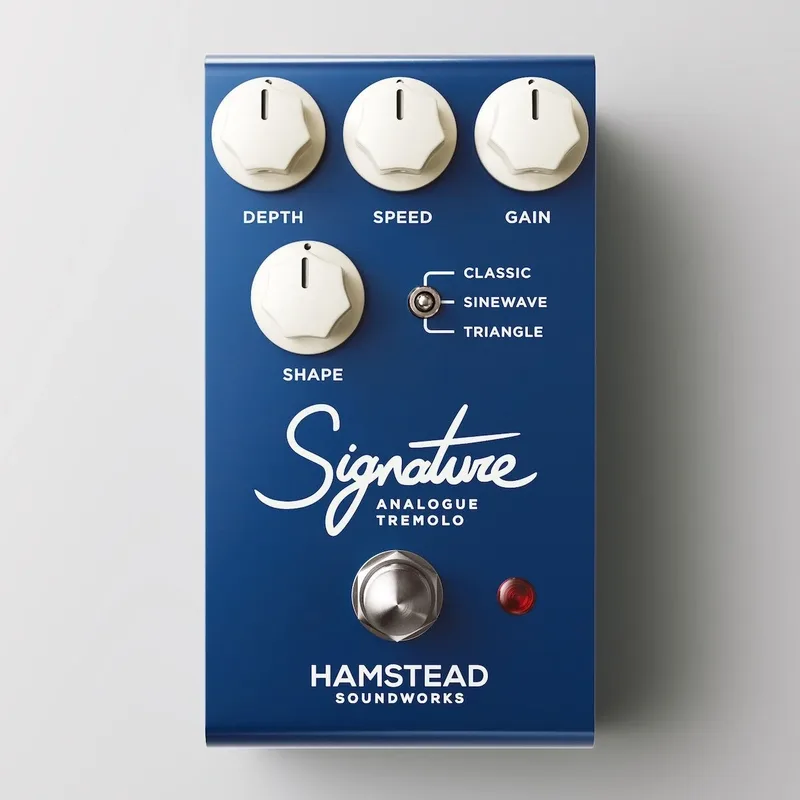


The Hamstead Soundworks Signature Tremolo is an all-analog tremolo and clean boost pedal from Hamstead Soundworks, a company based in Cambridgeshire, England, that designs and builds its gear in Great Britain12. It first appeared in December 2015 as a stand-alone version of the tremolo circuit built into the company's handbuilt Artist 20+RT Series amplifiers, with a clean gain boost circuit added32. Guitar World dates the pedal's arrival to 2016, when Hamstead first put the tremolo circuitry from its Artist +RT series amps into stompbox form4.
The pedal gives you two functions in one box: a tremolo and a boost, each with its own footswitch on the original version5. The boost supplies up to 10dB of clean gain, set by the central Gain knob, and can be used to accentuate the tremolo, switched out separately for a solo lift, or run into the front end of an amp to push it harder132.
Signature and Classic tremolo modes
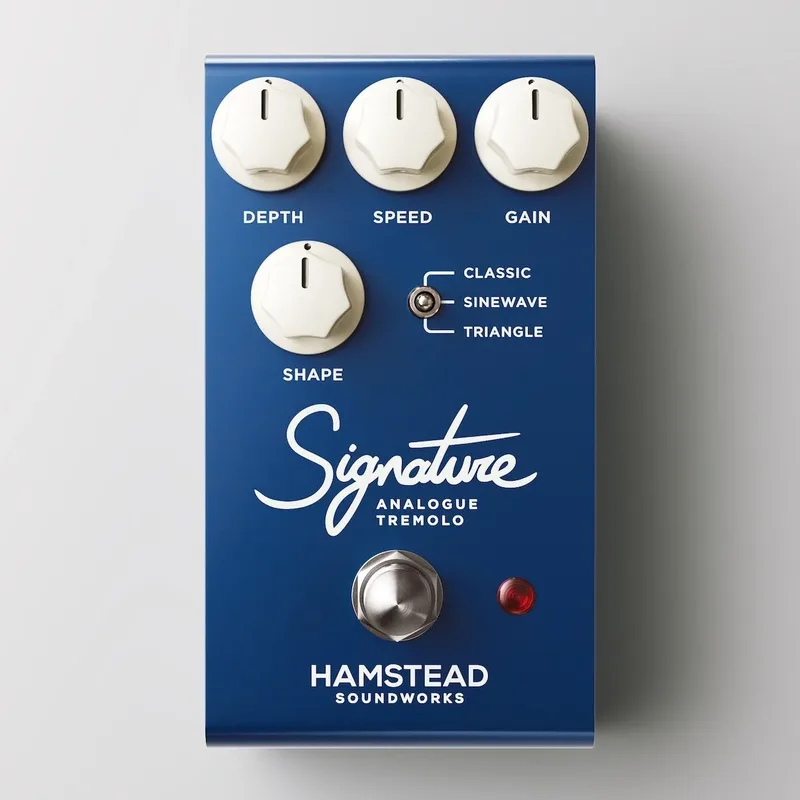
A mini switch toggles between two modulation modes on the original pedal2.
| Mode | What it does |
|---|---|
| Signature (Sinewave) | Hamstead's own true sine wave tremolo, described by the maker as a true sinusoidal waveform for the cleanest, smoothest and most musical sounding tremolo1 |
| Classic (Output Bias) | Replicates the valve-powered tremolo circuits of vintage amplifiers, the output-bias style31 |
| Triangle (MKII only) | A third waveform Hamstead says is far more natural sounding than the name suggests, particularly useful with the Shape control1 |
MusicRadar's reviewer Trevor Curwen found the Signature mode "gorgeous":
"Signature is Hamstead's own true sine wave tremolo and it sounds gorgeous: smooth in its undulation with plenty of musical capabilities care of the thoughtfully chosen ranges of the Speed and Depth knobs."5
Guitar World's review of the MKII describes the sinewave mode as "buttery smooth, melding naturally with your tone," and notes that the Classic setting delivers the authentic sound of output bias tremolo as found in some vintage amps4.
Controls and how it shapes the sound
The original pedal carries the same Speed and Depth rotaries featured on the Artist 20+RT amplifier: Speed operates between 0.4 and 15Hz and Depth between 0 and 100%32. Hamstead says the Depth control runs from subtle modulation movement through to aggressive side-chain style pumping volume1. Speed can also be placed under the control of an external expression pedal, or a high/low speed switch, for changes on the fly14. Guitar World found the Depth and Speed knobs give a great range, from a slow deep throb to a fast shimmer4.
The Gain control provides the boost of up to 10dB, which Hamstead says can really accentuate the tremolo effect or push the front end of an amplifier1. The tremolo section has its own on/off footswitch with LED status2.
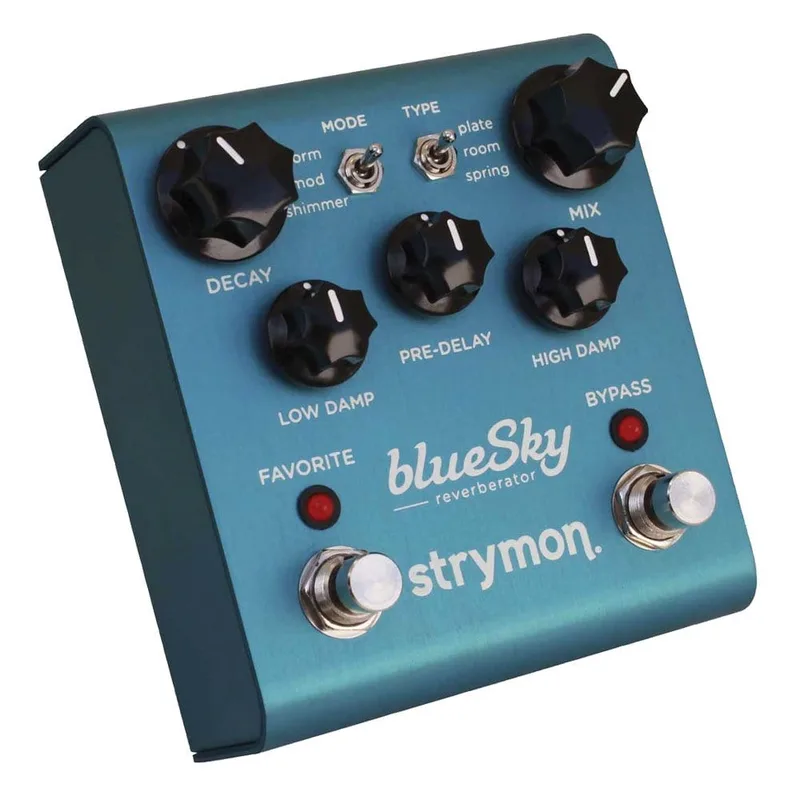
The enclosure is a rugged two-part chassis, marginally smaller than Strymon's smaller offerings such as the BlueSky, with a subtly sloping top for easier access to the two footswitches5.
Power and bypass
Power requirements are 9 to 18V DC at 250mA, center negative, with the adaptor not supplied34. At 250mA this pedal draws more current than many analog stomps, so check your power supply's capacity per output before daisy chaining.
As shipped, the pedal features buffered bypass, which Hamstead recommends because it provides silent switching, but there is an internal DIP switch to change it to true bypass5. The MKII is also listed with buffered bypass4.
From the Artist 20+RT amp to the MKII
The pedal's lineage goes back to the Artist 20+RT amplifier, where the RT denotes reverb and tremolo. The tremolo circuit from that amp has now found its way, with a few extra features, into stompbox form5.
In 2026 Hamstead released the Signature Analog Tremolo MKII, which takes the Signature Sinewave circuit straight out of the Artist +RT series amplifiers and puts it in a more compact format14.
| Original (2015/2016) | MKII (2026) | |
|---|---|---|
| Waveforms | Signature, Classic | Sinewave, Classic, Triangle14 |
| Boost switching | Independent boost footswitch5 | No extra footswitch for the boost circuit4 |
| Footprint | Larger | Smaller footprint4 |
| Extra features | Tremolo on/off footswitch with LED241 | Control input, Shape control14 |
| Controls | Depth, Speed, Gain42 | Depth, Speed, Gain, Shape, Modulation Mode switch, internal Power Up mode dipswitch, bypass footswitch4 |
The Shape control is new for the MKII and allows you to tilt any of the waveforms to the left or right. In Triangle mode it creates up and down sawtooth waveforms, and it can accentuate the thump of output bias style tremolo in Classic mode1. Guitar World notes the Triangle waveform is capable of sawtooth and reverse sawtooth patterns with the Shape knob in play4. Delicious Audio also lists expression and speed control pedal support for the MKII6.
What reviewers said
MusicRadar's review lists the pedal's tremolo and boost being independently switchable in one box, its two tremolo types and its excellent quality of sound as reasons to buy5. Guitar World's verdict on the MKII calls it a solid choice for an impeccably built, vintage-inspired tremolo overall, offering a trio of waveforms and 10dB of boost in a more compact format4.
"Offering a trio of waveforms and 10dB of boost in a more compact format, the Hamstead Soundworks Signature Analogue Tremolo remains a solid choice for impeccably built, vintage-inspired tremolo."4
The pedal has also appeared in That Pedal Show's tremolo demo, where Mick and Dan compared it among five tremolo pedals7.
Videos
Eirik Stordrange
MusicStreet
Guitar Interactive Magazine
Questions
Can the boost on the Hamstead Signature Tremolo be used without the tremolo?
Yes. The original pedal has an independent boost footswitch, so the clean gain boost can be switched on by itself for a solo lift of up to 10dB, or used to fatten up the front end of an amp. It can also boost the tremolo output when both are engaged. The MKII drops the separate boost footswitch and keeps boost on the Gain knob.
Is the Hamstead Signature Tremolo true bypass or buffered?
It is buffered bypass as shipped, which Hamstead recommends because it provides silent switching. An internal DIP switch lets you change it to true bypass if you prefer. The MKII is listed with buffered bypass as well.
Is the Hamstead Signature Tremolo analog?
Yes. It is a 100% all-analogue design, including the waveform creation, where many tremolo pedals use digital circuitry to generate their waveforms. The MKII keeps the all-analogue design.
How much boost does the Hamstead Signature Tremolo give?
Up to 10dB of clean gain, set by the Gain control. Hamstead says it can accentuate the tremolo effect or push the front end of an amplifier, and reviewers found it transparent rather than colored.
What is the speed range of the Hamstead Signature Tremolo?
The Speed control works from 0.4 to 15Hz, matching the rotaries on the Artist 20+RT amplifier. Speed can also be controlled by an external expression pedal or a high/low speed switch, so changes can be made on the fly.
What changed on the Hamstead Signature Analogue Tremolo MKII?
The MKII loses the extra footswitch for the boost circuit but offers a smaller footprint, a control input, a third waveform (Triangle) and a Shape control that tilts any waveform left or right. In Triangle mode the Shape control creates up and down sawtooth waveforms.
Sources (7)
- Signature Tremolo, Hamstead Soundworks
- Hamstead Soundworks Launch Stand-Alone "Signature" Tremolo/Boost Pedal, Guitar Interactive Magazine, 2015-12-08
- Hamstead Soundworks launches standalone Signature Tremolo/Boost guitar pedal, MusicRadar, 2015-12-07
- Hamstead Soundworks Signature Analogue Tremolo MKII review, Guitar World, 2021-02-10
- Hamstead Soundworks Signature Analogue Tremolo review, MusicRadar, 2016-10-13
- Hamstead MKII Signature Analogue Tremolo, Delicious Audio, 2021-04-15
- TPS AB Comparisons, That Pedal Show, 2017-01-17