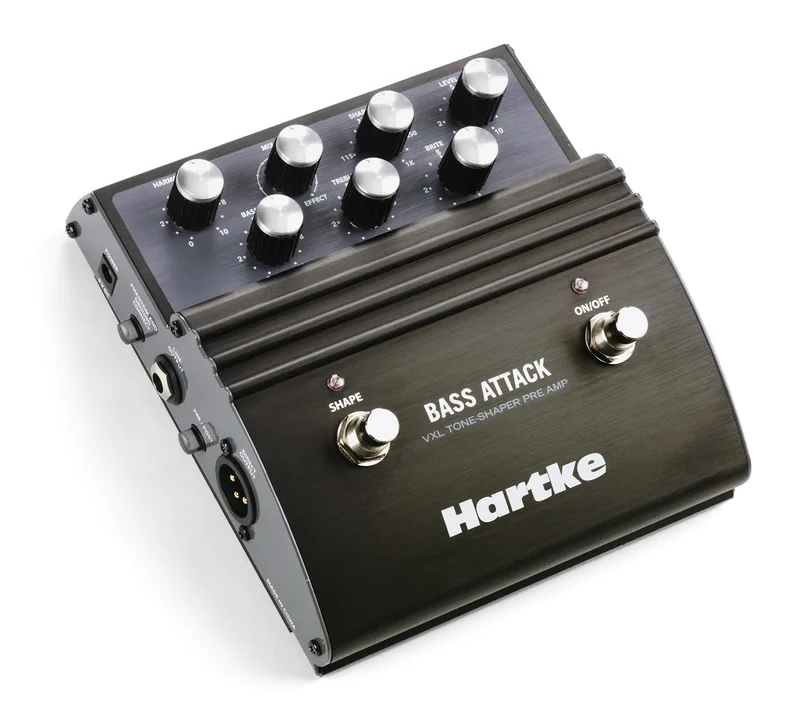



The Hartke VXL Bass Attack Tone-Shaper Preamp is a bass pedal that combines four jobs in one box: preamp, overdrive, equalizer and DI1. Hartke describes it as a Preamp/Direct Box, and Guitar.com reviewed it in March 2016 as a bass guitar preamp and tube-emulation distortion pedal with a DI output23. It sits in the same family as other preamp pedals and bass pedals, but its selling point is that it packs Hartke's Shape EQ curve, a tube-style harmonics section and a balanced XLR output into a single wedge-shaped enclosure.
Hartke lists the VXL Bass Attack as discontinued and unavailable for order on its own product page3. It was priced at £79 in the UK when Guitar.com reviewed it in March 20162.
What it is and what it does
The VXL Bass Attack is built as a preamp first. The bass, treble and level controls are cut/boost controls that are active as soon as you plug in, flat at the center position or 5 on the dial, so Guitar.com's reviewer advised remembering to set them flat before you start2. Engaging the basic two-band EQ, in the reviewer's words, "provides degrees of practical width without loss of definition and decent cut and bite"2.
The pedal's signature feature is the Hartke Shape circuit, which Hartke calls a world-famous preset EQ curve. A footswitch activates the sweepable shape control, offering various preset EQ curves as tonal starting points, and the rotary control sets the center frequency of the curve: clockwise for thunderous lows, counter-clockwise for more pronounced high end23. Guitar.com's reviewer found that "rotating anti-clockwise uncorks starting-point sounds that are thinner and more lightweight, with good barking, raspy variations," while clockwise gives a thick, thudding boom2.
The overdrive side is a tube emulation. Hartke says the variable Harmonics control emulates the warmth of a tube preamp3, and Guitar.com found the overdrive itself to be "a decent facsimile of the warm snarl that valves provide," adding that Jack Bruce's classic Cream-era snarl is pretty easy to approximate2. The key to the overdrive function, as with most overdrive and distortion pedals, is the mix dial, which takes you from a bit of grunt under clean notes to full-on mayhem2.
Controls and layout
The pedal has two stomp switches and a set of rotary controls, laid out on a gray control panel in a wedge-shaped metal box with a black top and back and gray sides2.
| Control | What it does |
|---|---|
| Bass, treble, level | Cut/boost controls, active on plugging in, flat at center or 5 on the dial2 |
| Shape footswitch | Activates the sweepable shape control, preset EQ curves as tonal starting points2 |
| Shape rotary | Sets the center frequency of the Shape curve: clockwise for thunderous lows, counter-clockwise for more high end3 |
| On/off footswitch | Activates harmonics, mix (dry to wet) and brite controls2 |
| Harmonics | Variable control emulating the warmth of a tube preamp3 |
| Mix | Dry to wet blend for the overdrive, from a bit of grunt to full-on mayhem2 |
| Brite | Cut/boost to higher frequencies2 |
| Pre/Post switch | Pre (out) sends the signal to the PA without affecting the original sound; Post (in) includes the harmonic effects in the XLR output3 |
| Ground/lift switch | Turns phantom power on/off2 |
Outputs and DI use
The VXL Bass Attack's output section is what makes it work as a DI box as well as a tone shaper. It carries a gold-plated balanced XLR direct output with a selectable Pre/Post switch, a 1/4" parallel output and a 1/4" input3. Guitar.com lists the same set: XLR DI out, line out, parallel out and input jack sockets, with the parallel out always emitting a clean signal2.
The Pre/Post switch matters for how you use it. In the Pre (out) position, the signal going to the PA can be tweaked without affecting the original sound; in the Post (in) position, the harmonic effects are included in the XLR direct output signal3. Guitar.com's practical advice was to press it for post mode if you are using the VXL for shaping, and leave it out if not2. The DI output also has a ground/lift switch, which the review describes as enabling use as a direct box for connection to a PA or for recording2.
Power
The Bass Attack will operate via a 9-volt battery, an optional AC adapter, or phantom power through the XLR3. The battery is accessed through a quick-release cover on the bottom, and Guitar.com noted the nine-volt power supply is not supplied2. Phantom power is switched on and off by the ground/lift switch2.
What reviewers said
Guitar.com reviewed the VXL in March 2016, describing it as Hartke's new bass pedal souping up the humble preamp formula2. The reviewer's verdict on the overdrive was positive:
"The overdrive itself is a decent facsimile of the warm snarl that valves provide"2
Guitar.com, March 20162
The review also flagged the practical points a buyer should know: the pedal is not true bypass, the EQ controls are active on plugging in so they need to be set flat before use, and the power supply is not included2.
Videos
HartkePolska
gearwire
creativemusicians
Questions
Is the Hartke VXL Bass Attack true bypass?
No. Guitar.com's review describes it as a DI pedal without true bypass, so the pedal's circuit stays in the signal path even when the effects are switched off. That is worth knowing if you run long cable runs or a large pedalboard.
Can the Hartke VXL Bass Attack be used as a DI box?
Yes. It has a gold-plated balanced XLR direct output with a ground/lift switch, which Hartke and reviewers describe as enabling use as a direct box for connection to a PA or for recording. A Pre/Post switch on the XLR output chooses whether your pedal's tone shaping reaches the PA.
Does the Hartke VXL Bass Attack run on a battery?
Yes. It operates via a 9-volt battery, accessed through a quick-release cover on the bottom, or through an optional AC adapter. It can also run on phantom power through the XLR connection, which the ground/lift switch turns on and off.
What does the Shape control do on the VXL Bass Attack?
It engages the Hartke Shape circuit, a preset EQ curve, and the rotary control sets the center frequency of that curve. Turned clockwise it favors thunderous lows; counter-clockwise it gives thinner, more lightweight sounds with more pronounced high end.
Is the Hartke VXL Bass Attack still made?
No. Hartke lists the VXL Bass Attack as discontinued and unavailable for order on its own product page. It was priced at £79 in the UK when Guitar.com reviewed it in March 2016, and it now turns up on the second-hand market.
Sources (3)
- VXL Bass Attack by Hartke, RockBoard PedalPedia, 2026
- Hartke VXL Bass Attack Tone-Shaper Preamp review, Guitar.com, 2016-03-14
- VXL Bass Attack, Hartke