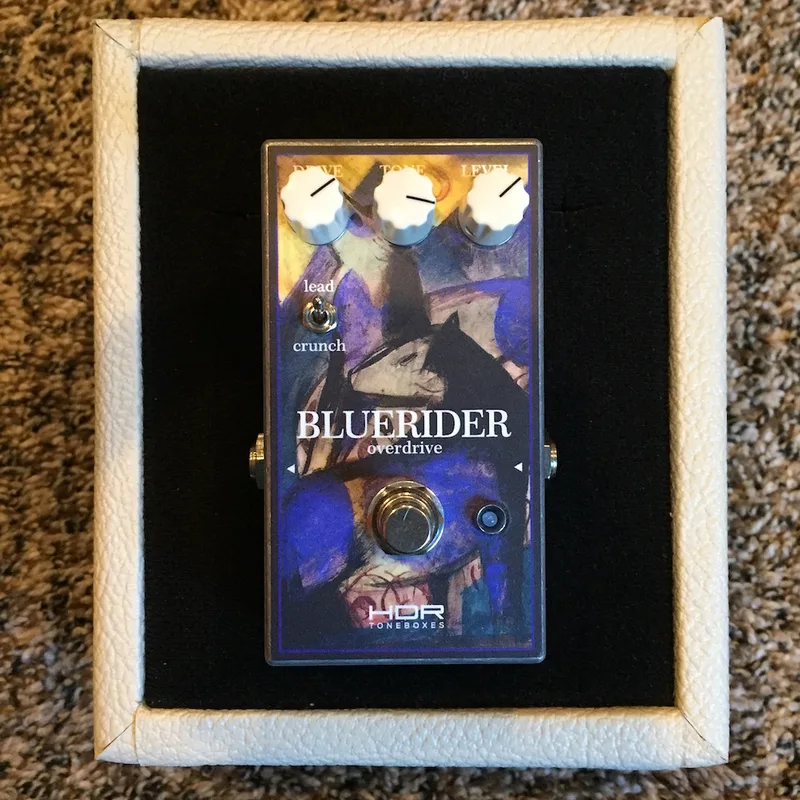
The Bluerider is an overdrive pedal from HDR Amplification, a small company from the Czech Republic. It is built on the circuitry of a classic green overdrive box, the family of circuits covered in our Boss SD-1 vs Ibanez TS9 Tube Screamer comparison, but HDR widened the Drive knob's range and added a Lead/Crunch toggle switch. The result, as the reviewer put it, is a pedal that covers "a multitude of styles, from rock to blues to light metal and more"1.
Controls and the Lead/Crunch switch
The Bluerider keeps the three-knob layout of the classic design and adds a two-position toggle. Pedal of the Day's Mike B described the changes this way1:
"HDR has taken it to another level, though, by increasing the overall range of the Drive knob, allowing for a multitude of styles, from rock to blues to light metal and more."
| Control | What it does |
|---|---|
| Drive | Sets the amount of overdrive, with a wider overall range than the classic design1 |
| Tone | Shapes the treble character of the drive1 |
| Level | Sets the output volume1 |
| Toggle: Crunch | The mellower setting; with Drive dialed back it works as a clean-ish boost1 |
| Toggle: Lead | Cranks up the volume, giving the signal a big boost and pushing the amp right to the edge1 |
The two toggle positions make the pedal do two jobs. In Crunch it can sit in front of an amp as a light push, and in Lead it becomes a louder, harder-hitting drive for solos. For where a circuit like this sits among its neighbors, see our Overdrive Pedals page, and for heavier textures the Distortion Pedals and Fuzz Pedals pages cover the alternatives1.
Power and size
The Bluerider runs from a 9 to 15V DC negative center adapter, with a regulated supply recommended, or from a single 9V battery. Its power consumption is low at 6mA at 9V DC, so it fits comfortably on any standard pedalboard supply1. The enclosure measures 70mm wide by 114mm deep by 50mm high1.
What reviewers said
Pedal of the Day's review, published on 21 November 2015, was positive. Mike B noted that "The Bluerider is especially clean at any volume, too, making it that much more of a versatile weapon in your sonic arsenal," and summed the pedal up as "an excellent take on a classic pedal, with some modern internal workings, better sonic ranges and toggle options"1.
Videos
Pedal of the Day
Questions
Does the HDR Toneboxes Bluerider take a battery?
Yes. The Bluerider runs on one 9V DC battery, and it can also be powered from an AC adapter at 9 to 15V DC with a negative center pin, with a regulated supply recommended. Its current draw is low at 6mA at 9V DC, so it sits easily on a pedalboard power supply.
What voltage does the Bluerider run on?
The Bluerider accepts 9 to 15V DC through a negative center AC adapter, with a regulated supply recommended. Its power consumption is listed at 6mA at 9V DC, and it can also run from a single 9V battery.
What is the difference between the Lead and Crunch settings?
The toggle switch selects between two characters. Crunch is the mellower setting, and with the Drive knob dialed back it works as a clean-ish boost. The Lead position cranks up the volume, giving the signal a big boost and pushing the amp right to the edge.
What classic pedal is the Bluerider based on?
Pedal of the Day's review describes the Bluerider as based on the circuitry of a certain classic green overdrive box, with the Drive knob's overall range increased over the original design. Players generally read that as a reference to the Tube Screamer family of overdrives.
Can the Bluerider work as a clean boost?
Yes, in the Crunch position. The review notes that while Crunch can get crunchy if needed, it also works as a clean-ish boost when the Drive knob is dialed back, which makes it usable as a light push in front of an amp.
How big is the Bluerider?
The Bluerider measures 70mm wide by 114mm deep by 50mm high, so it is a compact enclosure that fits a standard pedalboard without taking up much room.
Sources (1)
- HDR Toneboxes Bluerider Overdrive, Pedal of the Day, 2015-11-21