

The Hotone Eko is a delay mini-pedal from Hotone's Skyline range, the company's line of compact stompboxes. RockBoard's PedalPedia describes it as a digital delay with a direct analog signal path, which the maker's specifications list as a hybrid circuit: your dry signal stays analog while the repeats are generated digitally1. The result, in Hotone's words, is a "Pure, warm, and natural echo tone--an excellent ambience maker"1.
It is a small box built like a much bigger one. MusicRadar's reviewer Michael Astley-Brown called it "a pocket powerhouse," noting its weighty zinc alloy shell and knobs that are either LED-lit or noctilucent, meaning they glow in the dark, a practical touch for dark stages2.
A compact hybrid delay
The Eko handles delay duties in Hotone's Skyline mini-pedal range, sitting alongside the line's other compact effects2. Its digital delay line, as RockBoard's PedalPedia puts it, "assures enough delay time and a pure signal path," while the analog dry path keeps your untouched guitar signal from passing through conversion1.
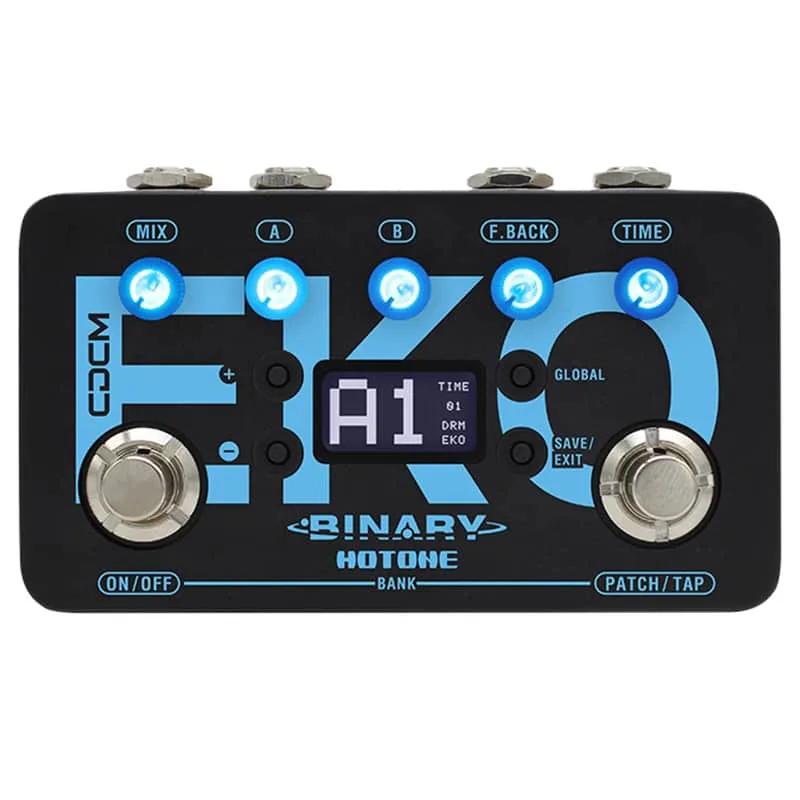
Maximum delay time is approximately 500ms1. That covers everything from tight slapback to ambient lead repeats, though it is well short of what larger delay workstations offer. Hotone's own Binary Eko, for comparison, carries algorithms for 17 delay types, including analog, digital, tape, dual, ping-pong, filtered, modulated and slap back, with stereo I/O and expression pedal support3. The little Eko trades that flexibility for a tiny footprint and simple operation.
How does it sound? MusicRadar's reviewer found that, like a real analog delay, longer delay times get a little noisy, but that the moody repeats never detract from what you are actually playing2. His verdict on the pedal's strengths: "Clever, compact feature set. Splendid psyched-out sounds."2
The controls
The Eko keeps its control set small, in keeping with its size. The knobs are LED-lit or noctilucent, so they glow in the dark for visibility on a dim stage2.
| Control | What it does |
|---|---|
| Knobs | Set delay time, mix and repeats; LED-lit or glow in the dark2 |
| MOD button | Press for a deeper, spacey feeling in the repeats1 |
The MOD button is the one feature beyond basic delay. Hotone's description is simple: "you can press the MOD button to get a deeper spacey feeling"1. In practice this adds modulation to the repeats, pushing the pedal toward the darker, moodier territory MusicRadar's reviewer described2.
Power and bypass
The Eko runs on 9V DC with a center negative plug, drawing 60mA1. That is the common standard for pedalboard power supplies, so it will run from most multi-output supplies without an adapter. The switching is true bypass, so when the pedal is off your signal passes through untouched2.
The Eko's 60mA draw at 9V DC center negative means a standard pedalboard supply handles it easily. As a mini-pedal it is a good fit for tight boards where a full-size delay will not fit.
Videos
HotoneAudio
Brett Kingman
MrSanSystem
Questions
Is the Hotone Eko true bypass?
Yes. MusicRadar's review of the Eko confirms the switching is true bypass, so with the pedal off your dry signal passes through without buffering or coloration.
What power supply does the Hotone Eko need?
The Eko runs on 9V DC with a center negative plug, drawing 60mA. A standard boss-style 9V power supply with the common center negative polarity will run it.
How long is the Hotone Eko's maximum delay time?
Maximum delay time is approximately 500ms, according to Hotone's product specifications. That is enough for ambient repeats and lead lines, though short of the multi-second loops of bigger delay workstations.
Is the Hotone Eko analog or digital?
It is a hybrid. Hotone describes the Eko as a digital delay stompbox with a direct analog signal path, and lists its circuit type as hybrid, so the dry signal stays analog while the delay line is digital.
Does the Hotone Eko have a battery option?
The Eko is powered by a 9V DC center negative supply drawing 60mA. Plan on a pedalboard power supply or a 9V adapter rather than a battery.
Sources (3)
- Eko by HOTONE, RockBoard PedalPedia, 2026
- Hotone Eko review, MusicRadar, 2014-01-14
- New At The BKLYN Stompbox Exhibit: Hotone Binary Series, Delicious Audio, 2018-05-21