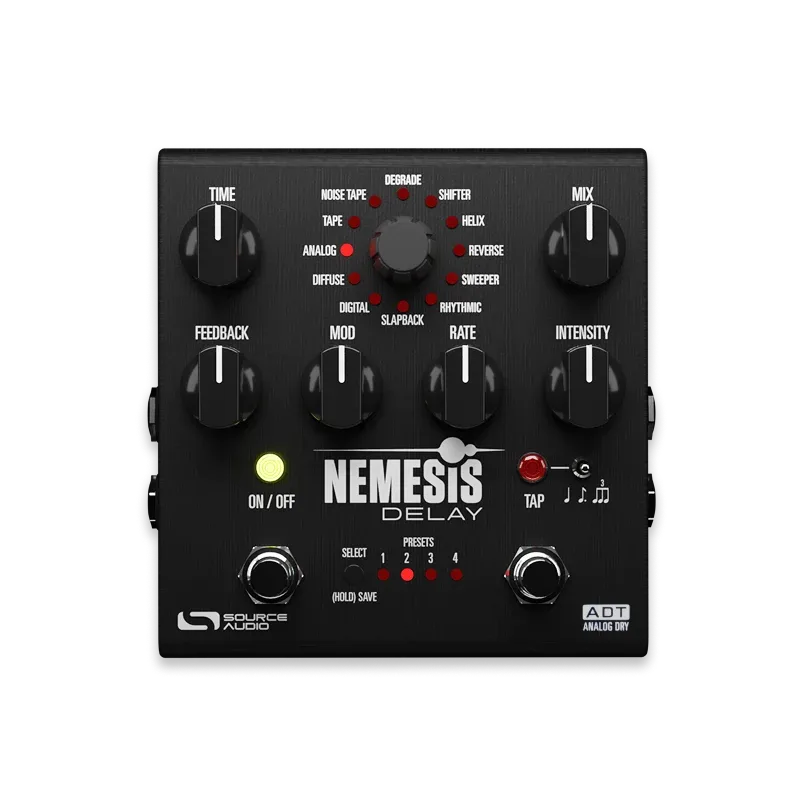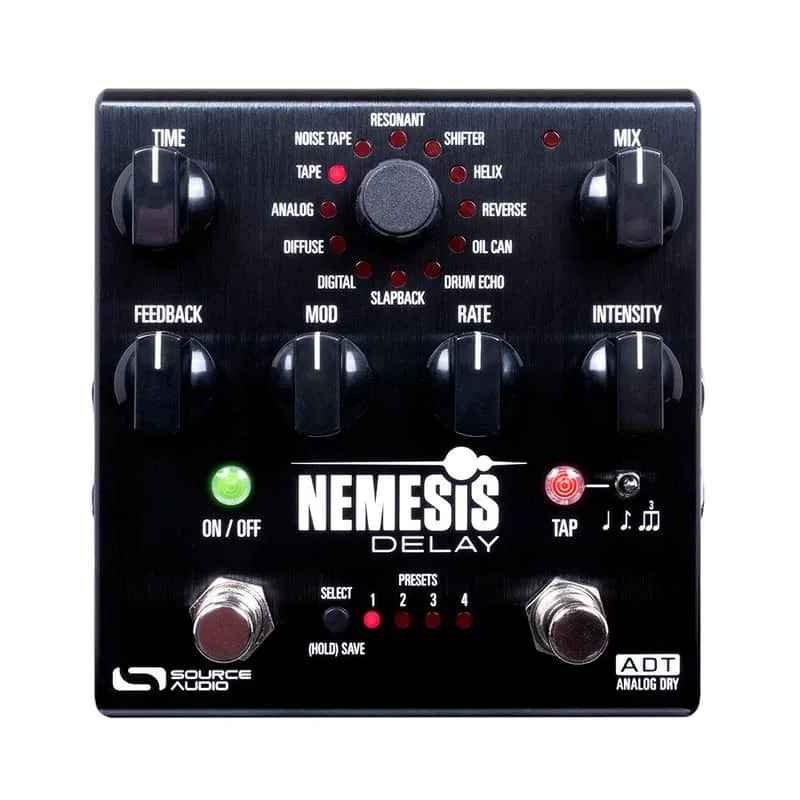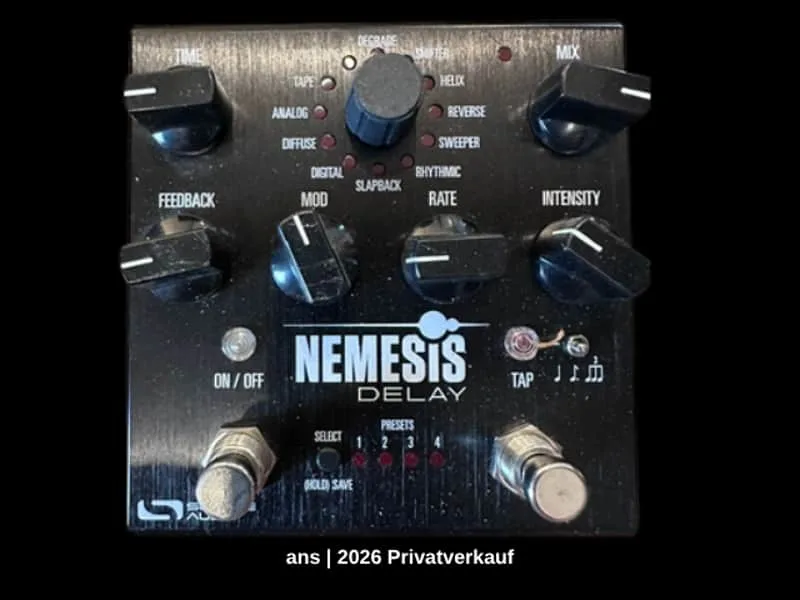


The Source Audio Nemesis Digital Delay Workstation is a delay pedal built around a digital engine: a 56-bit signal path with 24-bit delay line processing, according to Guitar Pedal X's comparison against the Boss DD-2001. It carries 12 delay modes on its panel, and through the Neuro App you can reach 12 to 14 further algorithms that swap in for the defaults, for 24 to 26 algorithms overall1.
Controls
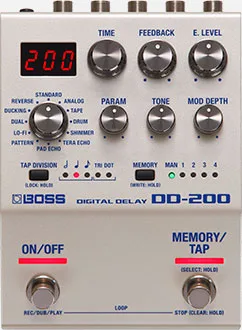
The Nemesis keeps the familiar delay pedal layout, with a couple of touches of its own. Guitar Pedal X maps its knobs against the Boss DD-200's1:
| Nemesis control | What it does | DD-200 equivalent |
|---|---|---|
| Mix | Delay level against your dry signal | E.Level |
| Intensity | Controls specific parameters per algorithm | Param |
| Rate | Sets delay rate from the panel; the DD-200 sets rate solely by its Tap Tempo footswitch | none (footswitch only) |
The Rate knob is the clearest difference: it is only on the Nemesis, while on the DD-200 rate is set solely by the Tap Tempo footswitch1. The Mix knob is described as very slightly different from the DD-200's E.Level but with largely the same impact1.
Some of the modes
The 12 onboard modes cover the standard delay ground and some more characterful territory. A few that Guitar Pedal X picks out1:
- Digital (01): the standard digital delay flavor, the same as the DD-200's Standard mode under a different label
- Rhythmic (08): a pattern-type delay, close in spirit to the DD-200's Pattern mode
- Degrade (09): the same sort of effect as the DD-200's Lo-Fi mode
- Noise Tape (15): a darker, more degraded sounding tape delay
- Helix (16): a reverse delay with octaver, described as a slightly different type of shifter or shimmer
One visible difference from the DD-200: the Nemesis has an LED indicator for each of its modes, where the DD-200 uses a small LED display1.
The Neuro App
The Neuro App is where the Nemesis opens up. Through it you can access the 12 to 14 further delay algorithms beyond the onboard dozen, with more scope for tweaking and replacing algorithms than the panel alone allows1. Guitar Pedal X's Stefan Karlsson calls the Nemesis's Neuro App the more capable of the two apps he compared, and notes that many players really rate app editing1.
"The Nemesis obviously has the more capable Neuro App and access to 12/14 further algorithms with more scope for Algorithm tweakability and replacement which many really rate."
How it compares
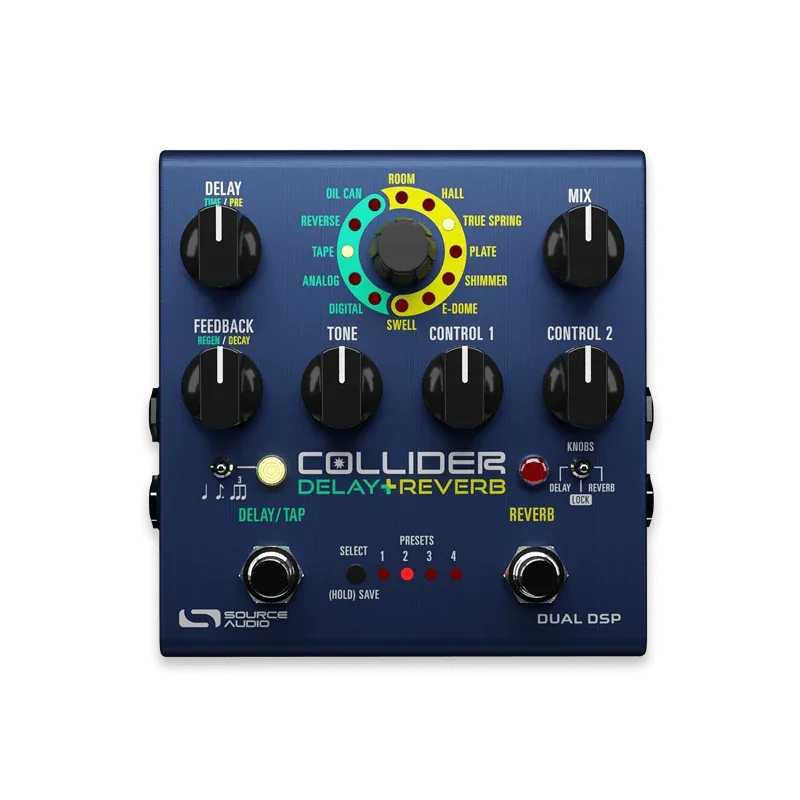
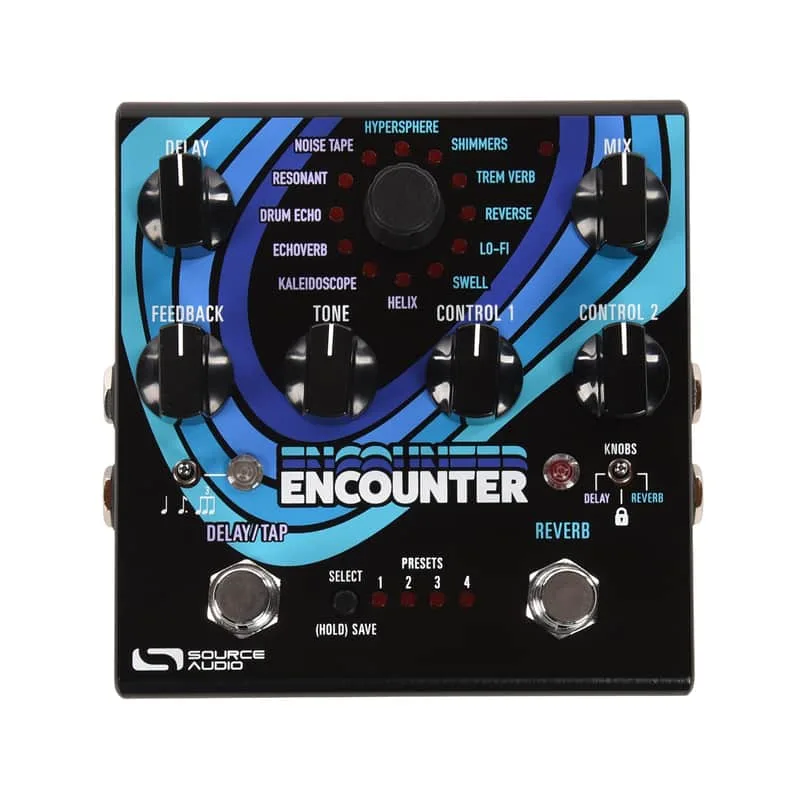
Guitar Pedal X's 2020 head-to-head with the Boss DD-200 found the two pedals share a lot: matching mode flavors under different labels, and equivalent Mix and Intensity/Param knobs1. The Nemesis answers with its panel Rate knob, per-mode LED indicators and the deeper Neuro App; the DD-200 answers with its display and its own mode set. Karlsson named the DD-200 his clear winner in that comparison1. For other takes on the format, Source Audio also makes the Collider and the Encounter Ambient Delay+Reverb, and an updated Nemesis Delay ADT version exists alongside the SA 260A One Series Nemesis Delay ADT.
Videos
ProGuitarShopDemos
Pete Thorn
Premier Guitar
Questions
How many delay algorithms does the Source Audio Nemesis have?
The Nemesis carries 12 delay modes on its panel, and through the Neuro App you can access 12 to 14 further delay algorithms that you can switch in place of the defaults. That gives 24 to 26 algorithms overall, depending on how you count them.
Is the Nemesis digital or analog?
It is a digital delay. Guitar Pedal X describes its signal path as 56-bit with 24-bit delay line processing.
What does the Intensity knob do on the Nemesis?
The Intensity knob controls specific parameters for whichever algorithm is selected, so what it does changes with the mode. Guitar Pedal X notes it works the same way as the Param knob on the Boss DD-200, just under a different label.
What is the Neuro App used for on the Nemesis?
The Neuro App lets you reach the further delay algorithms beyond the 12 onboard modes and gives more scope for tweaking and replacing algorithms. Guitar Pedal X calls it the more capable app of the two delay workstations it compared, and notes that many players really rate app editing.
What is the Helix mode on the Nemesis?
Helix is mode 16, a reverse delay with an octaver. Guitar Pedal X describes it as a slightly different type of shifter or shimmer.
Sources (1)
- Guitar Pedal X, Guitar Pedal X, 2020-07-26