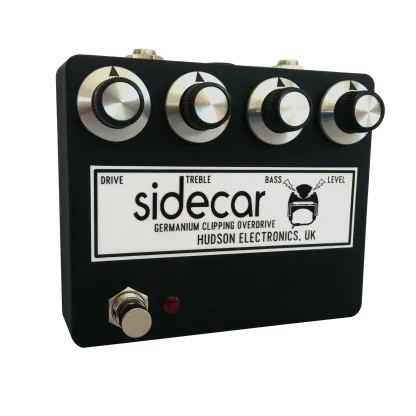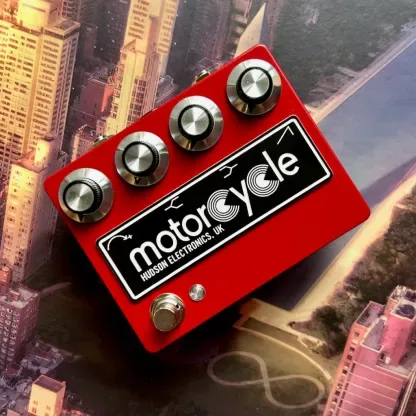


The Hudson Electronics Motorcycle is a limited-run overdrive pedal, described by the maker as a modified version of its Sidecar overdrive. It is Hudson's take on the soft clipping overdrive circuit, with the added versatility of a powerful two band EQ, and it has been tuned to give more distortion in the lower frequencies and a different EQ response than the Sidecar. A transformer at the end of the signal chain softens the attack and adds a subtle layer of saturation.1
The pedal came about when Joe's Pedals asked Michael Hudson to revisit the Overdrive 999, and the idea of the Motorcycle was born.1
The controls
The Motorcycle carries four knobs. The Drive and Level controls work much as they do on the Sidecar, while the two band EQ is where the pedal departs from a straightforward soft clipping drive12.
| Control | What it does |
|---|---|
| DRIVE | Regulates how hard the pedal is driven.1 |
| LEVEL | Sets the overall output.1 |
| BASS | Adjusts the low end content of the signal, +/- 15 dB at 165 Hz (shelving).1 |
| TREBLE | Adjusts the high end content of the signal, +/- 15 dB at 10 kHz (shelving).1 |
The op-amp in the circuit is described by Hudson as a high-performance, high-fidelity audio operational amplifier.1
How it differs from the Sidecar
The Sidecar's front end is a modified version of the classic 808 overdrive, tuned for a bigger low-end, wider gain range and greater headroom.2 Reviewing the Sidecar, Pedal of the Day's Mike B wrote: "The Drive control pushes the gain of the Sidecar, starting slow and mellow and moving quickly to crunchy and distorted."3
The Motorcycle keeps that soft clipping foundation but changes the voicing in two ways. First, it is tuned to give more distortion in the lower frequencies, with the EQ given a different response. Second, it places a transformer at the end of the signal chain, which softens the attack and adds a subtle layer of saturation.1 Both pedals share the Drive and Level controls and the two band EQ.12
Power and availability
The Motorcycle runs on a standard 9 to 24 volt DC regulated power supply with a 2.1mm negative tip barrel connector, and draws 50mA.1
At 50mA, the Motorcycle draws more current than many overdrives, so a low-current daisy-chain output may not keep up. Hudson specifies a 2.1mm negative tip barrel connector for the power supply.1
The pedal is a limited run available exclusively from Joe's Pedals.1
Videos
Joe's Pedals
Kit Trigg Band
George Watts Guitar
Questions
How is the Hudson Motorcycle different from the Sidecar?
The Motorcycle is a modified version of Hudson's Sidecar overdrive. It has been tuned to give more distortion in the lower frequencies and a different EQ response, and it adds a transformer at the end of the signal chain that softens the attack and adds a subtle layer of saturation. Both pedals share the same Drive and Level controls and a two band EQ.
Can I run the Hudson Motorcycle at 18V?
Yes. Hudson specifies a standard 9 to 24 volt DC regulated power supply with a 2.1mm negative tip barrel connector, so 18V is within the pedal's rated range. Current draw is 50mA, which is higher than many overdrives, so check what your power supply's outputs are rated for before sharing a socket.
Where can I buy the Hudson Electronics Motorcycle?
The Motorcycle is a limited run available exclusively from Joe's Pedals, according to Hudson Electronics' product page. It is not a standard catalogue pedal, so availability depends on the limited run.
What diodes does the Hudson Motorcycle use?
The Motorcycle uses a pair of germanium diodes for clipping, as part of Hudson's take on the soft clipping overdrive circuit.
Sources (3)
- Motorcycle, Hudson Electronics UK
- SIDECAR - HUDSON ELECTRONICS UK, Hudson Electronics UK
- Hudson Electronics Sidecar Overdrive, Pedal of the Day, 2016-03-10