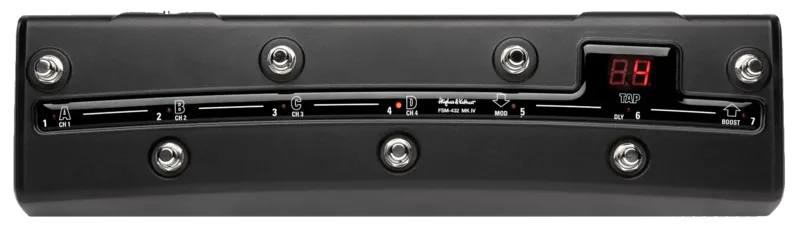
The Hughes & Kettner FSM-432 MK IV is a MIDI foot controller, the company's board for selecting presets and controlling its amps directly from the floor. Hughes & Kettner describes it as more than a preset switcher: in stompbox mode it switches channels directly and turns modulation effects, delay and boost on and off independently1. It is the successor to the FSM-432 MKIII, carrying over everything that made that board popular and adding new functions1.
The three operating modes
The board runs in three modes, and each suits a different way of playing1:
- Direct 7-Mode gives direct access to your seven most wanted sounds, with copy sounds and Tap Delay to set the delay time at the controller.
- Preset-Mode selects presets on the connected amp over MIDI.
- Stompbox-Mode switches channels directly and activates modulation effects, delay and boost independently, so the board behaves like a row of separate stompboxes rather than a preset bank.
For players who move between the two styles of use, the ability to switch channels and toggle individual effects in Stompbox-Mode is the main difference from a plain preset controller. If you are comparing MIDI boards generally, see the MIDI Pedals page1.
Expression pedals and connections
Beyond the MIDI ports, the FSM-432 MK IV offers two 1/4" jack inputs to connect expression pedals or single footswitches. Hughes & Kettner says these are freely assignable to remote control any pot and switch except the Master Volume of the GrandMeister and Black-Spirit 200, in realtime1. That means a connected expression pedal can sweep an amp parameter of your choosing as you play, and a single footswitch can trigger a function you assign to it. For pedal choices, see Expression Pedals.
The MIDI connections are a 5-pin MIDI IN and a 7-pin MIDI OUT that is 5-pin compatible1. The 7-pin output is what carries phantom power to the board from a compatible amp.
Power
The board can be powered two ways1:
- An external power supply, AC or DC, 9 to 15 volts, drawing 250 mA.
- Phantom power over the MIDI connection, at 23 volts and 50 mA.
Phantom power is the convenient route with a compatible Hughes & Kettner amp, since it removes the need for a separate supply on the pedalboard. If you power the board externally instead, the supply must deliver 9 to 15 volts at 250 mA, AC or DC.
Compatibility and firmware
Hughes & Kettner states the FSM-432 MK IV is fully compatible with the MK III and also works with the TubeMeister Deluxe 40, TubeMeister 36, Coreblade and Switchblade1. Firmware updates are installed via the MIDI port, which the company describes as the way to keep your board up to speed1.
The MK IV's housing is slimmer than the earlier board's, with straight edges that leave a smaller footprint and fit legacy pedalboards better1.
Questions
Is the Hughes & Kettner FSM-432 MK IV compatible with the MK III?
Yes. Hughes & Kettner states the FSM-432 MK IV is fully compatible with the MK III, and it carries over everything that made the earlier FSM-432 MKIII popular while adding new functions. It also works with the TubeMeister Deluxe 40, TubeMeister 36, Coreblade and Switchblade amps.
Which amps does the FSM-432 MK IV work with?
Hughes & Kettner lists the FSM-432 MK IV as fully compatible with the MK III and working with the TubeMeister Deluxe 40, TubeMeister 36, Coreblade and Switchblade. It is designed as the MIDI board for the company's amps, handling preset selection and direct amp control over MIDI.
Does the FSM-432 MK IV need a power supply?
It can run on an external power supply of 9 to 15 volts, AC or DC, drawing 250 mA. It can also be phantom powered over the MIDI connection at 23 volts and 50 mA, so when it is connected to a compatible Hughes & Kettner amp you may not need a separate supply at all.
Can I plug an expression pedal into the FSM-432 MK IV?
Yes. The board has two 1/4-inch jack inputs for expression pedals or single footswitches. Hughes & Kettner says these are freely assignable to remote control any pot and switch except the Master Volume of the GrandMeister and Black-Spirit 200, in realtime.
How do I update the FSM-432 MK IV firmware?
Firmware updates are installed through the MIDI port. Hughes & Kettner describes this as the way to keep the board up to speed, so no separate USB connection is involved.
Sources (1)
- FSM-432 MK IV, Hughes & Kettner, 2025-07-25