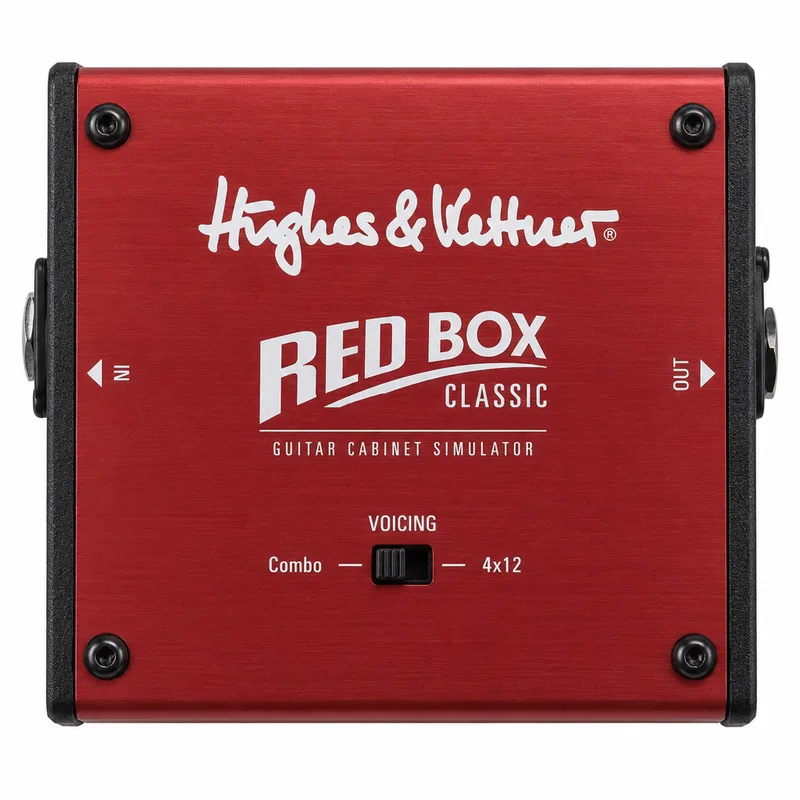


The Hughes & Kettner Red Box Classic is a DI (Direct Injection) box with built-in speaker cabinet emulation: a simple recording and PA interface that converts Line, Out and Speaker Out signals into balanced, frequency-compensated signals for a direct feed to a mixer1. In plain terms, it lets you take your amp's signal straight to the desk or an audio interface and have it sound like it went through a guitar cabinet, with no microphone involved.
It belongs to the family of speaker simulation units, but it is a DI rather than a stompbox: no footswitch, no effects loop, just a jack in, a balanced XLR-style output out, and one voicing switch12.
What it does and how it is controlled
The Red Box Classic has exactly one control: a voicing switch that selects between a 4x12" cabinet voicing and a 2x12" combo voicing1. That is the whole front panel. Everything else is in the fixed filter network, which shapes the direct signal so a mixer feed does not sound thin and fizzy the way a raw line out does.
Because it accepts Speaker Out signals, it can be placed between an amp head and its speaker cabinet, capturing the sound of the amp itself without a microphone1. One builder who used it that way reported it "captures the amp sound really well, no more microphones needed"1.
Powering it
The unit is flexible about power. The manual lists 48V phantom power (delivered down the balanced output cable from the mixer), a 9V battery, and adapters in both 9 to 15V AC and 9 to 24V DC ranges1. Builders have confirmed working builds on 9V, 18V and phantom power1.
Phantom power comes from the mixing desk down the balanced output cable, so on a desk without phantom power you need the battery or an adapter.
The circuit, for builders
The Red Box Classic has been reverse-engineered by the DIY community. A vero layout was published on Guitar FX Layouts in October 2016, based on an original schematic by Bernard d'Ur, with a Red Box MkII schematic by Gottfried Divos also referenced1.
The layout uses a TL064 opamp. TL074 and TL084 substitutions have been reported working, with one caveat from a commenter1:
"do not even try a TL084. It won't work because it draws too much current and it will load the phantom power badly"1
Two corrections to the original layout matter to anyone building one:
- The 6K8 and 470R resistor pairs were swapped between the phantom power divider and the opamp outputs; the layout was corrected on 31 March 20181.
- Some builders found the output low with the original values; one replaced the right-hand 470R with 470k and reported the unit then worked correctly1.
After the resistor swap, one commenter wrote that "the build is spot on and recommended to anyone who wants to capture the sound of their amp and pedals" without miking1.
Classic versus Pro
The Red Box Pro is the higher-spec sibling. Per commenter research, the Pro adds a ground lift switch, a selector between line and speaker input, and a transformer in the output, none of which the Classic has1. The Classic is the simpler unit: one voicing switch, no ground lift, no input selector, and no output transformer. One commenter saw the transformer-free design as a feature, calling it "super, a DI box without an audio transformer"1.
What players said
The Red Box Classic has a long track record with players. Beaker, a commenter on the layout page, called it "a very good DI box, especially for recording - I have been using one for years"1. A verified builder described the circuit as a "Supperb DI and cab sim!" after building it with metal film resistors and MKT caps, tested on 48V phantom only1. Another builder reported an easy build: "Made this with a TL074 and it's excellent. Fired up first try, which was a first for me!"1
It has also seen bass duty. Will Kenworthy reported that his band's bass player used one for years, running a Fender P-Bass into a SansAmp, then into the Red Box and the PA1.
Where the line went next
Hughes & Kettner's current version of the speaker simulation is the Red Box 5, which the maker describes as the latest version of the award-winning Red Box design2. It keeps the balanced XLR output and 1/4" jack input of the original line and adds filtering options for small or large housings, modern or vintage speakers, and loose or tight cabinet response, plus modern and vintage speaker modes2. Compared with the Classic's two fixed voicings, the Red Box 5 gives the player more control over the simulated cabinet's character.
Videos
Run Sa-nguanmoo
ahjteam
DEW Valis
Questions
Does the Hughes & Kettner Red Box Classic need phantom power?
No, phantom power is only one option. The manual lists 48V phantom power via the balanced output jack, a 9V battery, 9 to 15V AC and 9 to 24V DC adapters. Builders have confirmed the circuit works on 9V, 18V and phantom power, so any of these supplies the unit.
Does the Red Box Classic have an audio transformer?
No. The Classic is an active, opamp-based design with no audio transformer in the signal path, which one commenter welcomed as a plus. The Red Box Pro, by contrast, adds a transformer in the output along with a ground lift switch.
What is the difference between the Red Box Classic and the Red Box Pro?
The Pro adds a ground lift switch, a selector between line and speaker input, and a transformer in the output. The Classic has none of those: one voicing switch, a jack input and a balanced output. The Pro is the more flexible unit for problem-solving on stage.
Can you use a Red Box Classic with a bass guitar?
Yes. One commenter reported that his band's bass player used one for years, running a Fender P-Bass into a SansAmp and then into the Red Box and the PA. It is a guitar cabinet simulator, so the voicing is voiced for guitar cabs, but it has been used for bass in practice.
What does the voicing switch on the Red Box Classic do?
It selects between two cabinet voicings: a 4x12 inch cabinet and a 2x12 inch combo. It is the only switch on the unit, so the choice is simply between the bigger, closed-back sound and the smaller combo sound.
Can a Red Box Classic take a speaker output signal?
Yes. It converts Line, Out and Speaker Out signals into balanced, frequency-compensated signals for a direct feed to a mixer, so it can sit between an amp head and its speaker. The Pro version makes this easier with a dedicated line/speaker input selector.
Sources (2)
- Guitar FX Layouts: Hughes & Kettner Red Box Classic DI, Guitar FX Layouts (tagboardeffects.blogspot.com), 2016-10-28
- RED BOX 5, Hughes & Kettner, 2025-12-03