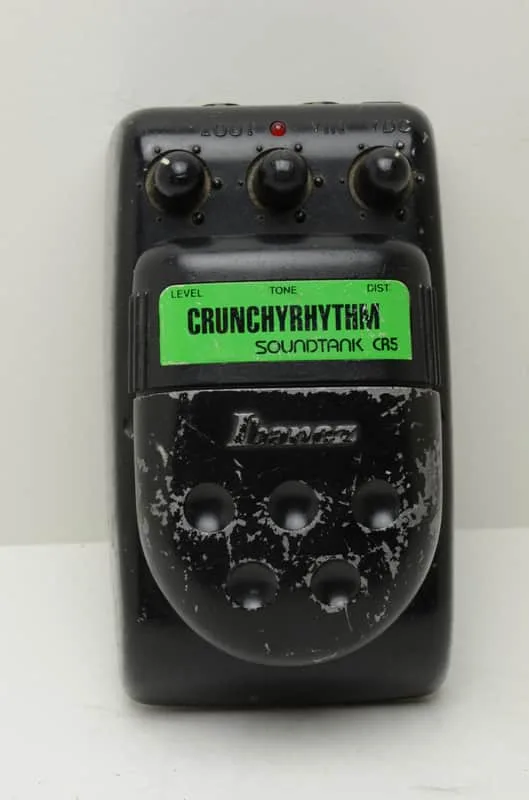


The Ibanez CR5 Crunchy Rhythm is a distortion pedal released in 1989 as part of the original Soundtank series, and produced until the second series launched in 19921. TONEHOME dates the metal enclosure version to 1989 to 1991, and the metal case specifically to 1989 to 19902. It was never re-issued2, and TONEHOME lists its availability today as rare, with high collectibility for the metal-case version2.
What it does to your sound
TONEHOME describes the CR5 as doing exactly what it says: the crunch is fairly bright but with good bass end and can go pretty far. The same description notes it is quite ear-piercing into a clean amp, but dynamic and shining into a slightly distorted amp2. That last point matters for placement on a board: this is a pedal that was voiced to work with an amp already breaking up, in the manner of many distortion pedals of its era rather than the smoother Tube Screamer overdrives Ibanez is better known for.
Inside the circuit: a differential pair instead of an op-amp
The CR5's claim to interest among circuit fans is its gain stage. According to Aion FX, it uses a differential transistor pair in place of an op-amp for the initial gain stage, with gain adjustable via a potentiometer in the feedback loop. Following the differential stage, the signal is hard-clipped via diodes to ground1. Aion FX notes these are the only two Ibanez circuits with a differential pair in place of an op-amp, the CR5 and the DS-101.
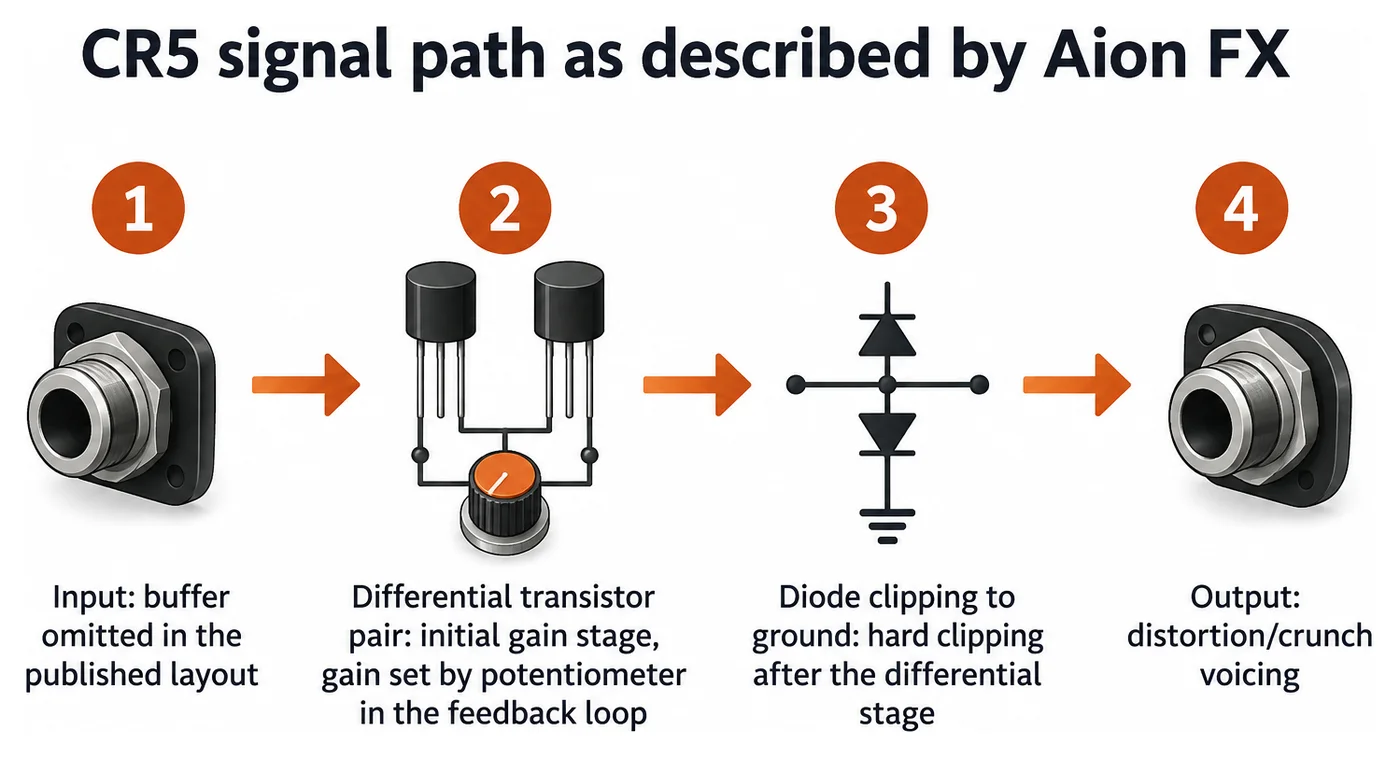
The published vero layout from Guitar FX Layouts omits the input buffer, which the author called quite obvious a choice for that build3. The author also noted the circuit is big, but should fit in a B-box enclosure without an issue3.
Relation to the DS-10 Distortion Charger
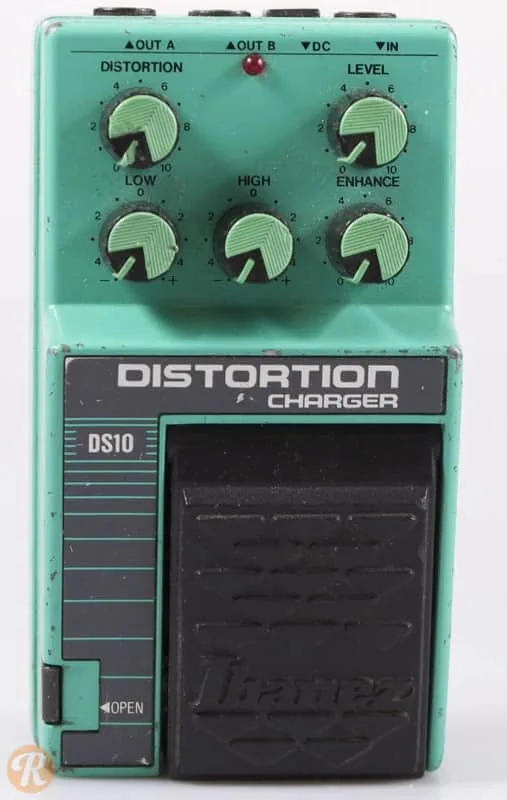
The drive section of the CR5 is very similar to the earlier DS-10 Distortion Charger from 1986, which shares the same differential transistor pair gain stage1. Aion FX is explicit about where the family resemblance stops: after the diode clipping stage, this is where the similarities with the DS-10 end1. The DS-10 goes further, with low and high EQ levels that, by TONEHOME's description, can simulate various amp brands, large stacks having more low end than small combo amps41. TONEHOME lists the DS10's collectibility as high as well4.
What reviewers and builders made of it
The CR5 has drawn more attention from the DIY community than from the press. Guitar FX Layouts published a vero layout in October 2013; the author noted the first version had errors, but all of those are now fixed and the current layout is verified3.
In a later comment on that page, dated 2016, the same author gave a frank verdict on the original pedal:
"The switching is a bit dodgy, and the enclosure is... well.. A Soundtank: The Doofiest Pedal Ever. But still; fuck me"
The Soundtank enclosure and switching draw criticism, but the sound surprised the builder. That matches TONEHOME's own description of a crunch that can go pretty far once it meets an amp with some dirt of its own2.
The CR5 was discontinued in 1992 and never re-issued12. Originals, especially the 1989 to 1990 metal-case version, are rare and collectible2, so most players who want the circuit today encounter it as a clone build from the verified layout2.
Videos
Hendry Wong
Hendry Wong
Questions
When was the Ibanez CR5 Crunchy Rhythm made?
Aion FX dates the CR5 to 1989, released as part of the original Soundtank series, and notes it was produced until the second series launched in 1992. TONEHOME gives the production run as 1989 to 1991 for the metal enclosure version, and 1989 to 1990 for the metal case specifically. Either way, it is a pedal from roughly the turn of the 1990s and has been out of production for decades.
Was the Ibanez CR5 ever reissued?
No. TONEHOME lists the CR5 Crunchy Rhythm as never having been re-issued. The pedal was discontinued when Ibanez launched its second series in 1992, and no later production run or reissue version exists. That, combined with its short run, is why originals are described as rare and the metal-case version as highly collectible.
Is the CR5 the same circuit as the Ibanez DS10 Distortion Charger?
Not quite. Aion FX says the drive section of the CR5 is very similar to the earlier DS-10 Distortion Charger from 1986, and both use a differential transistor pair in place of an op-amp for the initial gain stage. But the similarities end after the diode clipping stage: the DS-10 adds low and high EQ levels that can simulate various amp brands, which the CR5 does not have.
Why is the metal-case CR5 so rare?
TONEHOME lists the CR5's availability as rare and its collectibility as high, specifically for the metal-case version produced from 1989 to 1990. The pedal had a short production life, was never reissued, and was discontinued in 1992 when the second series launched. A short run of a niche distortion pedal from a series known for its plastic-looking enclosures leaves few survivors.
Can you build a CR5 clone from a verified layout?
Yes. Guitar FX Layouts published a vero layout for the CR5 in October 2013. The author noted the layout initially had errors, but after they were fixed the current layout is verified. The author also noted the circuit is big, but should fit in a B-box enclosure without an issue, and that the input buffer is omitted in the layout.
Sources (4)
- Charon Overdrive / Ibanez CR5 Crunchy Rhythm, Aion FX, 2019-08-03
- TONEHOME, TONEHOME, 1991
- Guitar FX Layouts: Ibanez CR5 Crunchy Rhythm, Guitar FX Layouts (tagboardeffects.blogspot.com), 2013-10-17
- TONEHOME, TONEHOME