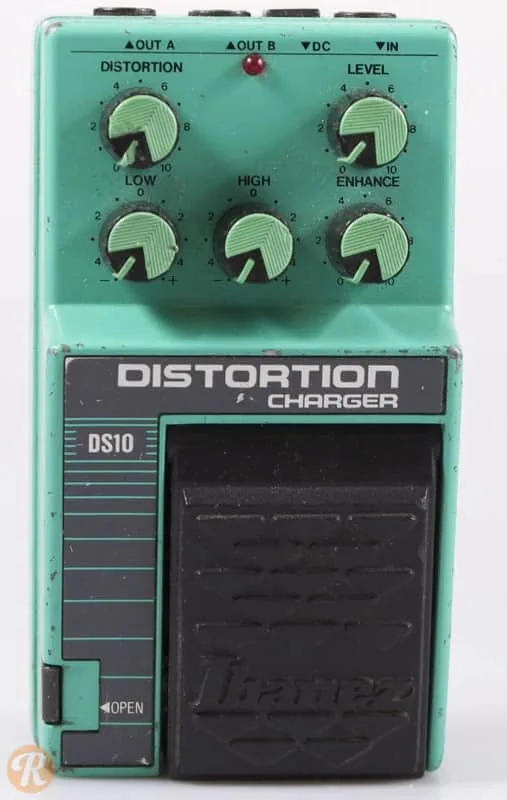


The Ibanez DS10 Distortion Charger is a distortion pedal from Ibanez's Power Series 10, produced in Japan from 1986 to 19901. It is a two-part design: a basic overdrive-style distortion stage with two band post-distortion equalization, plus a separate Enhance section that TONEHOME describes as one where "high frequency signals are sampled, phaseshifted, and remixed into the output"1. The result, in TONEHOME's words, is "a clear yet sweet sound"1.
The Enhance circuit and output B
The Enhance section is the DS10's distinguishing feature. In TONEHOME's description it works in three steps1:
- The high frequency part of the signal is sampled.
- That sampled signal is phase shifted.
- It is remixed into the output, adding upper harmonic content on top of the distorted core of the sound.
Because the circuit reacts to how hard you play, TONEHOME's advice to owners is to "use the volume control creatively on the guitar"1.
The pedal carries two outputs, and output B is what makes the Enhance section more than a fixed tone control1:
| Output | What it carries |
|---|---|
| Output A | The main output of the pedal, distortion with the Enhance circuit applied1 |
| Output B | The Enhance circuit on its own, usable independently of the distortion stage1 |
TONEHOME also notes that by using output B, the clean sound can also be enhanced, meaning the section works on its own, apart from the distortion stage1. A player can therefore send the enhanced signal to one amp or channel and the main output to another.
The circuit inside
Builder Aion FX, which has documented the DS10 circuit, notes a detail that sets its gain stage apart from more conventional designs: "It uses a differential transistor pair in place of an op-amp for the initial gain stage"21.
"It uses a differential transistor pair in place of an op-amp for the initial gain stage."
That choice shapes how the distortion forms before the diode clipping stage. Aion FX also draws a line between the DS10 and related Ibanez designs, noting that "This is where the similarities with the DS-10 end" after the clipping stage21.
Collecting a DS10 today
TONEHOME rates the DS10's collectibility as high and its availability as good, so examples do reach the secondhand market regularly despite the pedal's age1. The pedal has not been re-issued1. For reference, TONEHOME lists a 1989 list price of 148 DM, in the currency of the time1. The original Ibanez Power Series pocket manual is available as a PDF from TONEHOME1.
The DS10 is a vintage pedal, produced from 1986 to 1990 and never re-issued1. Any unit a player finds today is secondhand, so condition and originality vary from example to example.
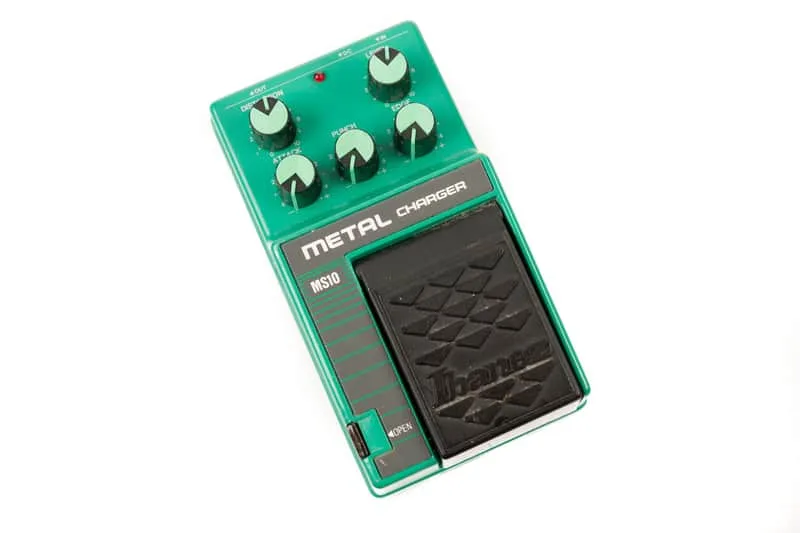
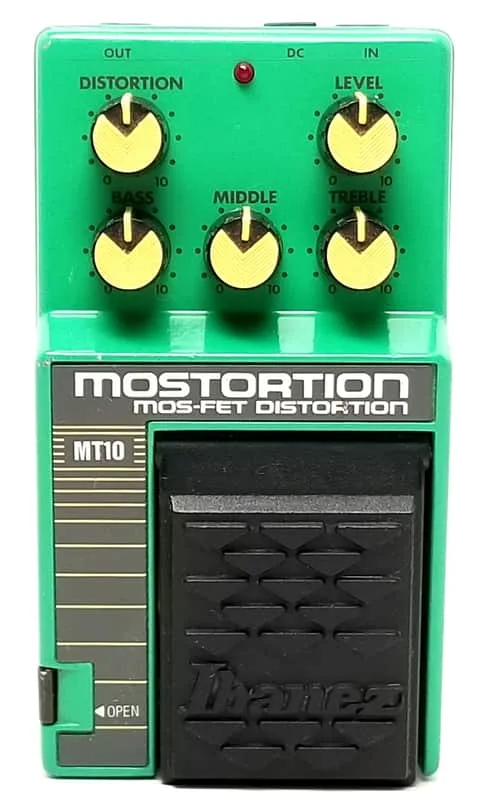
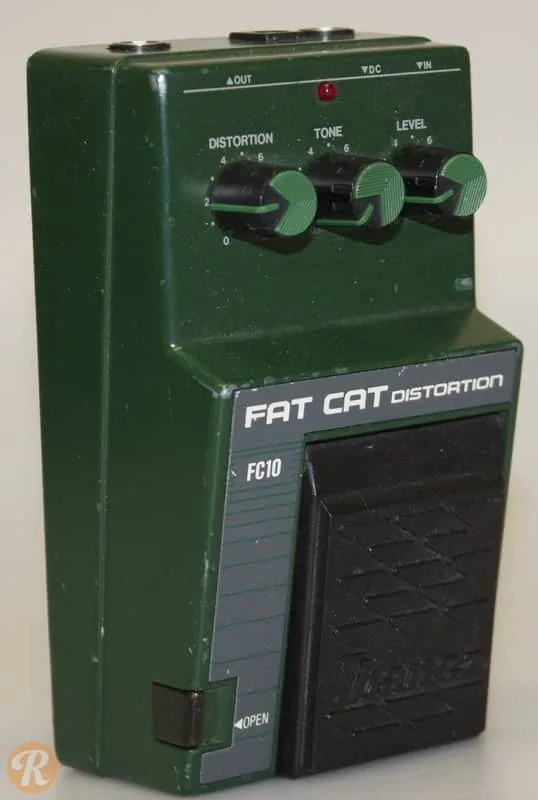
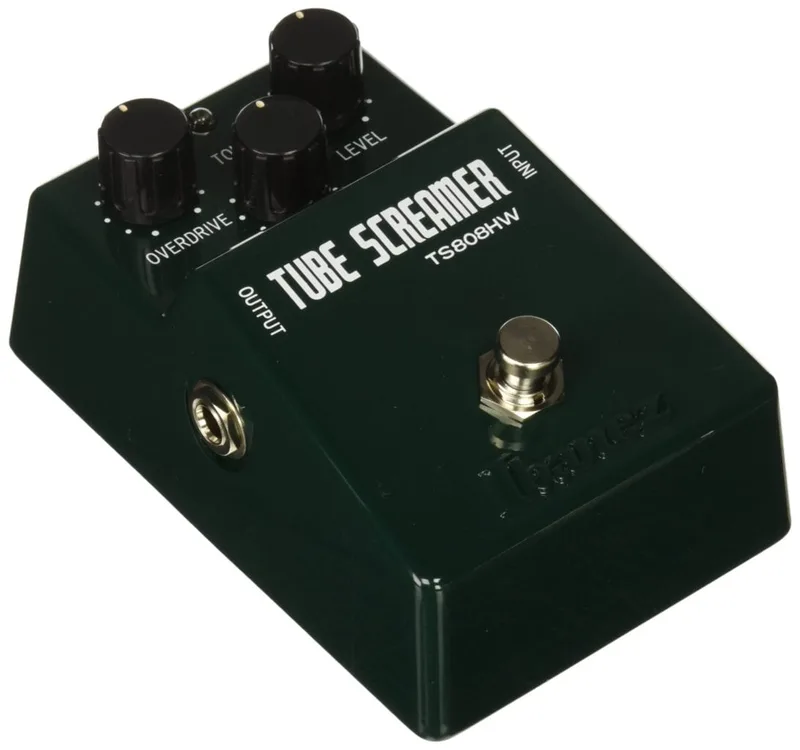
Players comparing it within Ibanez's own range can look at other Power Series 10 designs such as the Ibanez MS10 Metal Charger or the Ibanez MT10 Mostortion, or browse the wider field in Distortion Pedals.
Videos
shnobel
Ariel Pozzo
Alberto Martinez Del Rio Guitar
Questions
What does the Enhance control do on the Ibanez DS10?
The Enhance section samples the high frequency part of the signal, phase shifts it, and remixes it into the output, adding upper harmonic detail on top of the distortion. TONEHOME notes that the Enhance circuit is sensitive to dynamics, so rolling the guitar's volume control changes how much of that enhancement you hear, which makes it a playing tool as much as a tone control.
What is output B on the DS10 used for?
The DS10 has two outputs, A and B. Output B carries the Enhance circuit on its own, so you can send the enhanced signal to a separate amp or channel while output A carries the main distorted sound. TONEHOME also notes that by using output B, the clean sound can be enhanced, meaning the circuit works independently of the distortion stage.
When was the Ibanez DS10 made?
TONEHOME lists the DS10 as produced from 1986 to 1990 as part of Ibanez's Power Series 10, and Aion FX dates the pedal to 1986. An example photographed by TONEHOME was made in Japan in 1987.
Has the Ibanez DS10 been reissued?
No. TONEHOME lists the DS10 as not re-issued. The pedal remains a vintage-only design, though it is available secondhand in reasonable numbers, and the circuit has been documented by builders such as Aion FX for players who want to recreate it.
Where was the Ibanez DS10 made?
Japan. TONEHOME's records for the DS10 identify it as a Japanese-built pedal, with an 1987 example listed as made in Japan.
Is the Ibanez DS10 a collectible pedal?
TONEHOME rates the DS10's collectibility as high, while also rating its availability as good, meaning examples turn up on the used market often enough that players can find one without much trouble.
Sources (2)
- TONEHOME, TONEHOME, 1987
- Charon Overdrive / Ibanez CR5 Crunchy Rhythm, Aion FX, 2019-08-03