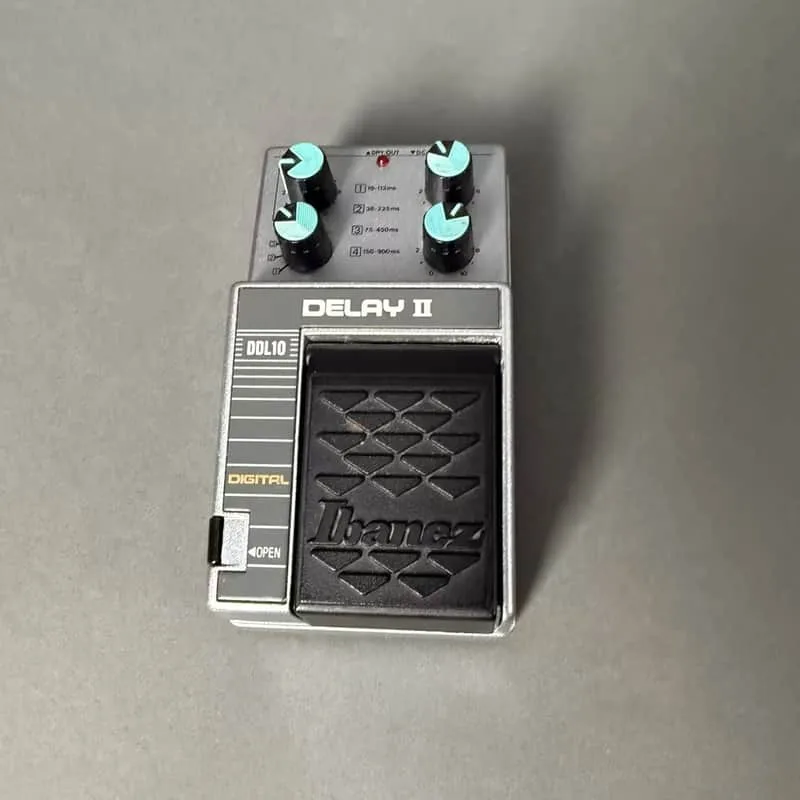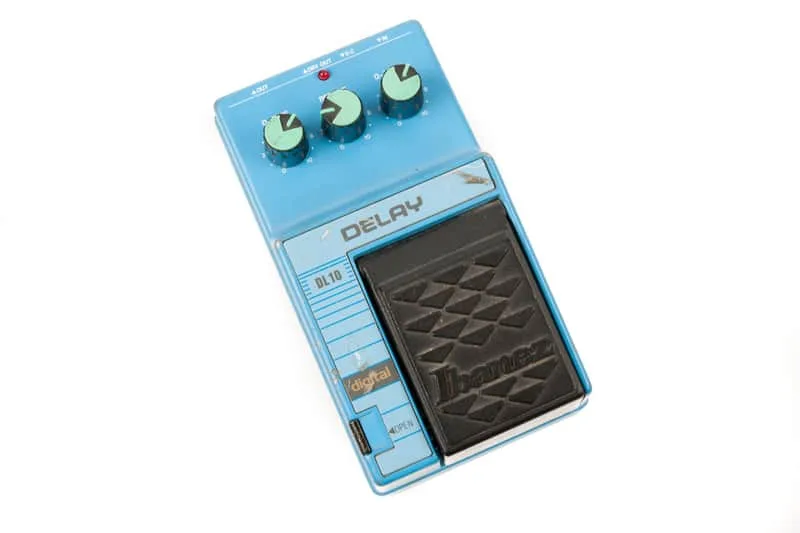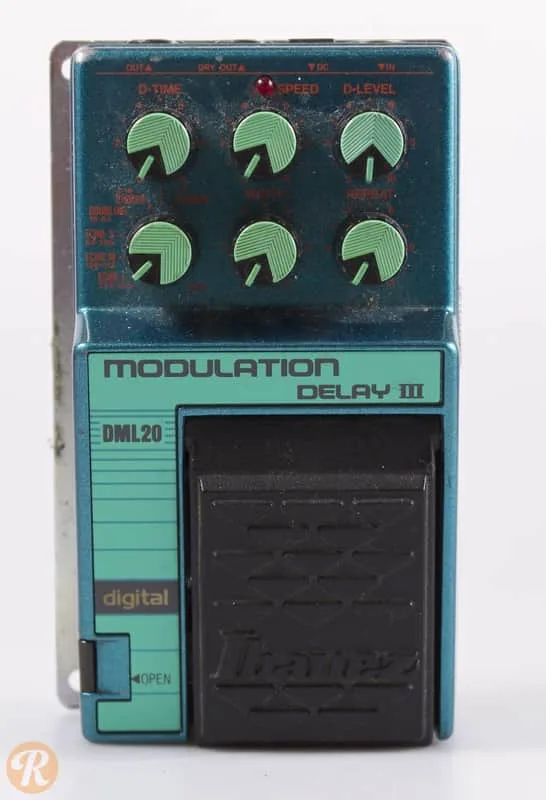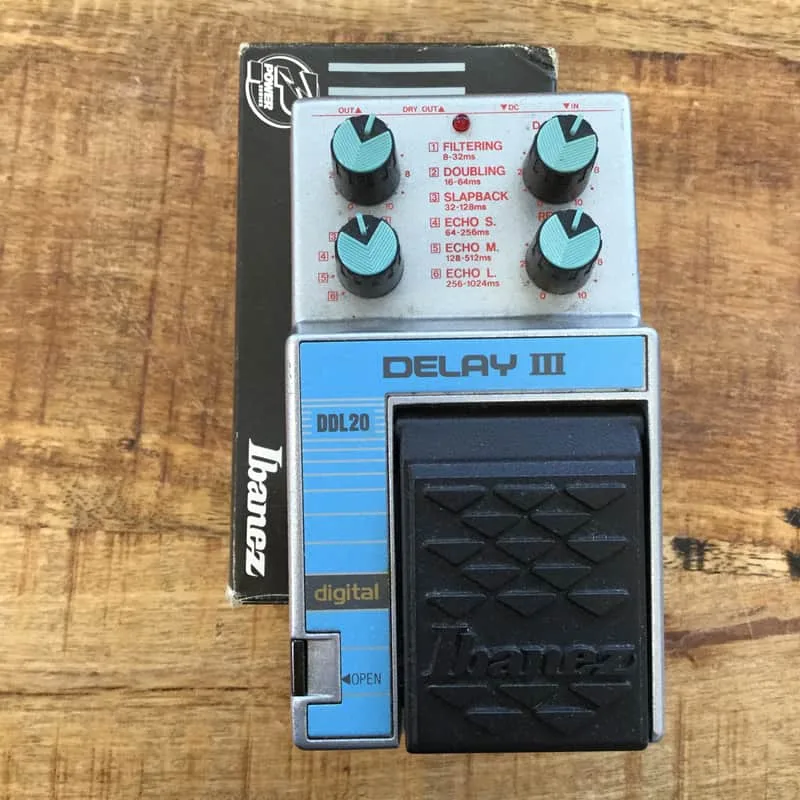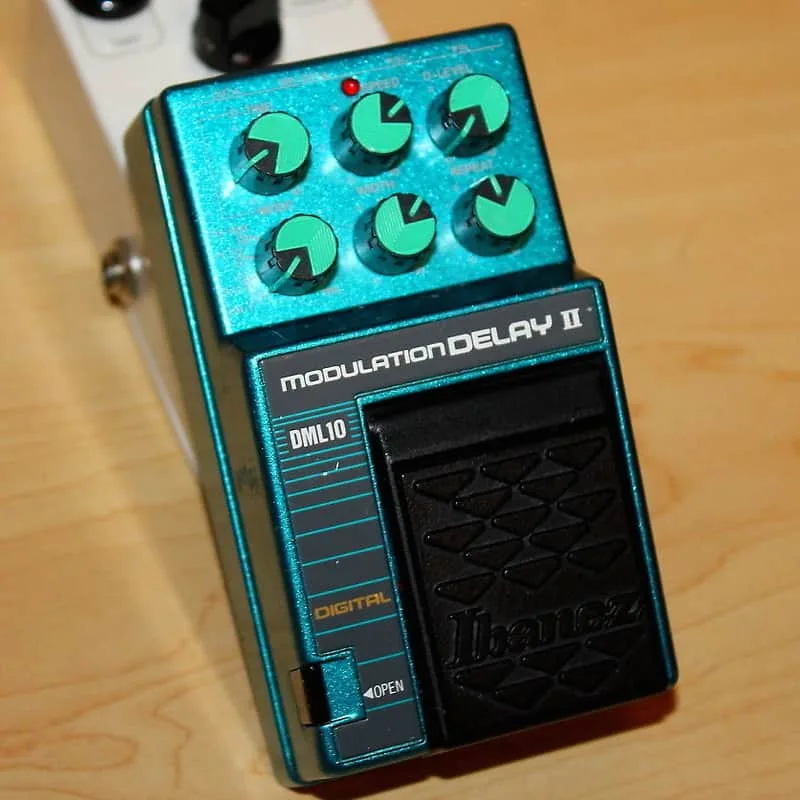


The Ibanez DML10 Digital Modulation Delay II is a digital modulation delay pedal from Ibanez, with a 1986 list price recorded as not available1. It sits alongside the related DDL10 Digital Delay II and DL10 Digital Delay of the same era. TONEHOME lists its availability today as rare1.
What it does
The DML10 is a delay with modulation built in. TONEHOME describes it as operating on the same principles as other delays, such as the DDL10, but with the added feature of modulation: a low frequency oscillator, or L.F.O., changes the delay time periodically1. With the width control set at zero, standard delay effects are available without modulation1.
Its delay range runs from 9 msec up to 900 msec, controlled by a four position mode selector1. The stereo output jacks produce normal effect and dry (no effect) outputs, which TONEHOME notes are for real stereo imaging, doubling and sound on sound effect1.
Controls
| Control | What it does |
|---|---|
| Mode selector (four position) | Selects the delay range and operating mode1 |
| D-Time knob | Fine tunes the delay time you want1 |
| Width control | Sets the sweep width, or distance between extremes in delay time1 |
| Speed control | Sets the period of the sweep cycle1 |
Delay, chorus and flanging
Because the modulation sweeps the delay time, the same circuit covers several effect types depending on where the delay time is set1:
- Standard delay: with the width set at zero, standard delay effects are available without modulation1.
- Chorus: achieved between 3.5 and 28 ms without repeats. TONEHOME suggests starting with the level about 4, width about 6 and speed at 41.
- Flanging: decrease the delay time below 15 ms and the pitch and delay sweeps are replaced by a "swooshing" sound called flanging1. TONEHOME adds that fast speed settings simulate a rotary organ speaker, while slow speeds duplicate two tape records slightly out of synch1.
"Decrease the delay time below 15ms and the pitch/delay sweeps are replaced by a \"swooshing\" sound called flanging."
Related Ibanez delays
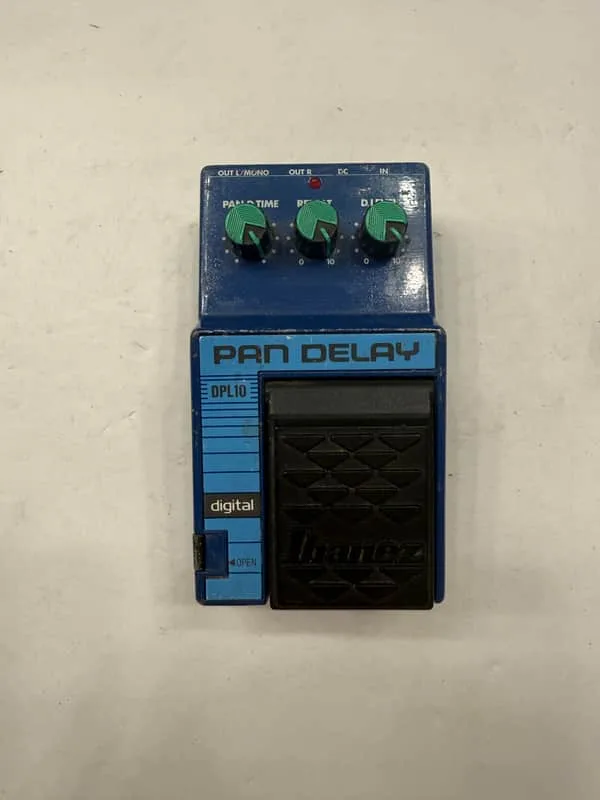
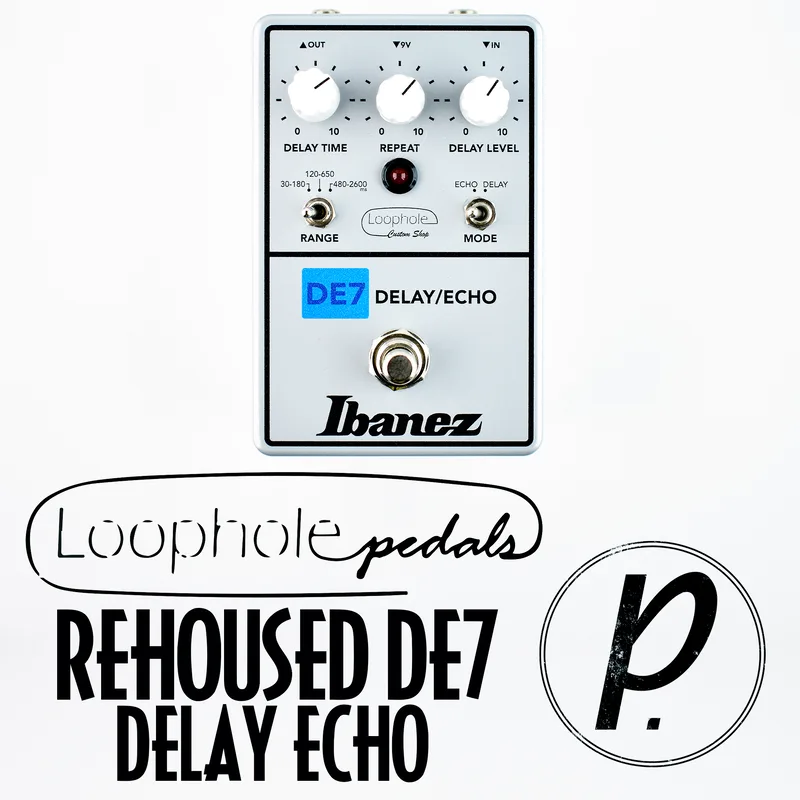
The DML10 was part of a wider Ibanez delay family of the mid 1980s. The DML20 Delay Modulation III was its larger sibling in the modulation delay line, while the DDL10 Digital Delay II and DDL20 Digital Delay III covered straight digital delay, and the DPL10 Digital Pan Delay added panning. Players looking at Ibanez's later delay designs can compare the DE-7, the ES2 Echo Shifter or the current Layer Delayer. For the wider picture, see Delay Pedals, Chorus Pedals and Flanger Pedals1.
Videos
chacofuzz
bbrunskill
gnawrighthrough
Questions
What is the delay time range of the Ibanez DML10?
The DML10 produces delays from 9 msec up to 900 msec, selected with a four position mode selector and fine tuned with the D-Time knob. At the short end of that range, below 15 ms, the pedal moves into flanging territory, and between 3.5 and 28 ms without repeats it produces a chorus effect.
Was the Ibanez DML10 ever reissued?
No. According to TONEHOME, the DML10 was produced from 1986 to 1987 and has never been reissued. The site lists its availability as rare and its collectibility as average, so units turn up on the secondhand market but not in large numbers.
Where was the Ibanez DML10 made?
The DML10 was made in Japan by Maxon, the company that built much of Ibanez's effect pedal range of the era, during its 1986 to 1987 production run.
How does the DML10 differ from the DDL10?
TONEHOME describes the DML10 as operating on the same principles as other delays, such as the DDL10, but with the added feature of modulation: a low frequency oscillator changes the delay time periodically. With the width control at zero, the DML10 behaves as a standard delay without modulation.
How do you get a chorus sound from the DML10?
Chorus is achieved between 3.5 and 28 ms without repeats. TONEHOME suggests starting with the level about 4, width about 6 and speed at 4, then adjusting from there.
Is there a manual for the Ibanez DML10?
Yes. TONEHOME hosts a scan of the 1986 pocket manual for the DML10 as a downloadable image on its product page.
Sources (1)
- TONEHOME, TONEHOME