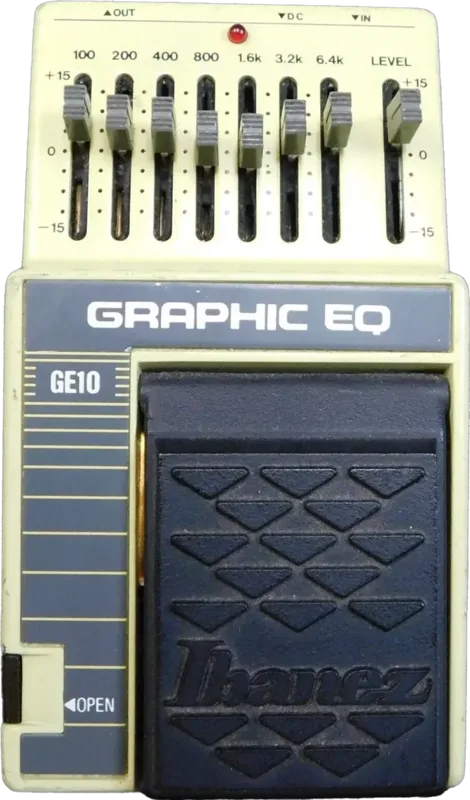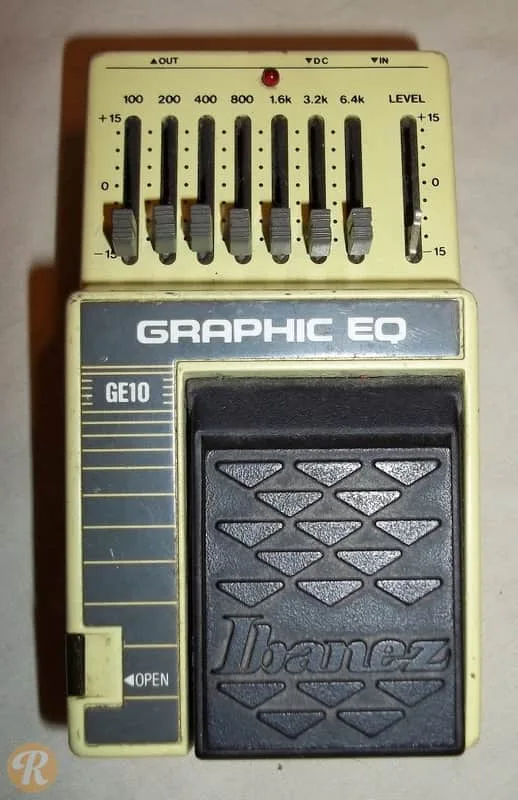


The Ibanez GE10 Graphic Equalizer is a seven-band graphic EQ from Ibanez's old 10 series, with an overall boost/cut control on top of the EQ itself1. Instead of adding overdrive or modulation, it shapes the frequency balance of your signal: seven sliders cover the octave ranges between 100Hz and 6.4kHz, each offering plus or minus 15dB of equalization2. ToneHome describes it as a tone "shaper" rather than an effect, a tool for versatility in basic tones2.
The pedal is discontinued and has not been reissued, but it remains available on the used market at low prices23.
What the GE10 does to your sound
The seven sliders sit at octave spacing from 100Hz up to 6.4kHz, and each one cuts or boosts its band by up to 15dB23. On top of the EQ, a master gain control provides an overall +/- 15dB of variation in the output level without disturbing any of the filter settings4. Pedal of the Day's reviewer described this master volume as an additional boost that is unaffected by the seven octave bands3.
ToneHome's band-by-band guide gives a picture of how a player can use each slider2:
| Band | What it does |
|---|---|
| 100Hz | Boost adds a rumble effect, like the resonance of a large speaker cabinet; cutting helps a muddy sound or attenuates hum and noise from bad AC lines or single coil pickups |
| 200Hz | Influences the overall bass characteristics; subtracting can emphasize a boost at 100Hz or 400Hz |
| 400Hz | A slight boost emphasizes warmth, especially after a distortion device; cutting removes midrange characteristics offensive in acoustic electric guitars |
| 800Hz | Midrange control |
| 1.6kHz | Boosting adds presence and clarity; an extreme boost emphasizes pick attack and amp feedback characteristics, while a slight cut smooths out a rhythm sound |
| 3.2kHz | Boosting adds bite and brilliance |
| 6.4kHz | Deals with the "sizzle" or "sparkle" |
One practical use the maker's own documentation highlights: by manipulating the 3.2kHz and 6.4kHz filters, troublesome feedback howls can be reduced or eliminated42.
Controls and connections
The GE10 keeps its interface simple: the seven band EQ and the master level are all on sliders1. Around the edges are the input and output jacks and a 9V adapter jack1.
The GE10 runs on 9V DC with a center negative plug4, the same convention as most modern pedals, so a standard center negative supply works.
Where it came from
The GE10 belongs to Ibanez's 10 series of compact pedals1. The production dates are reported differently: ToneHome lists 1986 to 19932, while Pedal of the Day gives 1985 to 19893. Either way, it is a 1980s pedal that has since been discontinued, with no reissue2. ToneHome rates its collectibility as average and its availability as good2, and Pedal of the Day notes you can find them used pretty easily and pick one up for a low price3.
What reviewers said
Two published reviews cover the pedal from different angles.
AMZ Guitar Effects reviewed the GE10 alongside other boost pedals and found it handy overall1:
"these little guys are very handy, good amount of gain and with all the controls flat, pretty 'flat'... it is noisier than the other pedals"1
That noise level is the main criticism on record: with the controls flat the pedal passes a fairly flat signal, but it runs noisier than the other pedals in that comparison1.
Pedal of the Day's reviewer, writing in 2016, praised both its build and its character, noting its rock-solid construction and "a warm sound to it that isn't always present in other pedals of this nature"3.
How it fits with other Ibanez pedals
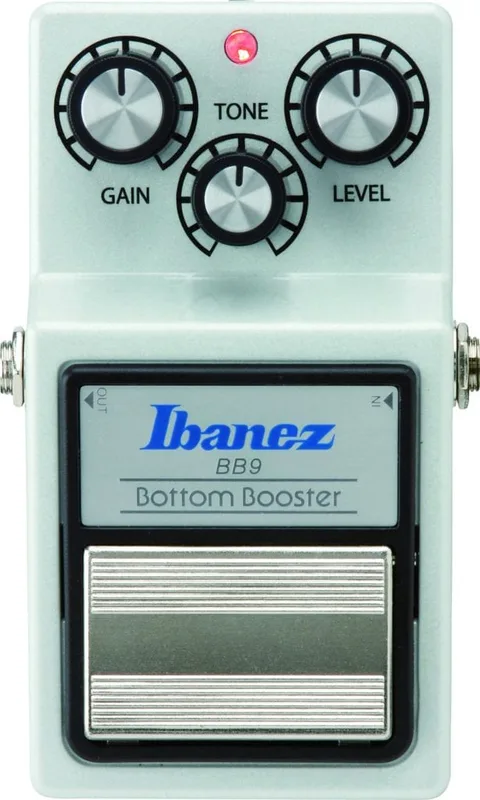
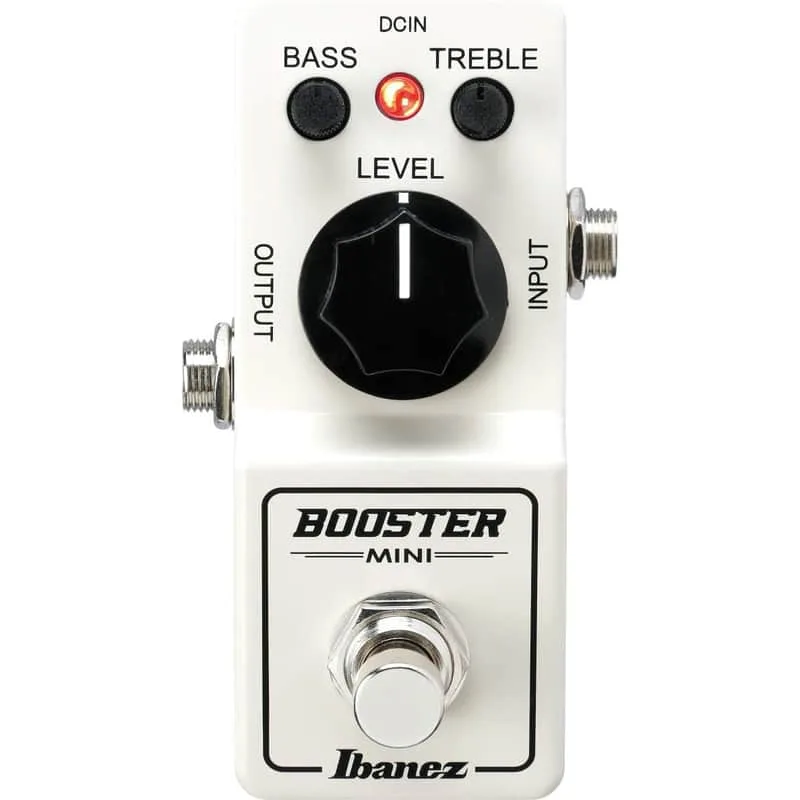
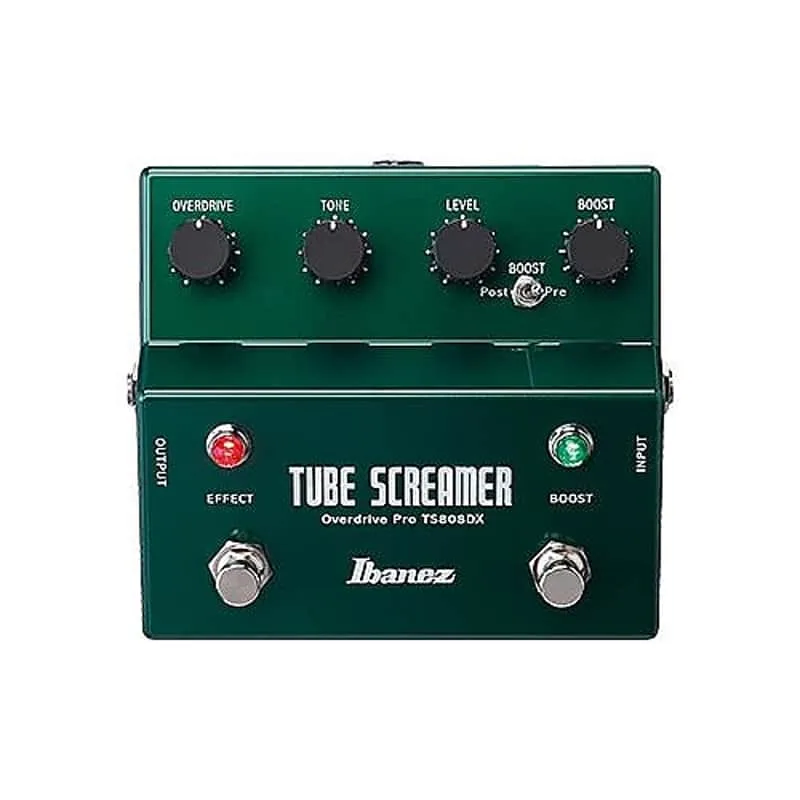
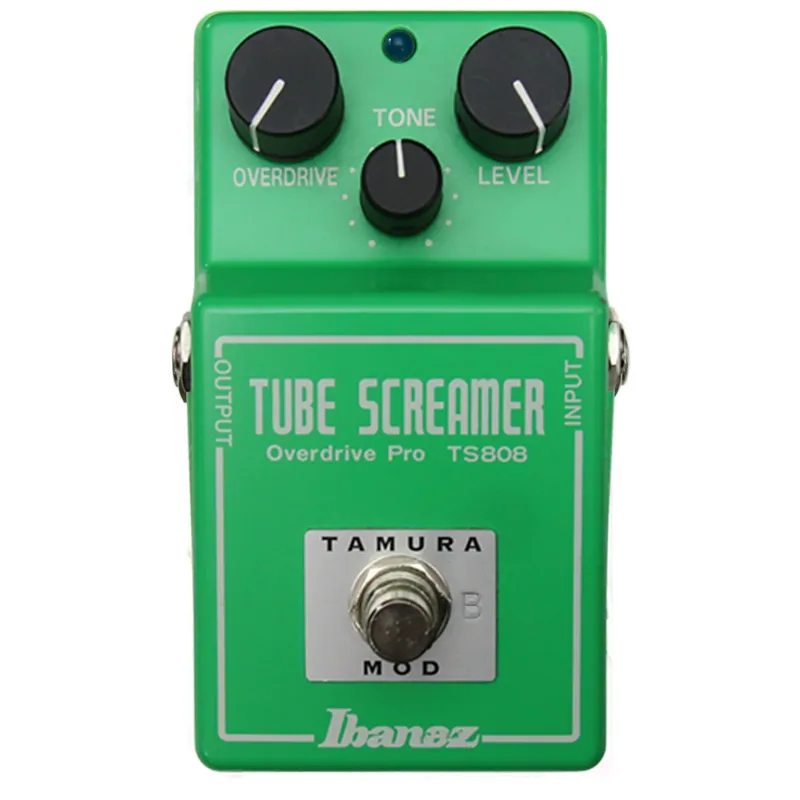
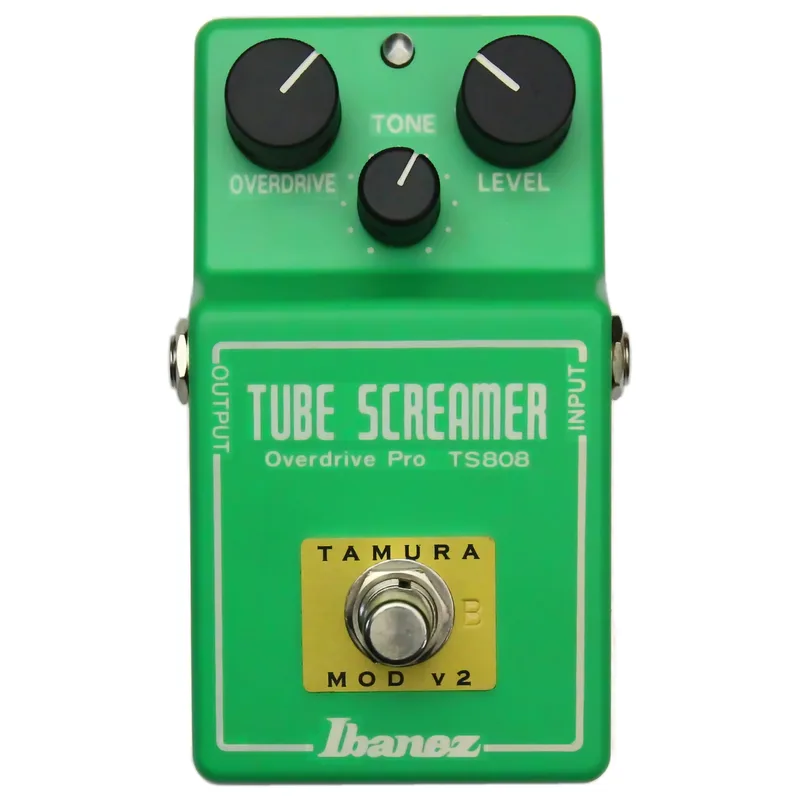
The GE10 is an EQ rather than a gain pedal, so it pairs naturally with the boost and overdrive side of a pedalboard. Players looking for a straight level boost from the same maker have options like the Ibanez BB9 Bottom Booster or the modern Ibanez BTMINI Mini Booster, while the TS808DX Tube Screamer Overdrive Pro combines overdrive with an independent clean boost. For more on the category, see Equalization Pedals and Boost Pedals.
Videos
Pedal of the Day
Shari Pedals
thescarletsnake
Questions
Which frequencies does the Ibanez GE10 control?
Seven octave-spaced bands: 100Hz, 200Hz, 400Hz, 800Hz, 1.6kHz, 3.2kHz and 6.4kHz. Each slider gives plus or minus 15dB of boost or cut, and a separate master level control adds another plus or minus 15dB of overall output variation.
How much boost or cut does the GE10 give?
Each of the seven bands offers plus or minus 15dB of equalization. The master gain control provides an additional overall plus or minus 15dB of output level variation without disturbing any of the filter settings.
Is the Ibanez GE10 still made?
No. The GE10 has not been reissued. ToneHome lists its production period as 1986 to 1993, while Pedal of the Day gives 1985 to 1989. It is discontinued but available used at low prices.
What power does the Ibanez GE10 use?
It runs on 9V DC with a center negative plug, through a 9V adapter jack on the pedal. The pedal has input and output jacks alongside the power jack.
Is the Ibanez GE10 noisy?
Yes, somewhat. An AMZ Guitar Effects review found it noisier than the other pedals tested, though otherwise handy with a good amount of gain and a flat response with the controls flat. Pedal of the Day described a warm sound not always present in similar pedals.
Sources (4)
- Reviews of boost pedals, muzique.com (AMZ Guitar Effects)
- TONEHOME, TONEHOME - the World of Vintage Guitar Effect Pedals
- Ibanez GE10 Graphic EQ, Pedal of the Day, 2016-01-20
- GE-10 Graphic EQ by Ibanez, RockBoard PedalPedia, 2026