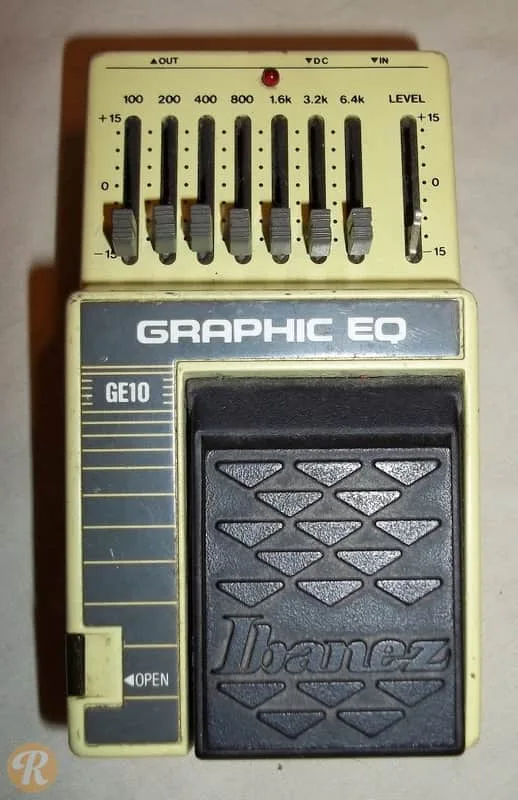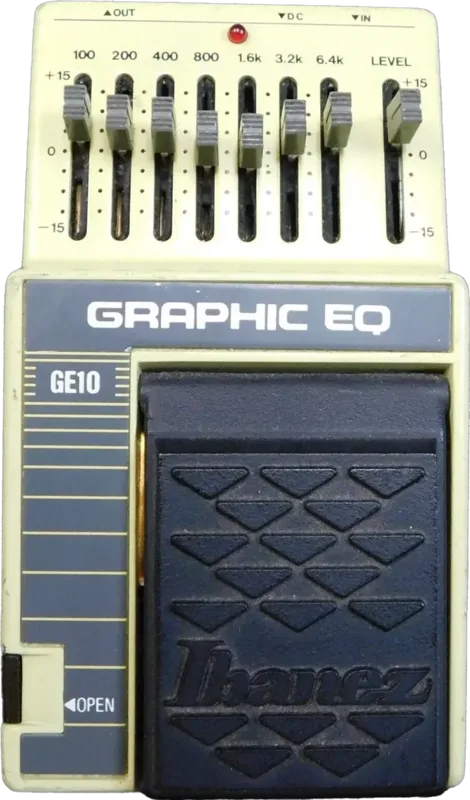


The Ibanez GE-10 Graphic EQ is a seven-band graphic equalizer pedal from Ibanez's 10 series, produced in Japan in the 1980s. It is an analog EQ pedal that lets you boost or cut seven octave-spaced frequencies between 100Hz and 6.4kHz, each with up to 15dB of cut or boost, plus a master level control for overall output12.
ToneHome describes it as a tone "shaper" rather than an effect: it does not add distortion, modulation or any processed character, it simply lets you redraw the frequency balance of your signal2. That makes it useful for scooping mids, adding bite, taming a boomy amp, or cutting the specific frequency that feeds back on a loud stage.
Seven bands from 100Hz to 6.4kHz
The GE-10's front panel is a row of sliders: seven octave-range filters plus a master level, all on sliders rather than knobs31. Each band offers plus or minus 15dB of equalization12. The seven frequencies are 100Hz, 200Hz, 400Hz, 800Hz, 1.6kHz, 3.2kHz and 6.4kHz4.
| Band | What it does, per the original Ibanez manual |
|---|---|
| 100Hz | Boosting adds a rumble effect, like the resonance of a large speaker cabinet; cutting helps a muddy sound, or attenuates hum and noise from bad AC lines or single coil pickups2 |
| 200Hz | Influences the overall bass characteristics of the sound; subtracting here can emphasize a boost at 100Hz or 400Hz2 |
| 400Hz | A slight boost emphasizes the warmth of a guitar sound, especially helpful after a distortion device; cutting removes midrange characteristics some players find offensive in acoustic electric guitars2 |
| 800Hz | Part of the midrange shaping between the warmth and presence bands4 |
| 1.6kHz | Boost for increased presence and clarity; an extreme boost emphasizes pick attack and amp feedback characteristics, while a slight cut smooths out a rhythm sound2 |
| 3.2kHz | Boosting adds bite and brilliance2 |
| 6.4kHz | Deals with the "sizzle" or "sparkle"2 |
Alongside the seven filters there is a master gain control that provides an overall plus or minus 15dB of variation in output level without disturbing any of the filter settings1. That means you can use it as a clean boost or cut after setting your curve, or recover level lost to heavy cutting.
Feedback control
One of the GE-10's practical stage uses is fighting feedback. The original documentation states12:
"By manipulating the 3,2kHz and 6,4kHz filter, troublesome feedback howls can be reduced or eliminated."1
Because acoustic feedback tends to howl at a specific resonant frequency, cutting just the offending band lets you kill the howl without flattening your whole tone. The same logic works for hum and single coil noise at the low end: the manual notes that subtracting at 100Hz attenuates hum from bad AC lines and single coil pickups2.
History and versions
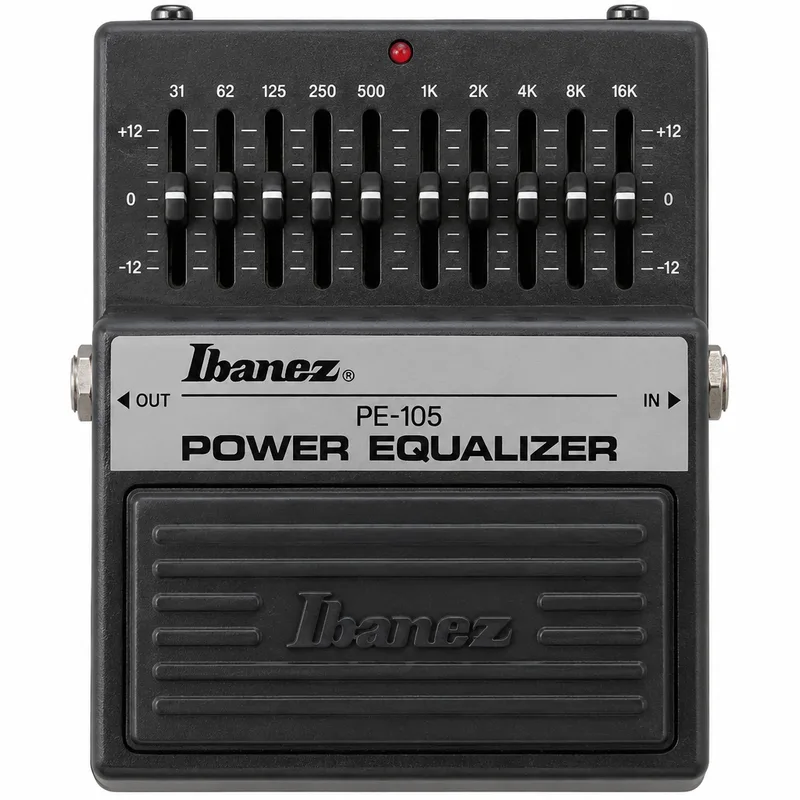
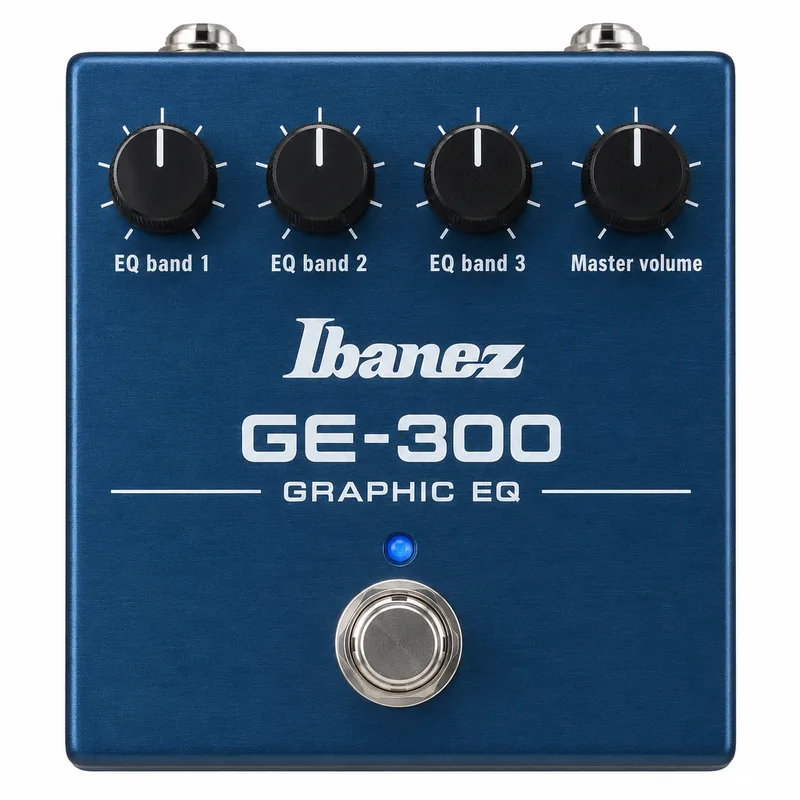
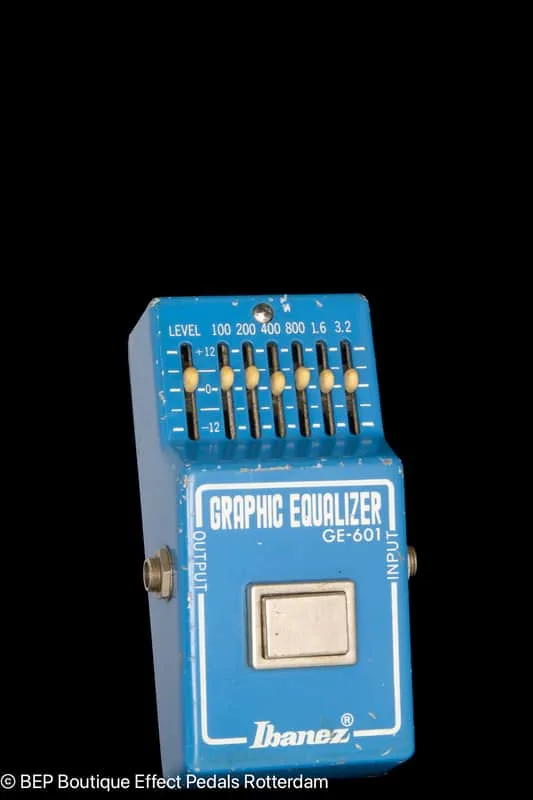
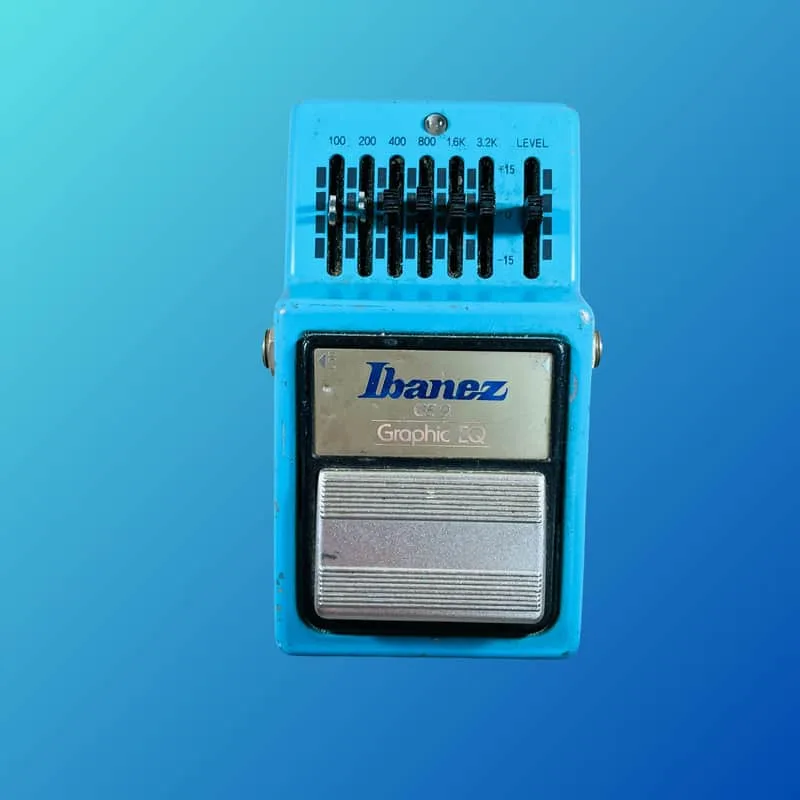
The GE-10 belongs to Ibanez's 10 series, the successor line to the earlier 9 series pedals. Ibanez had been making EQ pedals for years before it: the PE-105 Power Equalizer in the late 1970s, the GE-300 Graphic EQ around 1979 to 1980, the GE-601 Graphic Equalizer in the narrow box series, and the GE9 Graphic EQ in the 9 series that preceded the 10 series.
The GE10's production period is given as 1986 to 1993, and it was made in Japan2. RockBoard's PedalPedia lists the pedal as the GE-10 Graphic EQ, an equalizer1.
The GE-10 has not been reissued21. Every unit on the market is a vintage original from the 1980s production run, so condition and availability vary.
The GE10 is part of Ibanez's 10 series, produced from 1986 to 1993 in Japan2. RockBoard's PedalPedia lists it as the GE-10 Graphic EQ, an equalizer effect1.
GE-10 versus the BE10 Bass EQ
The GE-10 is an equalizer, one of the effect types Ibanez offered in its 10 series1. It was produced from 1986 to 1993 in Japan2, and runs on 9V DC, center negative, drawing 17mA1.
Power and connections
The GE-10 runs on 9V DC with a center negative plug, drawing 17mA1. It connects through standard input and output jacks plus a 9V adapter jack3.
The GE-10 takes its power from a 9V adapter jack rather than a battery31, so it needs a power supply or pedalboard output with the correct center negative polarity.
What reviewers said
Pedal of the Day, reviewing the GE10 in 2016, highlighted its flexibility: "The GE10 features seven octave range sliders that fluctuate between 100Hz and 6.4kHz," each with plus or minus 15dB of equalization, letting you boost or cut the seven frequencies to shape your tone4. AMZ's coverage of the 10 series notes the slider-based control set, with the seven band EQ and master level all on sliders3.
Videos
Pedal of the Day
thescarletsnake
Arito Suzuki
Questions
Is the Ibanez GE-10 analog or digital?
The GE-10 is an analog graphic equalizer. Its circuit is built around analog filtering, with seven octave-spaced bands from 100Hz to 6.4kHz, each offering up to 15dB of boost or cut. It was part of Ibanez's 10 series of analog pedals produced in Japan in the 1980s.
What power does the Ibanez GE-10 need?
The GE-10 runs on 9V DC with a center negative plug, drawing about 17mA. It connects through a 9V adapter jack rather than a battery, so you need a suitable power supply or a pedalboard power output with the correct polarity.
Can the GE-10 help reduce feedback?
Yes. The original Ibanez documentation says that by manipulating the 3.2kHz and 6.4kHz filters, troublesome feedback howls can be reduced or eliminated. Cutting the offending band instead of boosting it lets you tame a howl without changing your overall tone.
Has the Ibanez GE-10 been reissued?
No. The GE-10 has not been reissued. It was produced in Japan during the 1980s and early 1990s, and units on the market today are vintage originals, so finding one means searching the used market.
What is the difference between the GE-10 and the BE10 Bass EQ?
Both are graphic equalizers from Ibanez's 10 series with an overall boost and cut control, but the GE-10 is voiced for guitar, with seven octave bands from 100Hz to 6.4kHz, while the BE10 Bass EQ is voiced for bass guitar. The GE-10's band layout targets the frequencies a guitar player shapes most.
Sources (4)
- GE-10 Graphic EQ by Ibanez, RockBoard PedalPedia, 2026
- TONEHOME, TONEHOME - the World of Vintage Guitar Effect Pedals, 1986
- Reviews of boost pedals, muzique.com (AMZ Guitar Effects)
- Ibanez GE10 Graphic EQ, Pedal of the Day, 2016-01-20