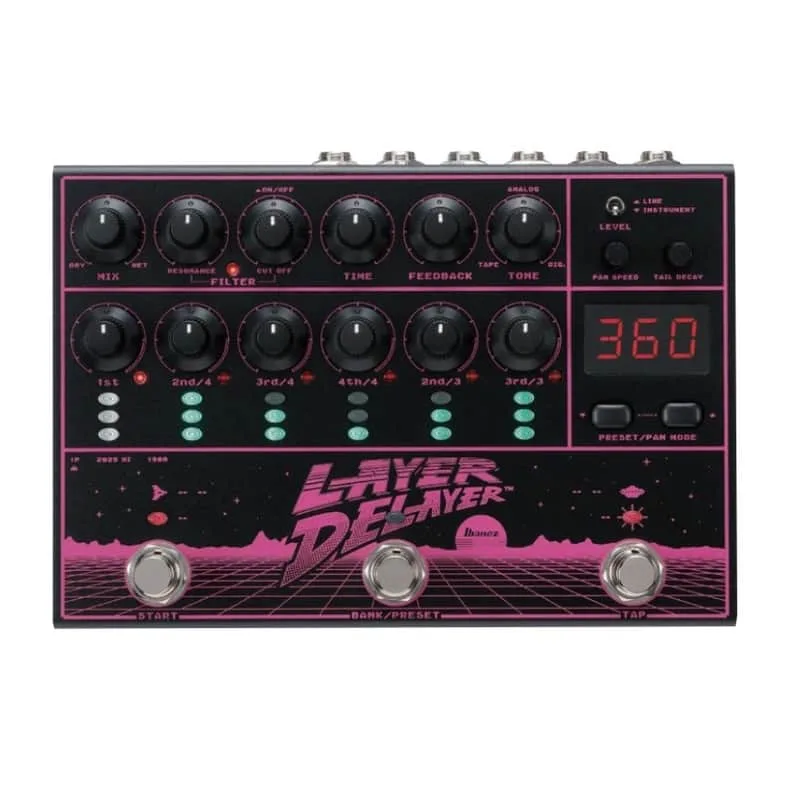


The Ibanez LD303 Layer Delayer is a stereo delay pedal that layers multiple repeats in the style of a multi-head tape machine, spacing them as sixteenth notes and triplets against a quarter-note base, with independent repeat levels up to +3dB and auto-panning between the left and right outputs1. Ibanez launched it in January 2026 as an ambitious, feature-packed delay that aims to do things a little differently, with stereo inputs and outputs, presets, MIDI and a wet-signal effects loop12.
Where most delay pedals give you one repeat spaced at one interval, the Layer Delayer sets its delay time as the length of a quarter note and then generates additional delay signals corresponding to sixteenth notes and triplets, the way a tape echo with multiple playback heads would1. Delicious Audio described it as a sophisticated, multi-engine stereo delay designed to be a comprehensive workstation3.
What it does to your sound
The core idea is layering. The delay time is set as the length of a quarter note, and the pedal then produces delay signals corresponding to sixteenth notes (1st, 2nd/4, 3rd/4 and 4th/4) and triplets (1st, 2nd/3 and 3rd/3), each with its own repeat level up to +3dB1. The result is a denser, more rhythmic repeat pattern than a single-tap delay, closer to what a multi-head tape echo or a rack delay with multiple taps produces.
On top of that sits the auto-panning. Eight pan modes move the repeats between the stereo outputs, with a Pan Speed knob controlling how fast they travel12. Guitar World noted that when using the pedal in stereo, the pan speed between speakers is highly customizable via those eight modes2.
The pan modes break down into families, each in Wide and Narrow versions, with the Narrow modes running at 50% width of the Wide modes1:
| Mode family | Behavior |
|---|---|
| N/A | Panning off |
| TR.W / TR.N | Triangle, Wide and Narrow |
| LR.W / LR.N | Left-Right, Wide and Narrow |
| RL.W / RL.N | Right-Left, Wide and Narrow |
| PP.W / PP.N | Ping Pong, Wide and Narrow; the sound image skips side to side at 50% width of the Wide mode1 |
The controls and footswitches
The pedal carries three footswitches: a Start footswitch for engaging the effect, a Bank/Preset footswitch, and a Tap Tempo footswitch12. A short press of the Bank/Preset switch increments the preset number, and a long press advances the bank1.
The top-panel controls cover the repeat structure and the sound of the repeats1:
| Control | What it does |
|---|---|
| Time | Sets delay time, 40ms to 1,500ms, or 40 to 1500 BPM1 |
| Feedback | Sets the number of repeats1 |
| Tone | Selects Tape > Analog > Digital delay styles1 |
| Pan Speed | Controls the spatial quality of the delay, how fast repeats pan1 |
| Preset / Pan Mode Down / Up | Steps through presets and pan modes1 |
| Level | Selects Line or Instrument output level1 |
The Tone control is where the pedal's three engines live. It sweeps through simulated digital delay, analog delay and tape echo tones that gradually transition in between, with a simulated low-pass ladder filter in the path1. Delicious Audio described the three modes as emulations of warm Tape, colored Analog, and pristine Digital delay3. The Level switch choosing between Line and Instrument output means the pedal can sit at the end of a pedalboard feeding an amp, or in a studio or effects-loop context at line level1.
Presets and MIDI
The Layer Delayer arrives with 20 artist-crafted factory presets and 50 preset slots in total, spread across five banks labeled A to E, leaving 30 user slots for your own sounds12. Presets and parameters can be recalled and changed over MIDI: the pedal has 5-pin DIN MIDI In and Thru for controlling parameters and presets in real time1, and Guitar World reported MIDI compatibility for nearly all of its parameters2. Delicious Audio also listed full MIDI I/O alongside USB-C, used for updates3.
The effects loop and connections
A built-in effects loop with Send and Return jacks sits on the delay signal path, so external pedals can be layered onto the wet repeats only, in tandem with the delay signal, while the dry signal passes through untouched12. For a player who wants, say, a fuzz or a filter only on the repeats, this is where it happens.
Connections are stereo throughout: 1/4" TS inputs and outputs for both right and left, with the left jacks doubling as mono1. There is also tap tempo on a dedicated footswitch1.
Power
The LD303 runs on a 9V DC supply, center negative, drawing 300mA1. Guitar World noted it is powered by the usual 9V plug2.
At 300mA, the Layer Delayer draws more current than most analog pedals, so it needs a proper 9V DC output from a power supply rather than a low-current daisy chain tap.
What reviewers said
Guitar Pedal X called it "a really cool and unique delay - somewhat reminiscent of the Andy Timmons' Halo Echo", adding that it was well priced for a stereo delay of this nature, with definite 80's overtones to the overall design1.
"the LD-303 offers desktop-level programmability in a pedal format. It’s an ideal choice for the player or composer seeking a single, powerful delay capable of everything from classic slap-back to meticulously sequenced, moving stereo panoramas."
Delicious Audio found that in practice the Layer Delayer excels at creating evolving soundscapes, precise dotted-note rhythms, and textured ambient beds3.
Where it sits in the Ibanez lineup
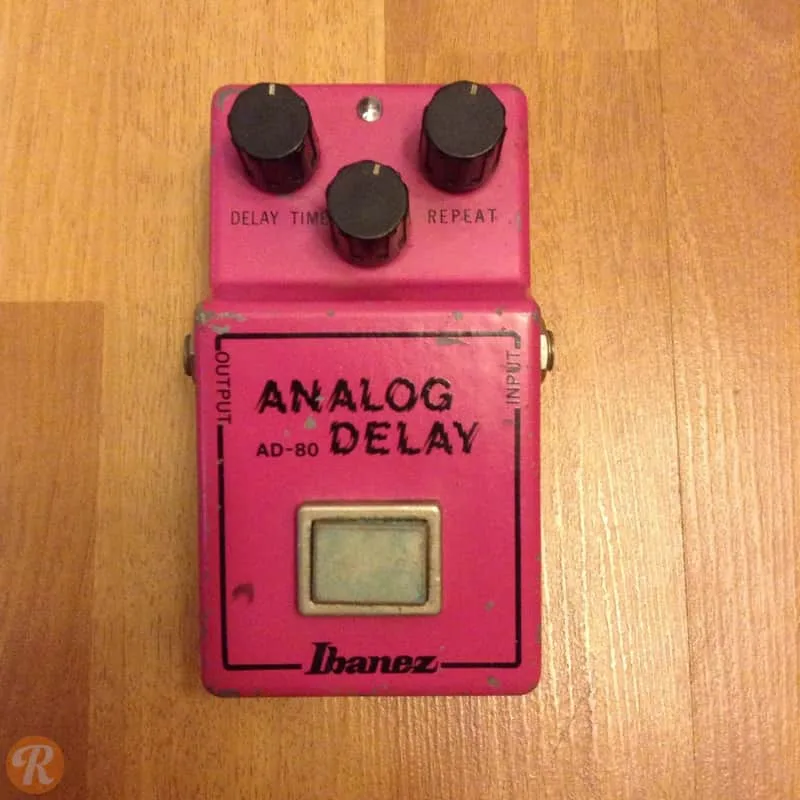
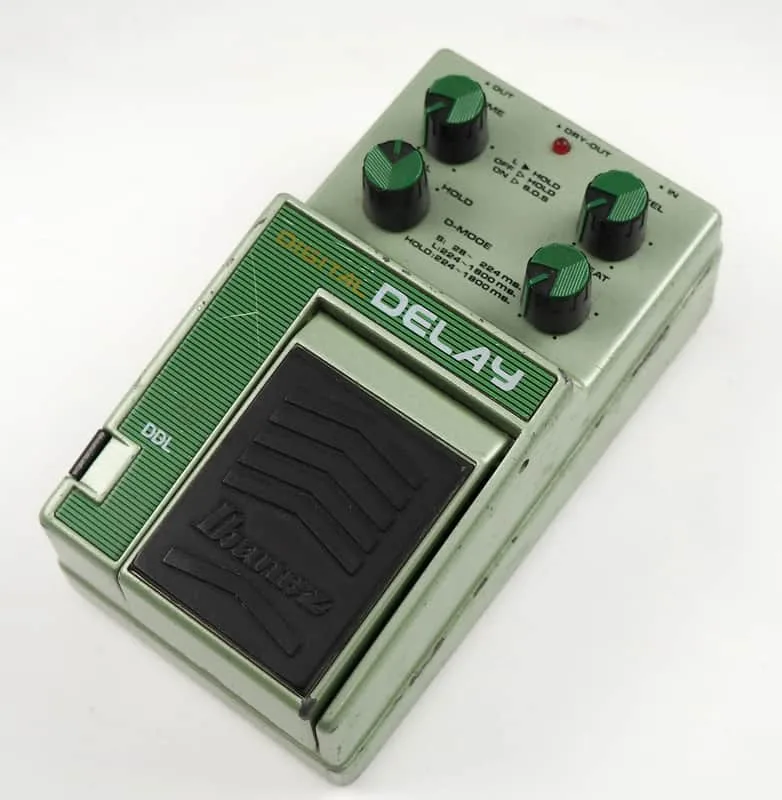
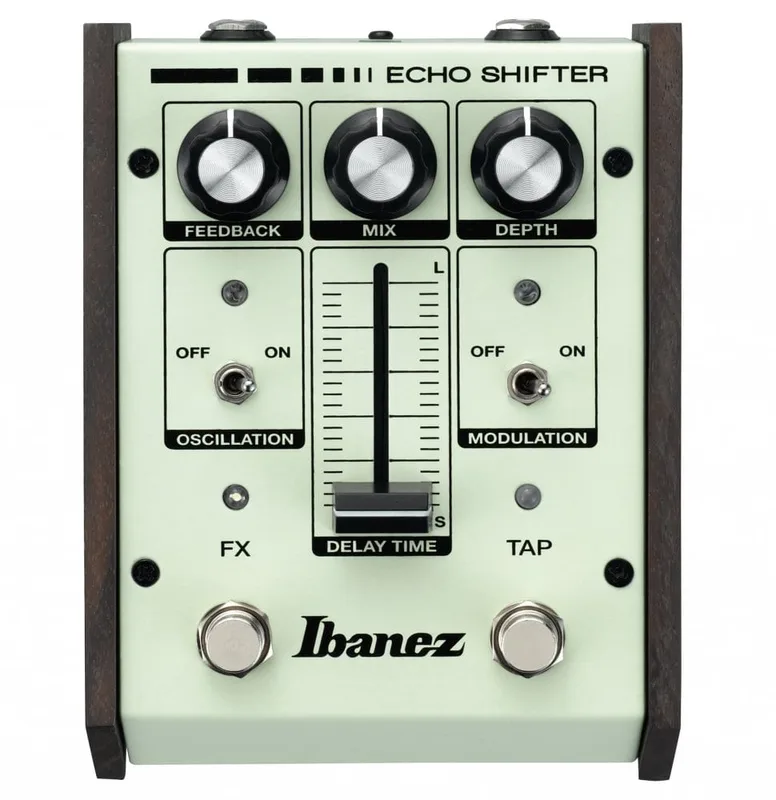
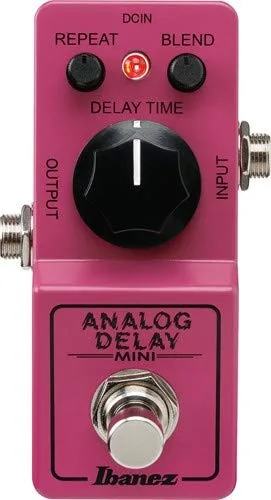
Ibanez has a long history of delay pedals, from vintage units like the AD-80 Analog Delay and the DDL Digital Delay to the Echo Shifter series and the compact Analog Delay Mini. The Layer Delayer is the company's return to the pedal game at the feature-packed end of that range, where Guitar World placed it among ambitious, do-things-differently delay pedals rather than simple retro repeats2.
Videos
Ibanez Guitars
Ibanez Guitars and Jack Gardiner
Ibanez Guitars and 千愛Chiaki
Questions
Does the Ibanez Layer Delayer have MIDI?
Yes. The LD303 has 5-pin DIN MIDI In and Thru connections for controlling parameters and presets in real time, and MIDI compatibility covers nearly all of its parameters. That makes it workable from a MIDI controller, a sequencer or a switching system on a larger board.
How many presets does the LD303 have?
It stores 50 presets across five banks, labeled A to E. Twenty of them are artist-crafted factory presets, and thirty are empty user slots for your own sounds. A short press of the Bank/Preset footswitch moves through presets, and a long press advances the bank.
What is the effects loop on the Layer Delayer for?
The LD303 has a built-in effects loop with Send and Return jacks placed on the delay signal path, so it affects only the wet repeats. You can plug another pedal into it and have that effect layered onto the repeats only, leaving your dry signal untouched.
Is the Layer Delayer tape, analog or digital?
It is a digital pedal that simulates all three. The Tone control sweeps from tape echo through analog delay to clean digital delay, with the tones gradually transitioning in between, and a simulated low-pass ladder filter shapes the repeats along the way.
How long is the delay time on the LD303?
Delay time runs from 40ms to 1,500ms, which also covers classic slap-back territory through to long ambient repeats. Time can also be set in BPM from 40 to 1500, and there is a tap tempo footswitch for setting the tempo by foot.
Sources (3)
- Guitar Pedal X, Guitar Pedal X, 2026-01-13
- Ibanez's Layer Delayer is its most ambitious pedal yet, Guitar World, 2026-01-14
- New Pedal: Ibanez Layer Delayer Delay, Delicious Audio, 2026-01-15