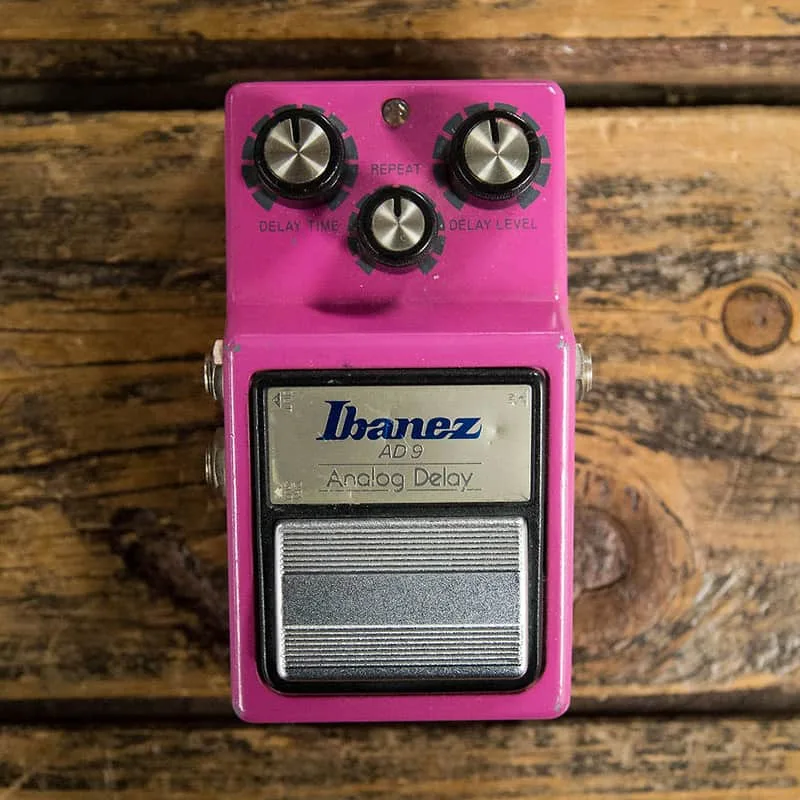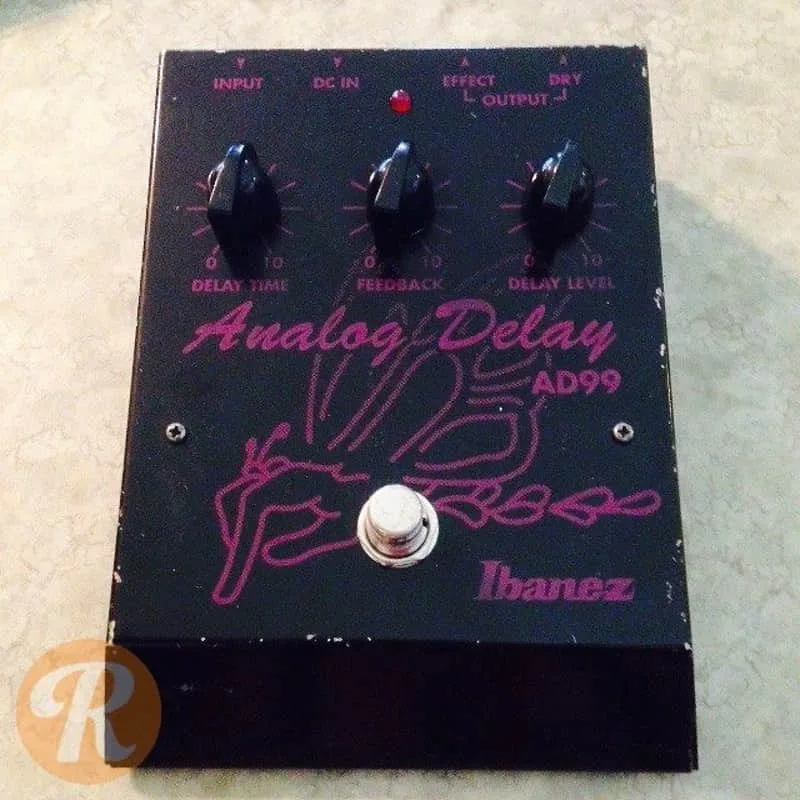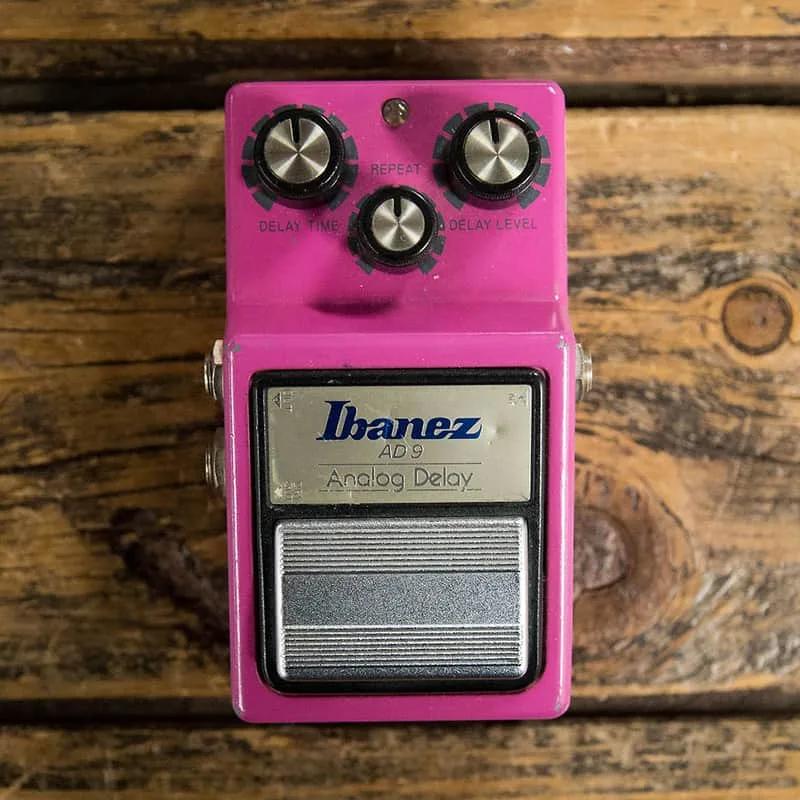


The Ibanez AD9 is an analog delay pedal, part of Ibanez's 9 Series, first produced from 1982 to 1984 and reissued from 2005 onward1. The original circuit was made by Maxon as an OEM manufacturer for Ibanez2, and it is built on bucket brigade device (BBD) chips: Analog Man notes the original Ibanez and Maxon versions used Panasonic MN3205 4096-stage bucket brigade chips with an MN3101 clock chip3. Guitar.com counts it among the classic BBD delays, alongside the Boss DM series and the Electro-Harmonix Memory Man4.
With three knobs and a warm, filtered repeat, it is the kind of delay a player reaches for when they want echoes that sit behind the note rather than reproduce it exactly. Pedal of the Day's reviewer put it plainly526:
"you can sound like you own your very own tape echo machine, and very few people would be able to tell the difference"
What it does and how it is controlled
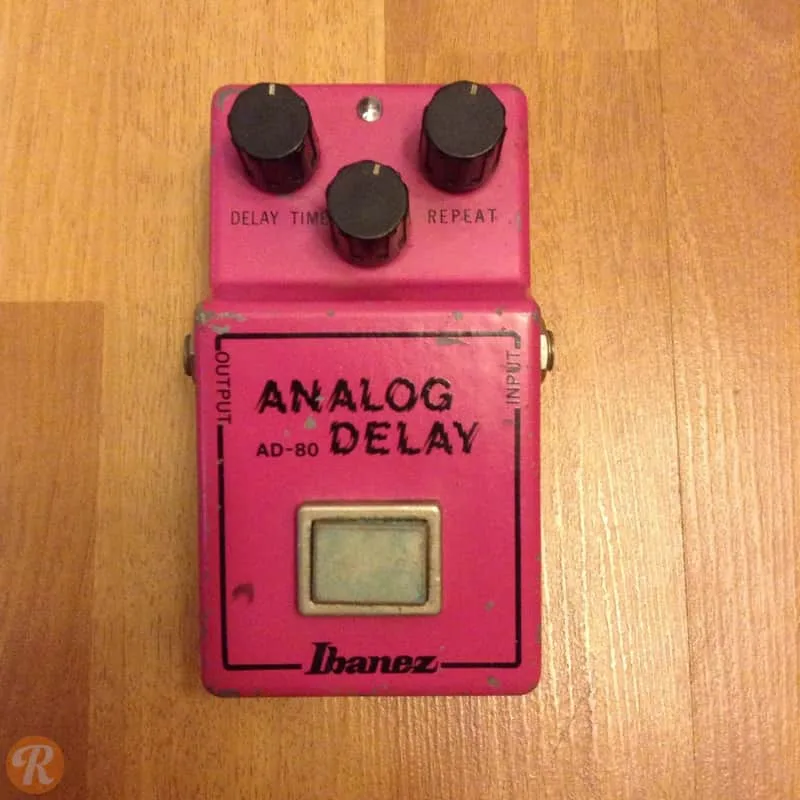
The AD9 is a straightforward three-knob delay. All three versions Analog Man has examined, the vintage model, the Maxon reissue and the Ibanez reissue, share the same basic control set1:
| Control | What it does |
|---|---|
| Delay Time | Sets the time between repeats; RockBoard describes a 300 ms range, Pedal of the Day says up to 500 ms57 |
| Feedback (Repeat) | Sets how many repeats and how quickly they fade |
| Delay Level | Sets the volume of the repeats against your dry signal |
The two published figures for maximum delay time disagree: RockBoard's product page describes a 300 ms time effect with a wide range of delay times and repeat settings5, while Pedal of the Day's review states the Delay Time knob goes up to 500 ms, enough for doubling, echoes and slapback7. Both agree the whole range is covered by a single knob.
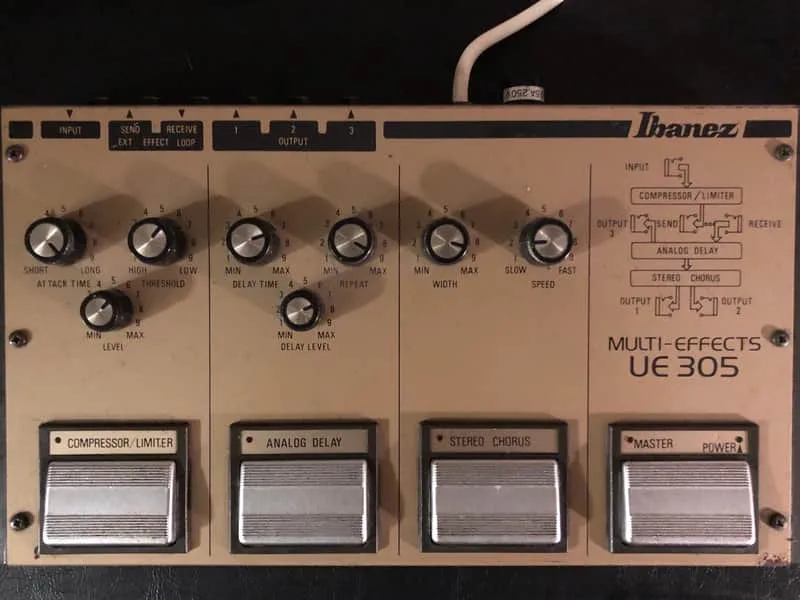
The pedal also appeared as the delay section of the Ibanez UE 305 multi-effect unit, so players sometimes encounter the same circuit outside a standalone box6.
How it compares with other analog delays
The AD9 sits in a family of closely related pedals. The vintage circuit was originally made by Maxon for Ibanez, and Maxon later built its own AD-9 reissue alongside the Ibanez one21. In a 2004 shootout published by Legendary Tones, David Szabados compared the two directly and found real differences in behavior:
- The Maxon AD-9 comes set up for self-oscillation from the factory8.
- The Ibanez AD-9 reissue, stock from the factory, is set to decay after a given number of repeats, even with the feedback control at maximum8.
Self-oscillation is the runaway feedback loop where repeats build into their own pitched howl; players who want that effect from the Ibanez reissue have to adjust it themselves. Pedal of the Day notes that while you can adjust the self-oscillation on the new ones, the reissues lack the separate bias trimpots for the internal chips and the balance trimpot that the older models have7.
Analog Man's comparison is blunt about the reissue's build:
"There is also a reissue Ibanez AD9 out now, which is cheaper as it is not true bypass and uses cheap delay chips."
The same page adds that Analog Man offers no mods for the reissues, while the vintage and Maxon units use what the site calls very expensive, rare Panasonic chips3. The reissue is not without its own improvements, though: Analog Man's reissue page notes it sports a new design compander circuit for lower noise over the original unit9. A compander compresses the signal going into the delay line and expands it on the way out, a common trick for quieting BBD noise.
Where it came from
The AD9 is an analog delay built on BBD (bucket-brigade device) circuitry, the same technology behind other classic analog delays such as the Boss DM series and the Electro-Harmonix Memory Man1. Of its sound, one reviewer wrote that "you can sound like you own your very own tape echo machine, and very few people would be able to tell the difference"7. The same review summed up its appeal as "super simple, wicked tasty, great prices, small pedalboard footprint"7.
Ibanez unveiled its plans to reissue the AD-9 at the NAMM show in January 2004, and the reissue has been in production since 200518. The reissue is manufactured by Ibanez itself rather than Maxon2.
If you buy a reissue and want to tweak its self-oscillation behavior, note that any internal tampering will void your warranty, as Pedal of the Day's review warns7. The bias and balance trimpots that made the older models easy to adjust internally are not present on the reissue.
What reviewers said
Published opinions on the AD9 line up around its simplicity and sound. Pedal of the Day's 2015 review summed it up in four short verdicts76:
"Super simple. Wicked tasty. Great prices. Small pedalboard footprint."
The same reviewer emphasized the analog character, repeating "Analog, analog, analog" and describing the tape-echo impression noted above7. On the vintage side, Analog Man's David Szabados wrote that "the character of a good analog delay is thoroughly enjoyable and difficult to capture from anything other than a genuine" analog circuit2, and Guitar.com's echo history places the AD9 among the BBD classics that remain popular with players4.
The main criticism in print concerns the reissue rather than the concept: Analog Man's view that the reissue is not true bypass and uses cheap delay chips, and therefore does not sound as good as the Maxon or original Ibanez versions3. Players comparing an original against a reissue today are effectively comparing two different parts of the pedal's history: a 1982 to 1984 Maxon-built unit with rare Panasonic BBD chips, and a 2005-onward Ibanez-built unit with a quieter compander circuit but fewer internal adjustment options39.
Videos
ProGuitarShopDemos
Reverb
Pedal of the Day
Questions
How long is the delay time on the Ibanez AD9?
Sources disagree on the maximum. RockBoard's product page describes a 300 ms delay time with a wide range of repeat settings, while Pedal of the Day's review puts the Delay Time control at up to 500 ms, enough for doubling, echoes and slapback. Both agree the delay time is set with a single knob.
Is the Ibanez AD9 analog?
Yes. The original 1982 AD9 is an analog delay built on bucket brigade chips. Analog Man notes that the original Ibanez and Maxon versions used Panasonic MN3205 4096-stage bucket brigade chips with an MN3101 clock chip. The 2005 reissue is also sold as an analog delay, though Analog Man says it uses cheaper delay chips than the vintage unit.
Does the AD9 reissue differ from the original?
Yes. The reissue, made by Ibanez since 2005, is cheaper, is not true bypass and uses cheaper delay chips, according to Analog Man. It does add a new compander circuit for lower noise. Reissues also lack the separate bias trimpots for the internal chips that the older models have.
Can the AD9 self-oscillate?
The reissue can be adjusted to self-oscillate, but from the factory it is set to decay after a given number of repeats even with the feedback control maxed. The Maxon AD-9, by contrast, comes set up for self-oscillation from the factory. Analog Man notes the reissue lacks the separate bias trimpots that make deeper adjustment possible.
Does opening the AD9 void the warranty?
Yes. Pedal of the Day's review warns that any internal tampering will void the warranty. This applies to the current reissue; the original 1982 to 1984 units have long been out of warranty, and vintage units are often serviced and modified anyway.
Sources (9)
- TONEHOME, TONEHOME
- Ibanez vs. Maxon AD-9 Delay Comparison, Analog Man (analogman.com), 2015
- Ibanez TS9 and TS808 Tube Screamers, Maxon OD9 and similar effects pedals and mods, Analog Man (analogman.com), 2022
- All About… Echo, Guitar.com, 2015-09-22
- AD-9 Analog Delay by Ibanez, RockBoard (www.rockboard.de), 2026
- Ibanez UE 305 Multi-Effect, Pedal of the Day, 2016-12-13
- Ibanez AD9 Analog Delay, Pedal of the Day, 2015-11-16
- Maxon AD-9 VS. Ibanez AD-9 Shootout, Legendary Tones (published on maxonfx.com, Godlyke, Inc.), 2004
- Ibanez vs. Maxon AD-9 Delay Comparison, analogman.com, 2015
 Tim Mahoney