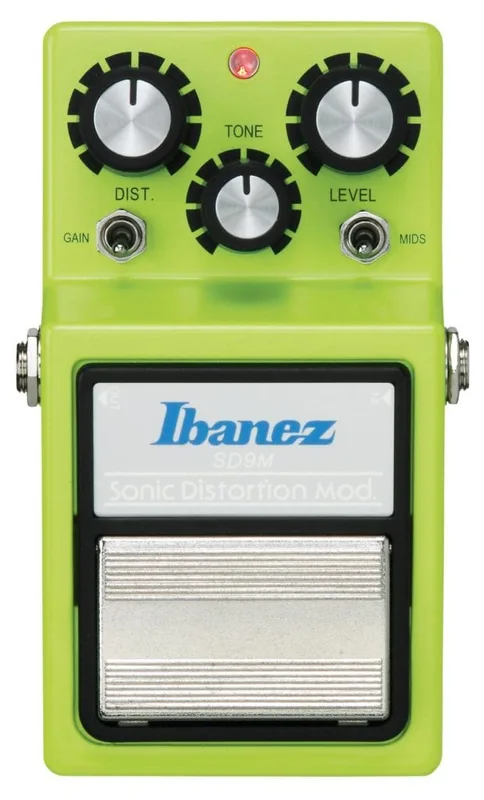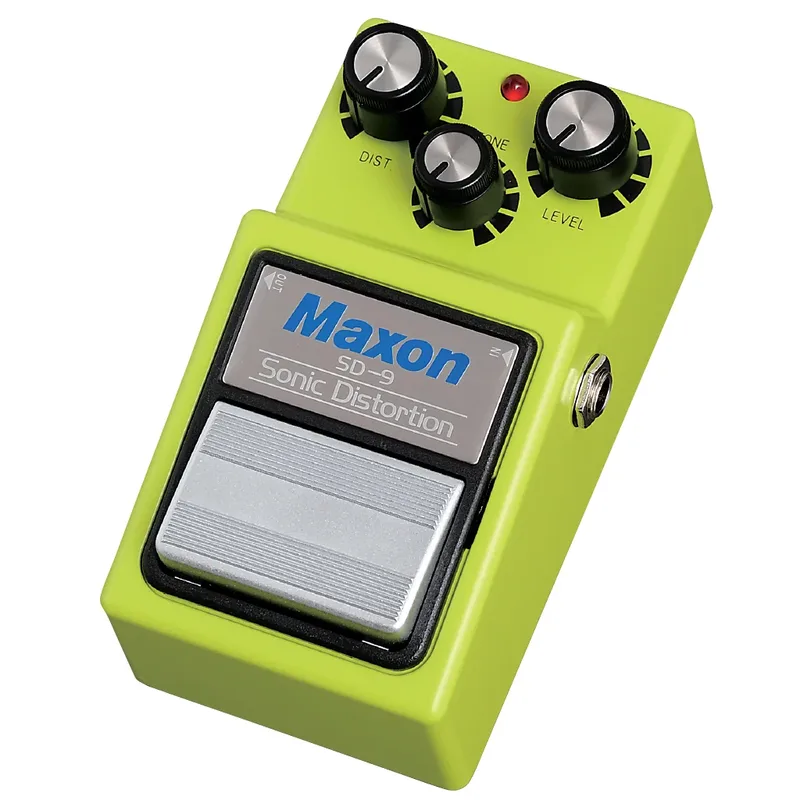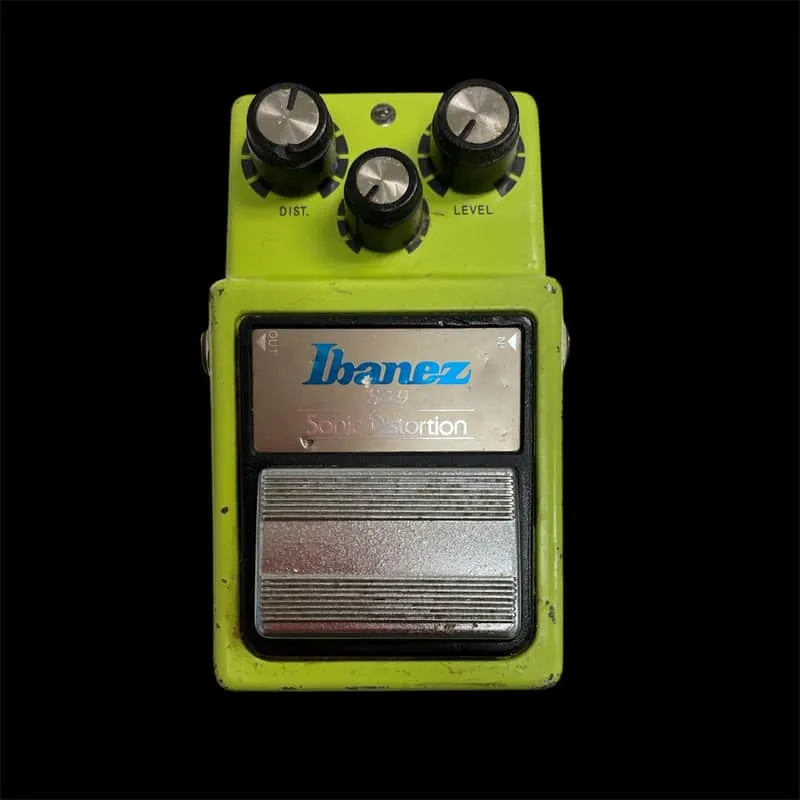


The Ibanez SD-9 Sonic Distortion is an analog distortion pedal made in Japan from 1982 to 1984, part of the same 9 Series as the TS9 Tube Screamer. Where the TS9 is an overdrive, the SD9 is a full distortion: more gain, a thicker and more saturated sound, and a tone control that scoops the midrange rather than boosting it. Ibanez describes it as a pedal that "expands on the traditional idea of distortion to create a wide new range of possibilities"123.
The SD9 was discontinued in 1985 along with the rest of the 9 Series, and originals are now collectible, with Tonehome rating collectibility as high and availability as good24. It has lived on through reissues: the Ibanez SD9M since 2012, and the Maxon SD-9 from 2002.
A heavier, mid-scooped cousin of the TS9
The SD9 sits in the TS9's shadow, but players who know it tend to rate it highly. On JHS Pedals' history of distortion, Josh Scott called it "the Ibanez SD 9 sonic Distortion kind of in the shadow of the ts9 at all times but it's really really great"5. JHS's written history gives it credit as "the TS9's younger brother"6.
Analog Man's take on the sound: "An SD-9 is sort of like a TS-9 designed for distortion, with more hair and a a thicker, more saturated distortion sound" that the site describes as great for leads or thick rhythm7. General Guitar Gadgets sums up the family difference simply: heavier distortion than the Tube Screamer8.
The two pedals share a platform but differ in the details that matter:
| SD-9 Sonic Distortion | TS9 Tube Screamer | |
|---|---|---|
| Effect type | Distortion | Overdrive |
| Tone shaping | Mid-scoop between 234 Hz and 867 Hz4 | Midrange hump character |
| Low cut corner | 1.54 kHz4 | 723 Hz4 |
| Op-amps | Two dual op-amps, referred to as JRC4558 chips9 | Different op-amp ICs used across versions; original used the TA75558P10 |
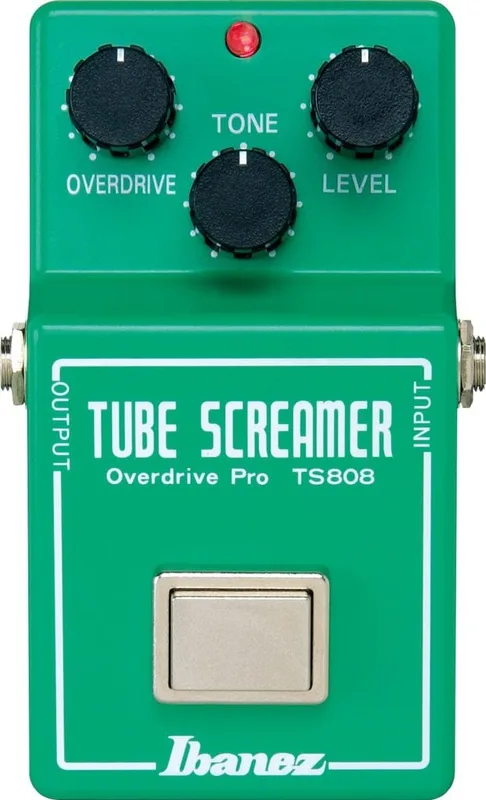
On That Pedal Show, the comparison came down to feel: the TS9 was described as "a bit more compressed" and smoother next to the SD9's character11.
The controls: Distortion, Tone and Level
Three knobs, in the classic 9 Series layout1:
| Control | What it does |
|---|---|
| Distortion | Sets the intensity of the distortion1 |
| Tone | Modifies the distortion with bass or treble boost for, in Ibanez's words, "exciting new colorations"1 |
| Output Level | Sets the output volume1 |
The Tone control is where the SD9 most departs from its sibling. Aion FX's circuit analysis measured the result as a mid-scoop between 234 Hz and 867 Hz41, the opposite of the Tube Screamer's famous midrange push. For a player, that means the SD9 leans darker and chunkier through the middle rather than cutting through a mix the way a TS9 does.
How the circuit works
The signal path follows the 9 Series template: input buffer, adjustable gain boost, clipping diodes, tone control, then volume and output buffer4.
The distortion itself comes from diode-to-ground hard clipping using back-to-back 1N914 diodes, which clip the signal to around 0.6V on both sides of the waveform4. The gain stage feeding those diodes runs from a gain of 71 at minimum Drive to 603 at maximum4, which is why the pedal gets genuinely saturated rather than just breaking up.
The circuit also includes an input buffer ahead of the amplifying stages, with D3 serving as a polarity protection diode (a 1N5817 in the popular DIY layout; any Schottky or 1N400X series diode works in an original unit except a zener)9.
Why the SD9 is quiet at full volume
The SD9's best-known quirk is its low maximum output. Aion FX calls it "perhaps a design flaw that there's no gain recovery section in the original pedal," which limits the available output volume41. Because the clipping diodes clamp the signal to about 0.6V, the Level control simply cannot push the pedal much louder than that.
The known fix, documented by Aion FX: adding a BAT46 or germanium diode (0.3V forward voltage) in series with each 1N914 increases the available volume by half, and stacking two 1N914s doubles it4. The later SD9M took a different route, adding extra op-amp gain stages not found in the original, which helps the volume issue but does not sound the same as an original SD94.
Power and bypass
The SD9 runs on 9V DC, center negative, drawing 8mA1. It is an analog circuit1.
The original SD9 is not true bypass. It uses an electronic flip-flop bypass, and the input and output buffers remain in the circuit even in bypass mode4. Players running several buffered vintage pedals in a chain should expect the same kind of small high-frequency loss Analog Man measured when testing a bypassed TS912.
History and versions
The SD-9 first hit stores around 1982 (Aion FX also cites 1983 as a date), was produced in Japan through 1984, and was discontinued in 1985 with the rest of the 9 Series due to poor sales24. Its designer was Susumu Tamura, the same engineer behind the Tube Screamer; Guitar World's Paul Riario calls the SD-9 "also a Tamura original"13.
The pedal's later life:
- 2002: Maxon, which had built the original pedals and then broke off from Ibanez, reissued the SD-9 in its Nine Series with a circuit identical to the 1980s version aside from true-bypass switching414.
- 2012 to present: Ibanez reissued it as the SD9M, a modified version with added gain stages24.
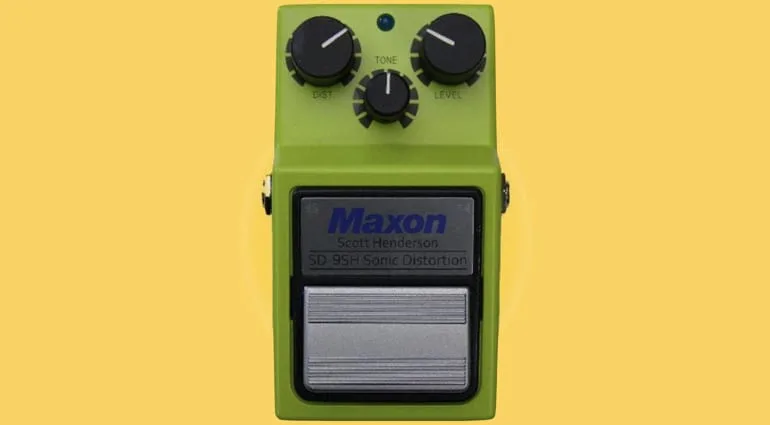
- 2020: Maxon released the Scott Henderson SD-9SH, a version with tweaks developed with Henderson and an additional output level control15.
Players associated with the pedal include Michael Landau, who That Pedal Show describes as having a long-term relationship with the Ibanez/Maxon SD916. A DIY builder reporting on the SD9M circuit called it "a true tool for hard rock. Power chords, single note and great sustain with very high gain without to be muddy"9.
Guitar World's Paul Riario, reviewing a related pedal, still held the original in high regard: "I still hold fast that the SD-9 is a great pedal with a distinct distortion unlike any other, despite its limitations," describing its overall character as warmly overdriven with scooped mids and borderline fuzzy at its peak13.
Videos
John Nathan Cordy
Alberto Martinez Del Rio Guitar
Leon Todd
Questions
What is the difference between the SD9 and the TS9 Tube Screamer?
The SD9 is a distortion pedal rather than an overdrive, with more gain on tap and a thicker, more saturated sound. Its tone control scoops the midrange between roughly 234 Hz and 867 Hz, while the TS9's tone shaping is a midrange hump. The SD9 also cuts lows at a higher corner frequency, 1.54 kHz versus the Tube Screamer's 723 Hz.
Is the Ibanez SD9 true bypass?
No. The original SD9 uses an electronic flip-flop bypass, and its input and output buffers remain in the circuit even when the pedal is bypassed. The 2002 Maxon reissue switched to true bypass, but the 1980s Ibanez originals are buffered.
Why is the SD9 quiet at full volume?
The original circuit has no gain recovery stage after the clipping diodes, which limits the available output volume. Because the 1N914 clipping diodes clamp the signal to around 0.6V on each side of the waveform, the level control cannot push the output much beyond that.
What is the Ibanez SD9M?
The SD9M is a modified reissue of the SD9 that Ibanez has produced since 2012. It adds extra op-amp gain stages not found in the original, which addresses the low output volume issue, though it does not sound identical to an original 1980s SD9.
Who designed the Ibanez SD9?
The SD9 is credited to Susumu Tamura, the same designer behind the Tube Screamer line. Guitar World's reviewer described the SD9 as a Tamura original alongside the classic Ibanez designs.
Is the Maxon SD9 the same circuit as the Ibanez?
Essentially yes. Maxon reissued the SD9 in 2002 under its own name with a circuit identical to the 1980s version, the one notable difference being true-bypass switching instead of the original buffered bypass.
Sources (16)
- SD-9 Sonic Distortion by Ibanez, RockBoard PedalPedia, 2026
- TONEHOME, TONEHOME
- Ibanez TS9 Tamura-Mod, maxonfx.com (Godlyke, Inc.)
- Meteor Vintage Distortion / Ibanez® SD-9, Aion FX, 2021-10-22
- 1970's Op-Amp Distortion (Boss DS-1, ProCo Rat, Ross Distortion, Ibanez SD-9, MXR Micro Amp), JHS Pedals (YouTube), 2019-04-04
- HISTORY OF DISTORTION PART 2, JHS Pedals
- Ibanez TS9 and TS808 Tube Screamers, Maxon OD9 and similar effects pedals and mods, Analog Man (analogman.com), 2022
- Ibanez™ SD9™ Sonic Distortion™ Clone: DIY Kit, PCB & Schematic, General Guitar Gadgets, 2014-05-12
- Guitar FX Layouts: Ibanez SD9M Sonic Distortion Mod, Guitar FX Layouts (tagboardeffects.blogspot.com), 2014-06-28
- Stratus Classic Overdrive / Ibanez® Tube Screamer, Aion FX, 2018-09-22
- Boss Super Overdrive Or Ibanez Tube Screamer? In Your Band, That Pedal Show (YouTube), 2021-12-03
- Ibanez Tube Screamer History, analogman.com, 2023
- TWA SH9 Scott Henderson Signature Distortion review, Guitar World, 2023-05-19
- SONIC DISTORTION (SD-9), Godlyke Distributing, Inc.
- Maxon Scott Henderson SD-9SH Sonic Distortion: "The best distortion in the world"?, gearnews.com, 2020-02-02
- What About The SD9 Sonic Distortion? Ibanez, Maxon/Analogman, Vemuram Butter Machine & TWA SH9, That Pedal Show, 2024-02-02