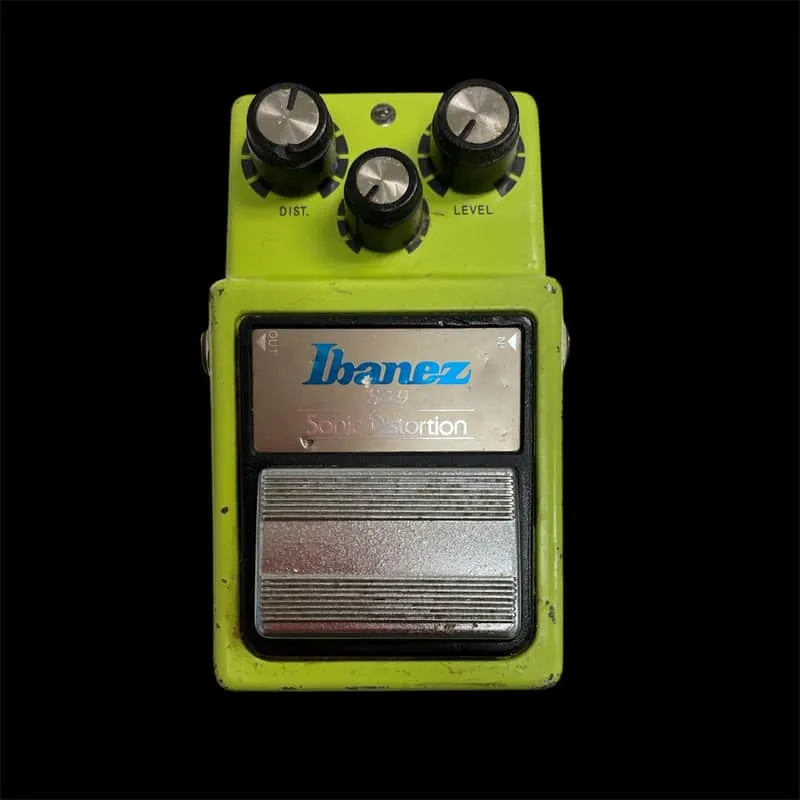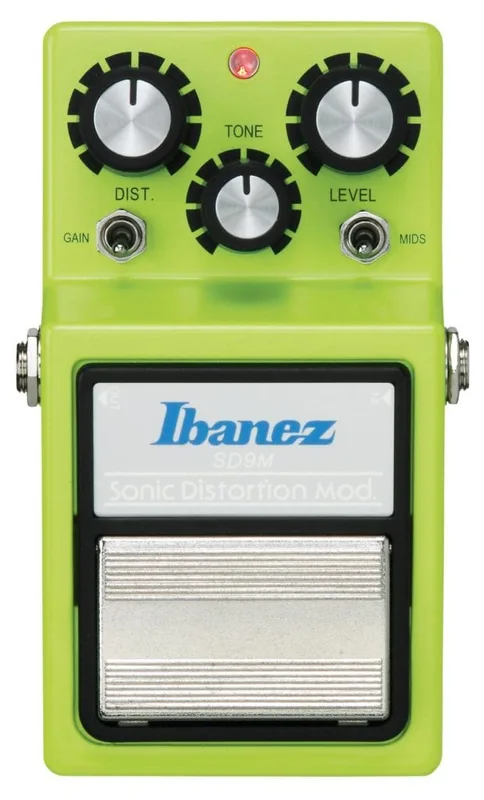


The Ibanez SD9M is a distortion pedal from Ibanez, an updated reissue of the SD9 Sonic Distortion that Ibanez released in 201212. Where the original SD9, made in Japan in 198223, is a sought-after vintage piece with high collectibility32, the SD9M puts a modified version of the same circuit back in production.
The reissue carries two changes over the original: a switchable +10x gain stage, and a midrange toggle switch that changes the EQ of the tone control1. Everything else about the Sonic Distortion's character, its filtering and its clipping architecture, carries over from the 1982 design.
What the SD9M does to your sound
The Sonic Distortion's tone control is a mid-scoop: it cuts frequencies between 234 Hz and 867 Hz1. The gain stage cuts lows with a corner frequency of 1.54 kHz, rolling off at 6 dB per octave above that point1. The result is a distortion voiced around the mids and top rather than the low end.
The SD9M's midrange toggle changes that voicing. A common modification changes the value of a capacitor in the tone section, which turns the mid-scoop into a slight mid-boost1, and the reissue puts that change on a switch. The second added feature, the switchable +10x gain stage1, pushes the circuit into much higher gain territory than the original.
A builder who worked with the modified circuit described it in practical terms5:
"it's a true tool for hard rock. Power chords, single note and great sustain with very high gain without to be muddy"5
mirosol, Guitar FX Layouts5
Inside the circuit: JRC4558 opamps and an input buffer
The Sonic Distortion circuit is built around two dual opamps, the type commonly referred to as JRC4558 chips5, the same family of opamp used in many classic Ibanez designs. The signal path starts with an input buffer, so the guitar signal hits the buffer first before going to the amplifying stages5.
In the original circuit, one half of the second dual opamp is completely unused. The popular DIY version of the SD9M puts that spare half to work as a buffer for the reference voltage5, a change that makes the layout cleaner to build without altering the audio path.
For players building the circuit from the widely shared vero layout, a few practical points have come out of the builder community5:
- Clipping diodes: D1 and D2 are the clipping diodes.
- Polarity protection: D3 is a 1N5817 in the layout; any Schottky barrier diode or any 1N400X will work, except a zener.
- Tone pot: a B20k pot works fine in place of the specified 25k.
- Layout correction: the resistor connecting to the 470nF cap to the diodes should be 2K2 (R10 in the schematic); an earlier version of the layout showed 10K.
- Bypass: the bypass method is separate from the layout; true bypass is suggested, at the builder's choice.
The layout was posted on 19 June 2014 and was not verified at the time of posting, as no one had yet built it5.
History: from the SD9 to the SD9M
The original Ibanez SD9 Sonic Distortion was made in Japan in 198223, part of Ibanez's 9 Series. Today it is rated highly for collectibility, with good availability on the vintage market2.
In 2012, Ibanez released an updated reissue of the SD9 called the SD9M12, which TONEHOME lists as "SD9M (modified), 2012 - present"2. The reissue remains in production, giving players access to the Sonic Distortion circuit without hunting down a 1980s original.
Adding a diode clipping switch
Beyond the two factory modifications, builders of the SD9M circuit have suggested going further. Adding a third switch to act as a diode clipping switch should be straightforward5. Since D1 and D2 are the clipping diodes5, a switch that selects between different diode types, or lifts them entirely for opamp-only clipping, changes the distortion character while leaving the rest of the circuit untouched.
Videos
Portal Gitarowy
Nagata Beck
Maxz Daduang
News
Questions
What is the difference between the Ibanez SD9 and SD9M?
The SD9M is an updated reissue of the original 1982 SD9 Sonic Distortion, released by Ibanez in 2012. It keeps the basic Sonic Distortion circuit but adds two modifications: a switchable +10x gain stage and a midrange toggle switch that changes the EQ of the tone control. The original SD9 was made in Japan in 1982.
What does the mid switch on the SD9M do?
It changes the EQ of the tone control. The stock SD9 tone control produces a mid-scoop between 234 Hz and 867 Hz; the modification changes the value of a capacitor in the tone section, which turns that mid-scoop into a slight mid-boost. The switch lets you move between the two voicings.
Where is the Ibanez SD9M made?
The original SD9 Sonic Distortion was made in Japan in 1982. The SD9M is a modified reissue that Ibanez released in 2012 and that remains in production. The research material does not state where the reissue units are manufactured.
Can you add a diode clipping switch to an SD9M build?
Yes. Builders of the popular vero layout report that adding a third switch to act as a diode clipping switch should be straightforward. D1 and D2 are the clipping diodes in the circuit, so a switch that selects or lifts those diodes changes the clipping character.
Sources (5)
- Meteor Vintage Distortion / Ibanez® SD-9, Aion FX, 2021-10-22
- TONEHOME, TONEHOME
- TONEHOME, TONEHOME
- SD-9 Sonic Distortion by Ibanez, RockBoard PedalPedia, 2026
- Guitar FX Layouts: Ibanez SD9M Sonic Distortion Mod, Guitar FX Layouts (tagboardeffects.blogspot.com), 2021-03-17