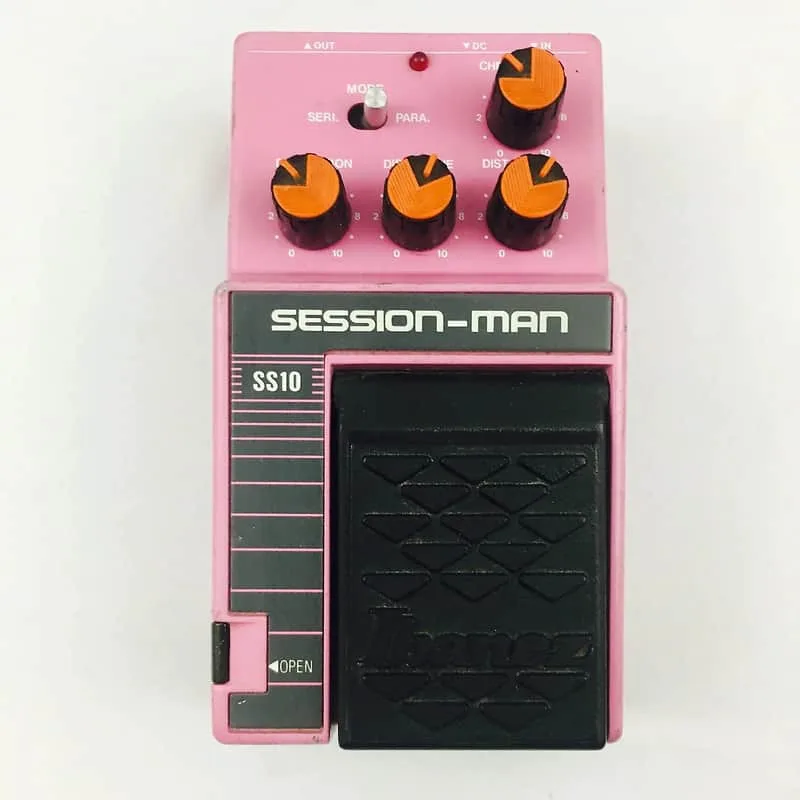


The Ibanez SS10 Session-Man is a vintage distortion and chorus pedal from Ibanez's Power Series 10, produced from 1986 to 19931. Instead of making you buy two separate boxes, it puts the circuits of two other Power Series pedals, the FC10 Fat Cat Distortion and the SC10 Super Stereo Chorus, into one analog unit, with a switch that runs the two effects one after the other or side by side2. ToneHome describes the result as giving you "both the fat sound and tenacious sustain of a distortion pedal with the lush and mellow tone of the chorus effect"1.
It is a discontinued pedal that Ibanez has never reissued, and it is not an easy one to find: ToneHome rates its availability as rare and its collectibility as high1. Pedal of the Day called it "one of the rarer and more sought-after units" from the Power Series, with prices that tend to fall on the higher side of the series' range2.
Two circuits in one box
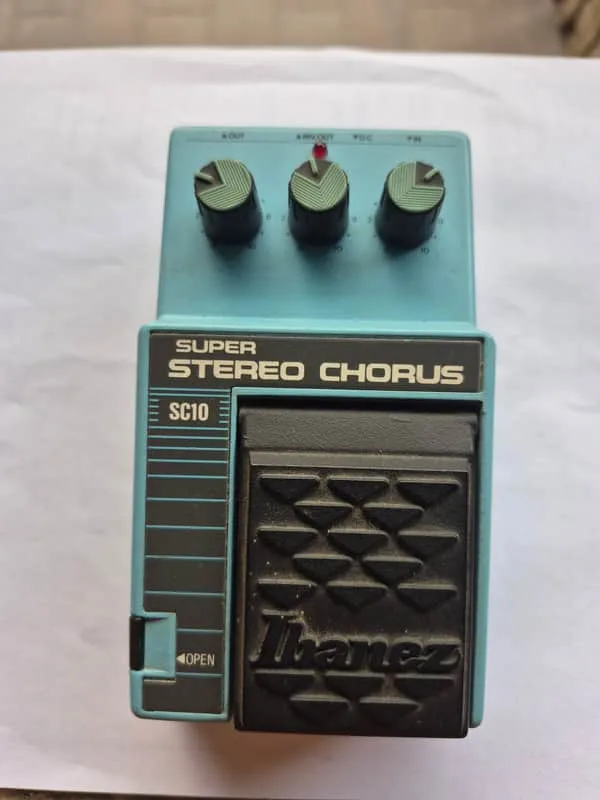
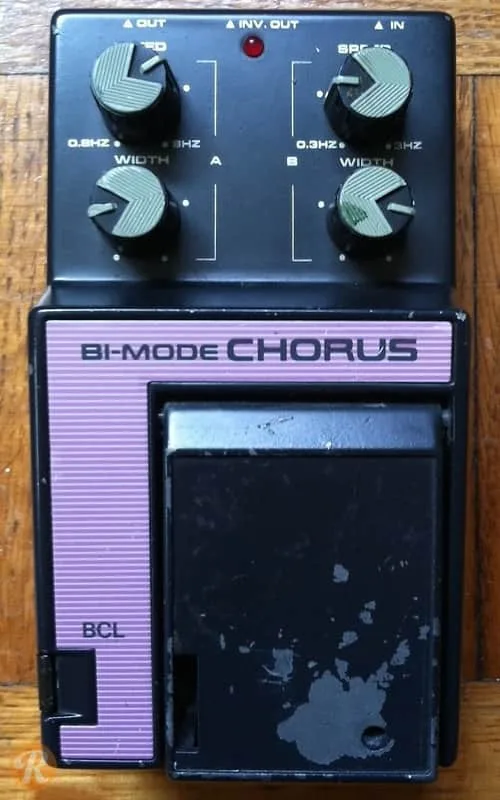
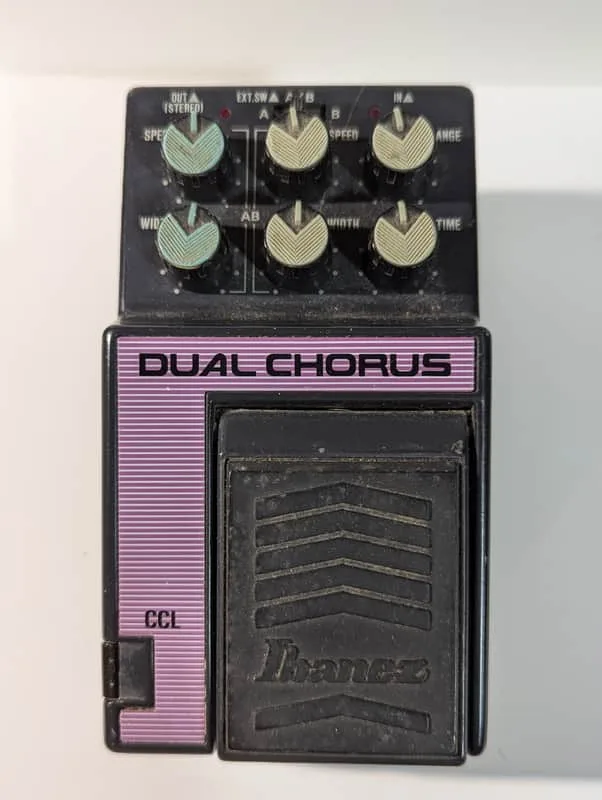
The SS10's two halves each come from an existing Power Series pedal. The distortion side is built on the FC10 Fat Cat's circuit, which ToneHome notes shares its principle with the TS10 and DS10: like those pedals, the FC10 gives extreme level boosts to incoming signals31. The chorus side comes from the SC10 Super Stereo Chorus, produced over the same 1986 to 1993 period, a pedal ToneHome describes as offering normal and inverted stereo outputs for "full, rich, true stereo"4. Pedal of the Day's reviewer summed up the SS10 as combining "two incredible analog circuits (FC10 Fat Cat Distortion & SC10 Super Stereo Chorus) built" into a single pedal2.
Series and parallel modes
The pedal's central feature is its Mode switch, which selects how the distortion and chorus connect1.
- Series Mode: the distortion output feeds the chorus input, so the two effects run one after the other1.
- Parallel Mode: the dry signal is fed to both the distortion and the chorus, and the two effects are summed at the output1.
The difference is more than wiring. ToneHome says the Parallel Mode "creates a beautiful unison timbre, mixing distortion with a rich yet clear chorus effect"1. Pedal of the Day's reviewer put the two modes in player's terms: "Parallel mode will give your leads a little or a lot of movement, while Series provides instant '80s nostalgia"2.
"In any case, it sounds fantastic, and conjures up sounds that will whisk you back 40 years."
The controls
The SS10's top-panel controls cover the distortion side and the chorus mix, while the chorus's own speed and width settings are hidden inside the pedal1.
| Control | What it does |
|---|---|
| DISTORTION | Adjusts the distortion drive1 |
| DIST.-TONE | Sets the distortion's tone, adjusted to taste alongside the drive1 |
| DIST.-LEVEL | Sets the distortion level; raised gradually until a clear sound is heard during the attack, and best kept relatively low1 |
| CHRS.-LEVEL | Balances volume between effect and dry (normal) levels1 |
| Mode switch | Selects series or parallel connection of the two effects1 |
The SPEED and WIDTH controls for the chorus section are not on the surface at all. They sit under the battery compartment beneath the footswitch, and they come from the factory adjusted for a typical chorus sound. ToneHome notes that "you can of course change the settings as necessary to suit the type of music and playing technique"1. On the standalone SC10, the equivalents are front-panel knobs: Speed controls the rate at which the effect moves, Width controls the range of the effect, and D-Time varies the point in time where the effect is created4. The SS10 hides the first two of those functions inside the case.
ToneHome's page links the pedal's original manual, which describes a setup procedure: set the Mode switch to PARA, adjust the DISTORTION and DIST.-TONE knobs to taste, then gradually raise the DIST.-LEVEL setting until you hear a clear sound during the attack1.
The SS10 and the SS20 Session-Man II
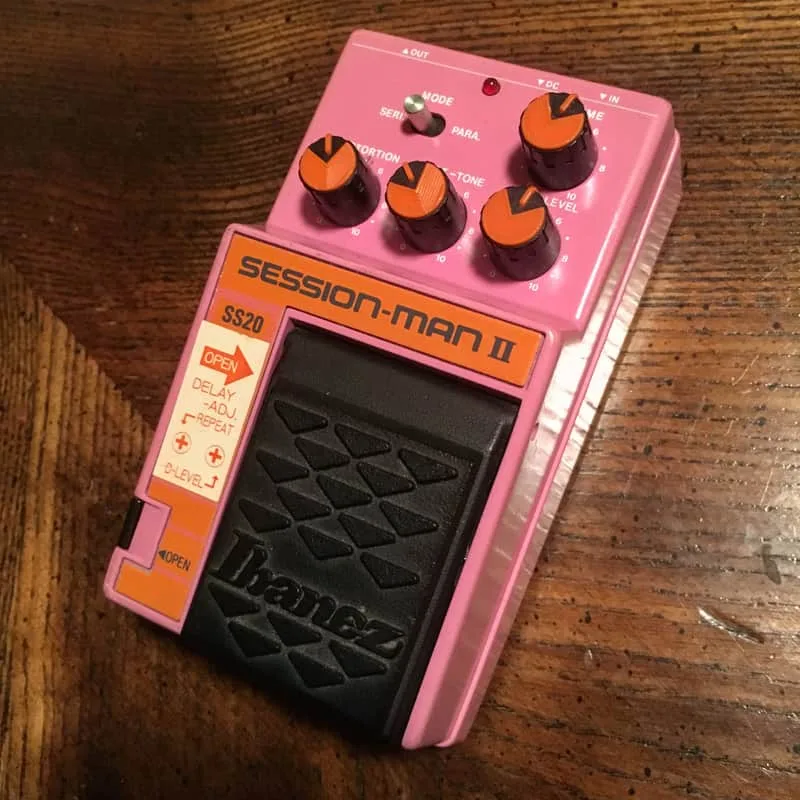
The SS10 has a sibling in the same series, the SS20 Session-Man II, produced from 1987 to 199351. The SS20 pairs distortion with delay rather than chorus, and like the SS10 it uses a MODE switch to select serial or parallel connection of its two built-in effects51. Pedal of the Day, which reviewed the SS20 in 2020, described its Series/Parallel toggle and noted that its Dist-Level control sets the output, with an internal Feedback/Repeats trimpot for the delay hidden under the footswitch, much as the SS10 hides its chorus trimmers61. Neither pedal has been reissued15.
Videos
Six string to rock
AMP BUDDIES
Pedal of the Day
Questions
When was the Ibanez SS10 Session-Man made?
Ibanez produced the SS10 Session-Man from 1986 to 1993 as part of the Power Series 10 line. Units were made in Japan; ToneHome's page for the pedal shows a Japan 1989 example. It has never been reissued.
Was the Ibanez SS10 ever reissued?
No. ToneHome records the SS10 Session-Man as not reissued, and the same is true of its sibling, the SS20 Session-Man II. Both pedals exist only as vintage units from their original 1980s and early 1990s production runs.
Where are the speed and width controls on the SS10?
The SPEED and WIDTH controls for the SS10's chorus section are not on the top of the pedal. They are internal trimmers located under the battery compartment beneath the footswitch. They come factory adjusted for a typical chorus sound, but you can change them to suit your music and playing technique.
What is the difference between the SS10 and SS20 Session-Man II?
The SS10 combines distortion and chorus; the SS20 Session-Man II, produced from 1987 to 1993, pairs distortion with delay instead. Both use a mode switch to run their two effects in series or parallel, and both were made in Japan and never reissued.
Is the Ibanez SS10 Session-Man rare?
Yes. ToneHome rates its availability as rare and its collectibility as high, and Pedal of the Day called it one of the rarer and more sought-after units from the Power Series. Prices tend toward the higher side of the series' range.
Sources (6)
- TONEHOME, TONEHOME, 1989
- Ibanez SS10 Session-Man Power Series Distortion Chorus, Pedal of the Day (www.pedal-of-the-day.com), 2025-05-22
- TONEHOME, TONEHOME
- TONEHOME, TONEHOME, 1988
- TONEHOME, TONEHOME
- Ibanez SS20 Session-Man II Delay Distortion, Pedal of the Day, 2020-06-20