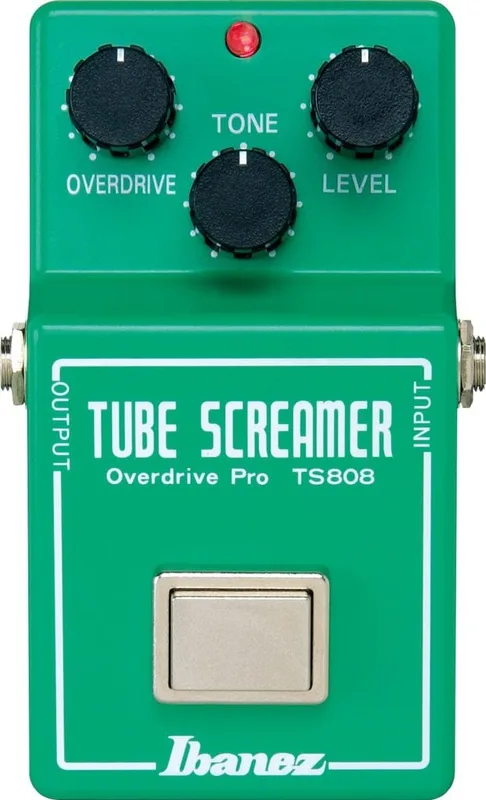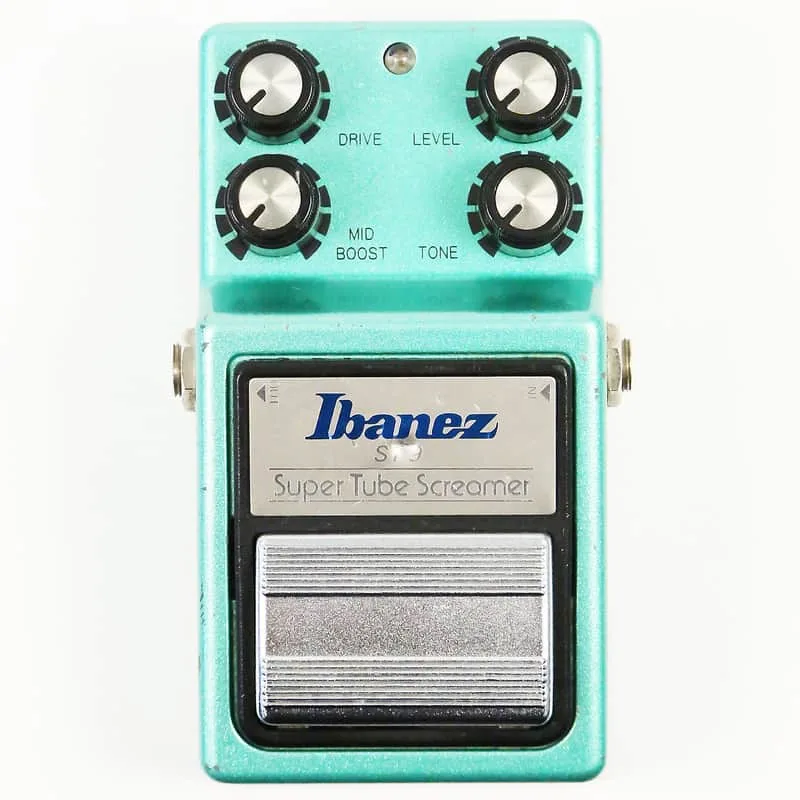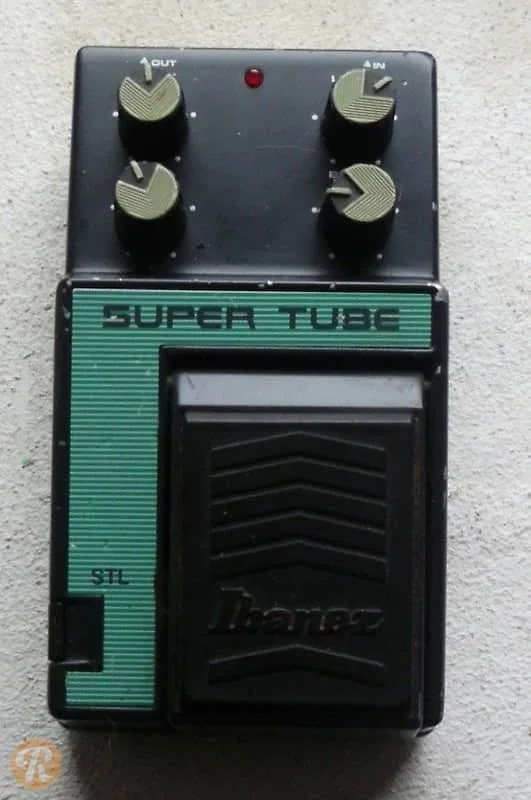


The Ibanez STL Super Tube is a four-knob distortion pedal that Ibanez built in Japan in 1985 as part of its Master Series L lineup. Under the name it is a Tube Screamer circuit wearing different clothes: as Premier Guitar put it in its Tube Screamer history, it is "Not officially a Tube screamer, but uses a Tube Screamer circuit with a 2-band EQ"1. Analog Mike Piera of Analog Man describes it in the same terms, calling it "like a 4 knob tube screamer"2.
What separates the STL from a standard Tube Screamer is that extra knob. Where the classic TS circuit gives you level, tone and drive, the STL adds a midrange control, and where that control sits in the signal path is the pedal's defining trait: on the related ST-9 Super Tube Screamer the MIDS control works before the clipping stage, while on the STL it comes after the clipping stage2. That placement means the midrange boost shapes the distorted signal rather than pushing the clipper harder, which is the practical difference between the two circuits for a player comparing them.
A four-knob Tube Screamer-style distortion
The STL arrived in the Master Series L, a series Ibanez built for only about a year. Piera notes that "This series was only made in about 1985"2, and the series had no Tube Screamer in its official lineup, which is why the STL carries the Super Tube name rather than the Screamer badge. Premier Guitar describes it as "a 4-knob affair with a Tube Screamer circuit and a 2-band EQ"1.
The four knobs break down like this:
| Control | What it does |
|---|---|
| Level | Output volume |
| Tone | High-frequency roll-off, Tube Screamer style |
| Drive | Gain into the clipping stage |
| MIDS | Midrange control, placed after the clipping stage2 |
The closest relative is the ST-9 Super Tube Screamer, sold in the 9 Series. TONEHOME calls the ST9 "the culmination of the Tubescreamer"42, and Piera describes both pedals as "like a Tube Screamer with an added MIDS control, which is before clipping on the ST-9 and after the clipping s[tage in the STL]"2. The ST-9 itself is a different kind of rare: Aion FX notes it "was only made in very small quantities, and only sold in Europe between 1983 and 1984"5. Premier Guitar calls the STL "similar to the rare (and very valuable) European ST-9 Super Tube Screamer that was never released in the US"1.
The STL Super Tube has never been reissued, so every unit is a 1985 Japanese original. TONEHOME rates its collectibility as high but its availability as good, meaning originals do turn up on the vintage market3.
Inside the circuit
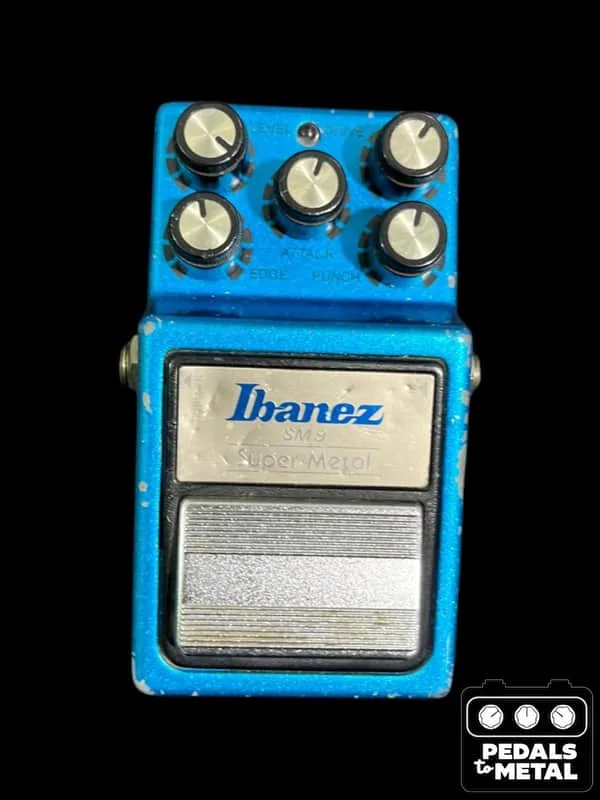
The STL's board follows the family pattern of the era. TONEHOME describes its PCB as similar to the SM9 Super Metal, built around two JRC4558D op amps, the same dual op amp that runs the classic Tube Screamer3. The rest of the signal path is Tube Screamer topology: a buffer, a clipping stage, and tone shaping, with the STL's midrange control sitting after the clipping stage rather than before it as on the ST-92.
The DIY community has documented the circuit closely. Guitar FX Layouts published a vero and tagboard layout for the STL in 2013, and the builders who worked through it left useful notes on the original parts6:
- The original schematic uses a 2SK30 FET, and a BF244A can be substituted for it, but not a 2N5457 even with source and gate flipped6
- Ceramic or polyester capacitors are recommended over tantalums for the 1µ caps, because there is voltage on both sides of each one6
- On the original schematic, D7 is a W03C6
The layout also makes the clipping diodes easy to reach, which the blog's author pointed to as a modding opportunity: "the clipping diodes are placed neatly where you can easily take them on the switch and have your way with them"6. The suggested approach there is a three-position two-pole switch, with the middle position as a diode lift, one end running four 1N4148s (two in series, two of those in parallel for more volume), and the other end 2 or 4 1N4001s or LEDs6.
Videos
Tomizrahi7
rev0tube
Can I get some Pedals
Questions
When was the Ibanez STL Super Tube made?
The STL Super Tube was produced in 1985, in Japan. It appeared in Ibanez's Master Series L lineup, a series that was only made for about a year, which is part of why the pedal is scarce today.
Has the Ibanez STL Super Tube been reissued?
No. The STL Super Tube has not been reissued by Ibanez. Original units remain the only way to get the stock circuit, and the pedal is rated as highly collectible, with good availability on the vintage market as of 2026.
Where was the Ibanez STL Super Tube made?
The STL Super Tube was made in Japan, like the rest of the short-lived Master Series L line from 1985. Its circuit board is similar to that of the SM9 Super Metal from the same era.
What was the original price of the STL Super Tube?
In Germany the STL Super Tube listed at 255 DM in 1985. The following year, 1986, it carried a US list price of $110 USD.
Is there a manual for the Ibanez STL Super Tube?
Yes. A scan of the original Ibanez STL manual is hosted by the vintage Ibanez reference site TONEHOME, so a player can still read the maker's own documentation for the pedal.
Sources (6)
- Green Giant: History of the Tube Screamer, Premier Guitar (www.premierguitar.com), 2011-10-18
- Ibanez Tube Screamer History, analogman.com, 2023
- TONEHOME, TONEHOME, 1986
- TONEHOME, TONEHOME
- Cirrus Dynamic Overdrive / Ibanez® ST-9, Aion FX, 2021-03-19
- Guitar FX Layouts: Ibanez STL Super Tube, tagboardeffects.blogspot.com (Guitar FX Layouts), 2013-06-16