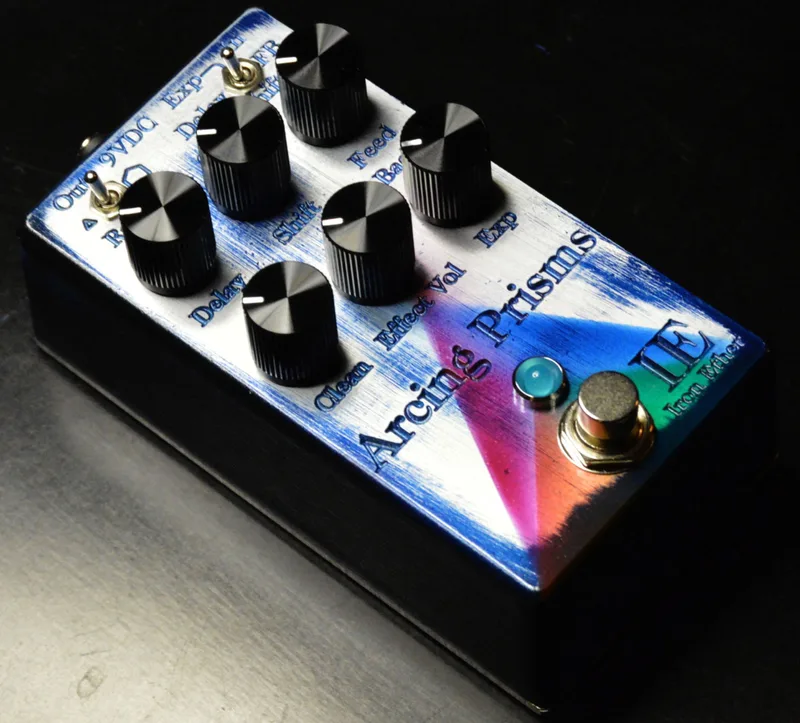


The Iron Ether Arcing Prisms is an analog pedal that combines a frequency shifter with a comb filter and delay line, locked together in a feedback loop1. The core idea is simple and unusual: the frequency shifter sits inside the feedback loop of the delay, so every time the sound repeats, it gets shifted again2. Instead of a delay that fades out unchanged, each repeat drifts further away from the original note.
Iron Ether's own way of describing the effect is a visual one. The maker explains the name as a picture of what a frequency shifter does to sound1:
"The name Arcing Prisms is my way of thinking about how a frequency shifter bends and spreads out the harmonic frequencies of a sound, similar to how a prism bends the different frequencies (colors) of light to turn white light into a rainbow."1
A frequency shifter inside a delay's feedback loop
A frequency shifter is not a pitch shifter. A pitch shifter transposes a sound by a musical interval, keeping the harmonic relationships of the original intact. A frequency shifter moves each harmonic by a fixed amount, so the spacing between harmonics changes and the timbre itself bends and spreads out. Iron Ether compares this to a prism splitting light into a rainbow1.
The Arcing Prisms places that shifter inside the feedback loop of a delay line, so each repeat is shifted again2. The maker describes the loop as a chain of prisms: "as the sound leaves one 'prism' it enters another and gets bent again, potentially over and over depending on the amount" of feedback1. With the Feedback knob low, the effect is a shifted echo that decays quickly. With it high, the sound can spiral, transformed on every pass through the loop.
Because the delay time and shift amount are both variable, the same circuit covers ground that players usually associate with several different delay, flanger and phaser pedals. Very short delay times with small shifts behave like flanging and phasing; longer times behave like a delay whose repeats never repeat153.
Controls
| Control | What it does |
|---|---|
| Shift | Frequency shift amount (range set by the Range switch) |
| Delay | Length of the delay line, from a few milliseconds up to around one second; turned all the way down it bypasses the delay line3 |
| Feedback | Amount of signal added from the delay output back to the frequency shifter input3 |
| Effect Vol | Volume of the frequency shifted and delayed signal3 |
| Exp | Amount of expression control added to the parameter selected by the Expression toggle; set to 0 when not using an expression pedal3 |
| Range switch | Sets the range of the Shift and Delay knobs3 |
| Expression switch | Routes expression pedal control to Delay time, frequency Shift amount, or Feedback amount3 |
Large hexagon and small triangle modes
The Range switch has two modes, marked with a large hexagon and a small triangle3.
- Large hexagon mode gives access to the full range of delay times, up to around one second, and the full frequency shifting range3.
- Small triangle mode limits the delay line to very short times and the shifting to only a small range around zero, keeping the effect in flanger and phaser territory3.
For a player who wants the pedal as a modulation box rather than a shifting delay, small triangle mode keeps the knobs usable across their whole travel instead of concentrating all the subtle settings at one end3.
Expression control
An expression pedal can be routed to delay time, frequency shift amount, or feedback, with an expression attenuator built in3. The Expression switch selects the target, and the Exp knob sets how much of the expression pedal's travel is added to that parameter3.
One extra use is built in: with no expression pedal connected, the Exp knob can extend the frequency shifting range higher when the Expression toggle is set to Shift3. Set it to 0 when the pedal is used without an expression pedal.
The related Super Arcing Prisms takes the same effects and adds foot-switch access to them. Iron Ether says an expression pedal on that pedal can control any of the main parameters, "sweeping from a flanger to delay, or phaser to frequency shifter," and describes results including "phasers that seem to shift forever up or down"5.
The engraved limited edition
The Arcing Prisms sold as an engraved and hand-painted edition, which Iron Ether describes as "a visual representation of that process," meaning the frequency shifting the pedal performs1. The related Super Arcing Prisms carries its graphics engraved three-dimensionally into the enclosure and hand-finished in three colors5.
Both pedals ship in 5 business days, Monday to Friday15.
Power and size
The pedal runs on an industry-standard 9 volt DC center-negative power supply and draws 85mA3. It measures 4.7" x 2.5" (12cm x 6.3cm), about the footprint of a standard compact pedal3.
The 85mA draw is higher than many analog pedals. On a small isolated power supply with limited per-output current, check that the output can deliver it before daisy chaining several digital or DSP-style pedals on the same line.
Videos
Ichabod Cranium
Ed Pettersen
Ichabod Cranium
Questions
Is the Iron Ether Arcing Prisms analog or digital?
It is an analog pedal. Iron Ether describes it as a frequency shifter and comb filter/delay line locked together in a feedback loop, and RockBoard's PedalPedia lists its circuit type as analog. It runs on a standard 9 volt DC center-negative supply.
What does a frequency shifter do compared with a pitch shifter?
A pitch shifter moves a whole sound up or down by a musical interval, keeping its harmonic relationships intact. A frequency shifter moves each harmonic by a fixed amount in cycles per second instead, so the spacing between harmonics changes and the timbre bends and spreads out. Iron Ether compares it to a prism bending light into a rainbow.
What is the difference between large hexagon and small triangle mode?
The Range switch sets the range of the Shift and Delay knobs. Large hexagon mode gives the full range of delay times, up to around one second, and the full frequency shifting range. Small triangle mode limits the delay line to very short times and the shifting to a small range around zero, which keeps the effect in flanger and phaser territory.
Can I control the Arcing Prisms with an expression pedal?
Yes. Expression control can be routed to delay time, frequency shift amount, or feedback, selected by the Expression switch, with an expression attenuator built in. The Exp knob sets how much expression control is added to the selected parameter, and should be set to 0 when no expression pedal is connected.
How much current does the Arcing Prisms draw?
It draws 85mA, running on an industry-standard 9 volt DC center-negative power supply. That is modest by digital standards but more than some analog pedals, so it is worth checking a power supply's per-output capacity.
Sources (5)
- Arcing Prisms, Iron Ether
- Arcing Prisms by Iron Ether, RockBoard PedalPedia, 2026
- Arcing Prisms, Iron Ether
- FMeron - Iron Ether, Iron Ether
- Super Arcing Prisms, Iron Ether