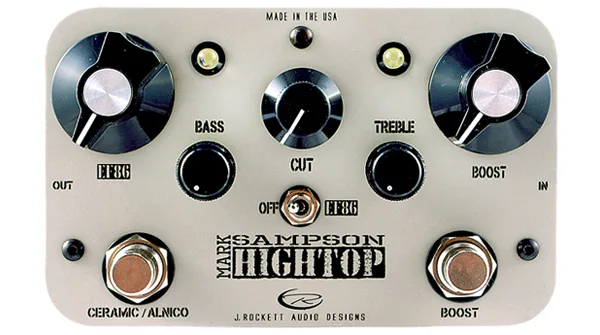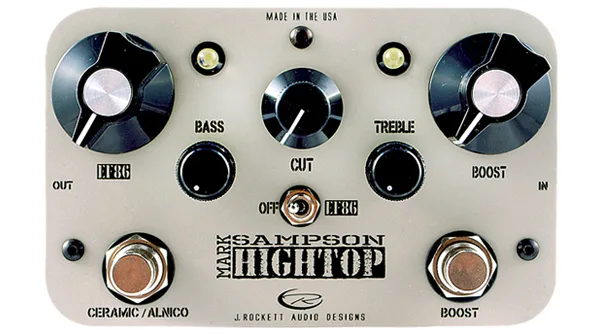


The J. Rockett Audio Designs Hightop Boost/EQ is an EQ/boost pedal built around a re-creation of the top boost sound that designer Mark Sampson is known for. The classic tone is captured using transistors instead of tubes, so the pedal delivers that voicing in a compact 9V format. It was announced in August 2013 as the first release in a collaboration between J. Rockett Audio Designs and Sampson12.
What it does
The Hightop operates, according to the announcement, "exactly like the beloved classic circuit, with separate bass and treble controls and a cut control"1. In other words, it is a two-band EQ and a boost in one box: you can shape the low and high end independently, trim the very top with the cut control, and then push the amp with roughly 15 dB of boost12.
The pedal also offers "the ability to introduce the sound of an EF86 tube sound"1. The EF86 is a preamp tube associated with certain classic British amp voicings, and here that character is produced by the transistor circuit rather than a real tube12.
Controls
The Hightop carries six controls12:
| Control | What it does |
|---|---|
| Bass | Bass EQ2 |
| Treble | Treble EQ2 |
| Cut | Trims out the extreme high-end frequencies2 |
| Boost | Sets the boost level, approximately 15 dB available12 |
| EF86 intensity | Sets the amount of the EF86 tube-style voicing2 |
| EF86 selector switch | Selects the EF86 voicing2 |
There is also a footswitch to select the sound of a ceramic magnet or an Alnico magnet speaker voicing, a detail Sampson added to the design2.
Power and size
The pedal runs on 9V DC with a standard 9V input sleeve, so it fits a normal pedalboard power setup1. It measures approximately 5" x 3"2.
Guitar Interactive Magazine noted that the Hightop is a pedal "in contrast to most EQ foot pedals," pointing to its compact footprint of approximately 5" x 3"2.
Where it came from
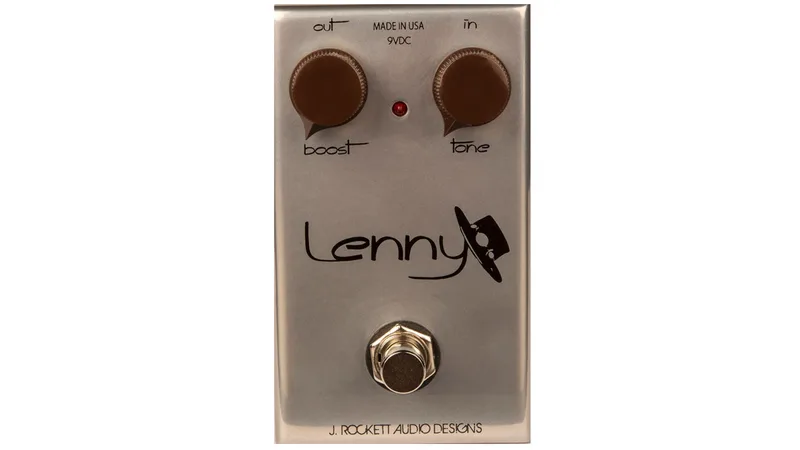
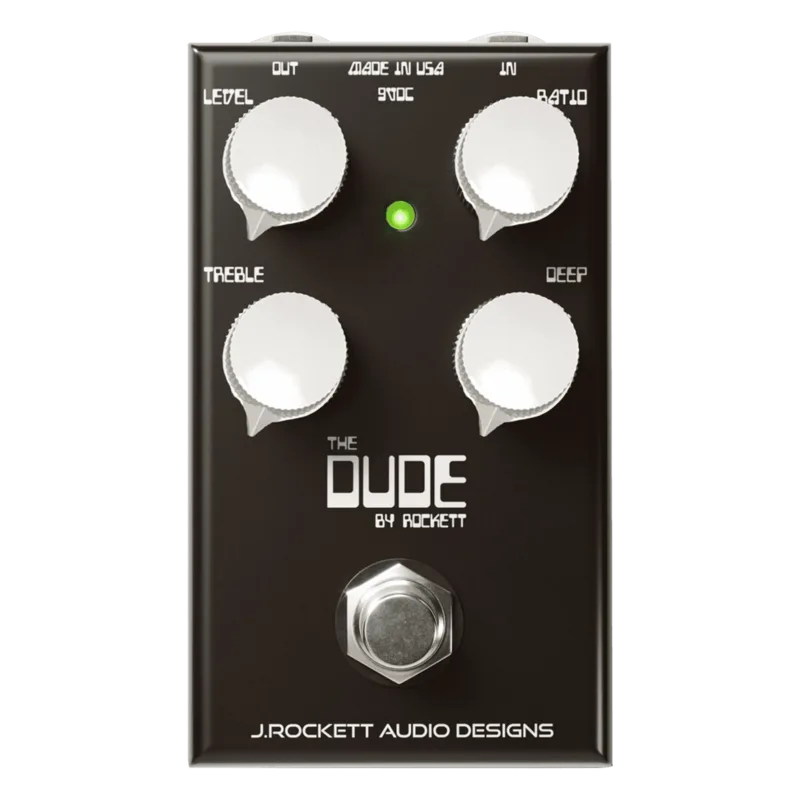
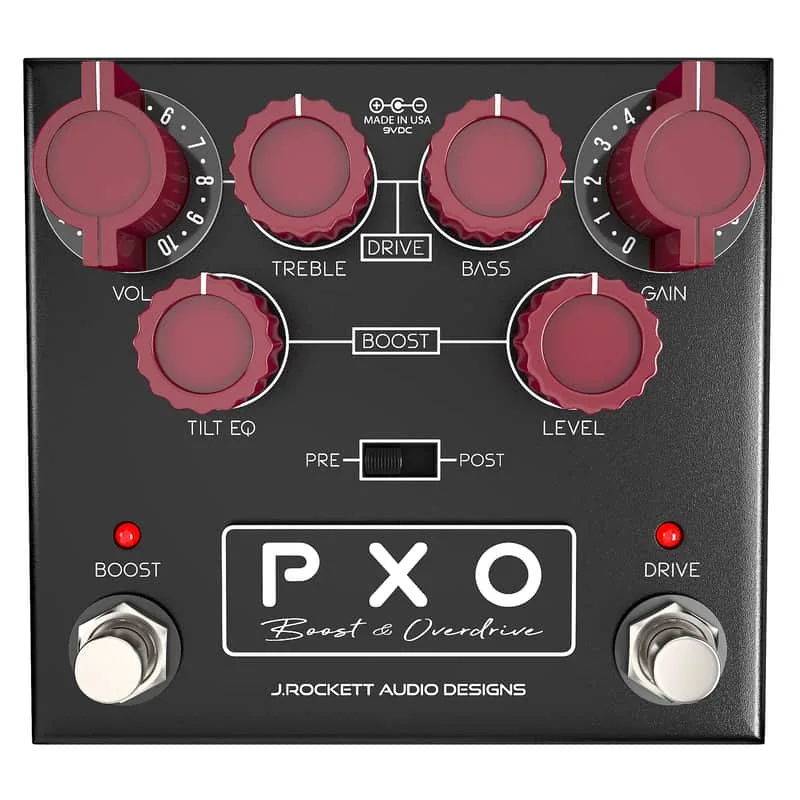
The Hightop was announced in August 2013 as the beginning of a collaboration between J. Rockett Audio Designs and Mark Sampson. As Premier Guitar reported, "The collaboration begins with the release of the J. Rocket Audio Designs Hightop Boost/EQ"1. Sampson has since put his name to other pedals in the J. Rockett range, and the maker's catalog includes boost and overdrive designs such as the Lenny Color Boost, the Dude and the PXO.
For players comparing it within the wider category, the Hightop sits among boost pedals and equalization pedals, combining both functions in one enclosure21.
Videos
J. Rockett Audio Designs
Prymaxe
Questions
Is the J. Rockett Hightop Boost/EQ true bypass?
Yes. The Hightop Boost/EQ uses true bypass switching, so when the pedal is off, your guitar's signal passes through without the circuit loading it. That matters on a pedalboard where the pedal sits between the guitar and the amp even when it is not being used.
Does the Hightop Boost/EQ use tubes?
No. Although the pedal is designed to re-create a classic top boost sound and can introduce the character of an EF86 tube, it does that with transistors rather than actual tubes. It runs on 9V DC, so there is no heater or high-plate-voltage supply to worry about.
What does the EF86 control do on the Hightop Boost/EQ?
The EF86 section lets the pedal introduce the sound of an EF86 tube, a preamp tube associated with certain classic British amps. It is set with an EF86 intensity knob and an EF86 selector switch, and a footswitch selects between a ceramic magnet or an Alnico magnet voicing.
What does the cut knob do on the Hightop Boost/EQ?
The cut control trims out the extreme high-end frequencies. It works alongside the separate bass and treble controls, letting you take the edge off the top without reshaping the whole EQ curve.
What power supply does the Hightop Boost/EQ need?
The Hightop Boost/EQ operates on 9V DC with a standard 9V input sleeve, so it works with a typical pedalboard power supply. No tube heaters or unusual voltages are involved, since the circuit is transistor based.
How much boost does the Hightop Boost/EQ give?
The pedal provides approximately 15 dB of boost, set with its boost knob. That is enough to push an amp's front end or lift a solo above a band mix, with the bass, treble and cut controls shaping the boosted tone.
Sources (2)
- J. Rockett & Mark Sampson Launch Hightop Boost/EQ, Premier Guitar, 2013-08-15
- J.Rockett Audio Designs & Mark Sampson Announce Hightop Boost/EQ, Guitar Interactive Magazine, 2013-08-16