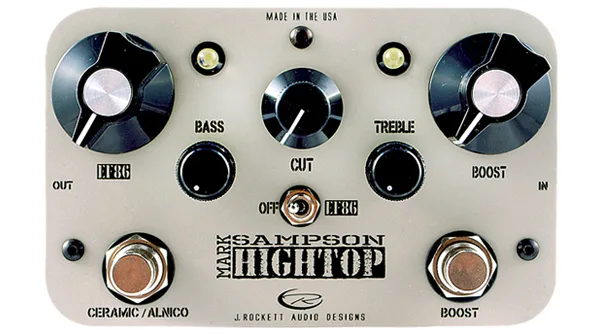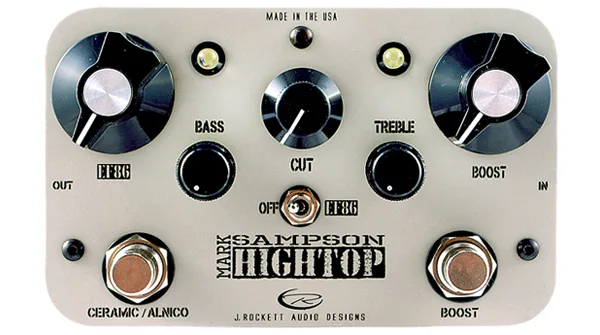


The J. Rockett Hightop Boost/EQ is an EQ and boost pedal from J. Rockett Audio Designs, designed in collaboration with Mark Sampson. Announced in August 2013, it is a re-creation of the top boost sound Sampson is known for, with the classic tone captured using transistors instead of tubes. Premier Guitar's announcement described the pedal as operating "exactly like the beloved classic circuit, with separate bass and treble controls and a cut control that helps trim out the extreme high-end frequencies"1.
A transistor re-creation of a classic boost sound
The Hightop's premise is simple: take the top boost sound associated with Sampson's work and build it with transistors rather than the tubes the original circuits relied on. Guitar Interactive Magazine's Jonathan Graham wrote that "Sampson has put his magic touch on a new series of pedals for J. Rockett Audio Designs," with the Hightop as the first release from that collaboration1.
The pedal is an EQ and boost in one box, described by J. Rockett Audio Designs as operating "exactly like the beloved classic circuit"2. In contrast to most EQ foot pedals, it adds a footswitch that selects the sound of a ceramic magnet or an Alnico magnet, a detail Sampson is credited with including1.
The controls: six knobs and switches
The Hightop's control set goes beyond a simple boost pedal's volume knob:
| Control | What it does |
|---|---|
| Boost | Sets the boost level, up to approximately 15 dB1 |
| Bass | Bass EQ control2 |
| Treble | Treble EQ control2 |
| Cut | Trims out the extreme high-end frequencies1 |
| EF86 intensity | Knob controlling the EF86 section's intensity2 |
| EF86 selector switch | Selects the EF86 section2 |
Two details are worth knowing before you dial it in:
- The unity setting for the bass and treble EQ controls is all the way to the left, not centered as on many EQ pedals1.
- Premier Guitar's release notes that "the magical mids can be found within the interaction of the bass and treble knobs," meaning the midrange is shaped indirectly through those two controls rather than by a dedicated mid knob1.
Sampson also included a footswitch to select the sound of a ceramic magnet or an Alnico magnet speaker, adding a further voicing option beyond the knobs1.
Power, bypass and size
The Hightop includes a footswitch to select the sound of a ceramic magnet or an Alnico magnet, alongside its main switching1. It carries a US street price of $2691.
The published specifications list 9V DC operation but no current draw figure, so check your power supply's per-output budget as you would for any pedal without a published draw.
Where it sits in J. Rockett's range
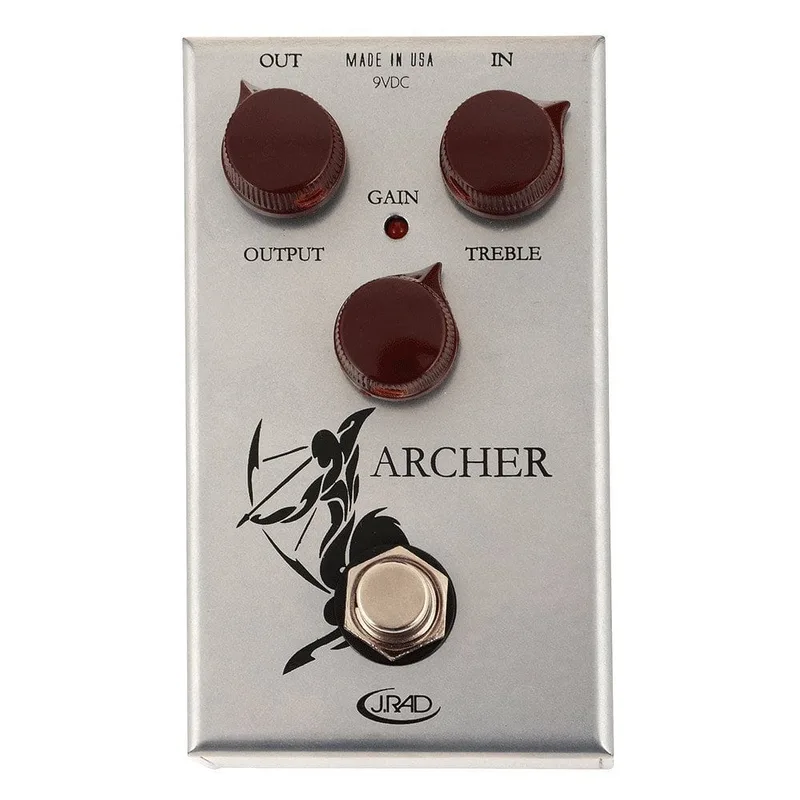
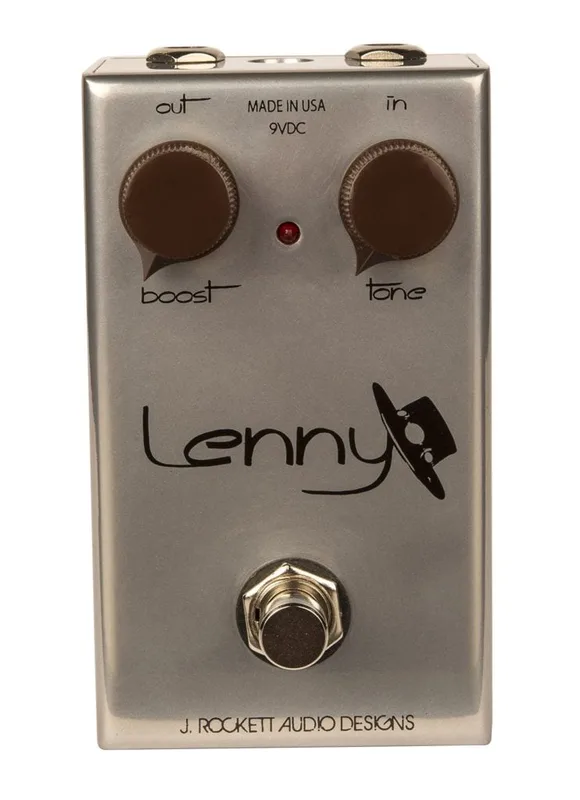
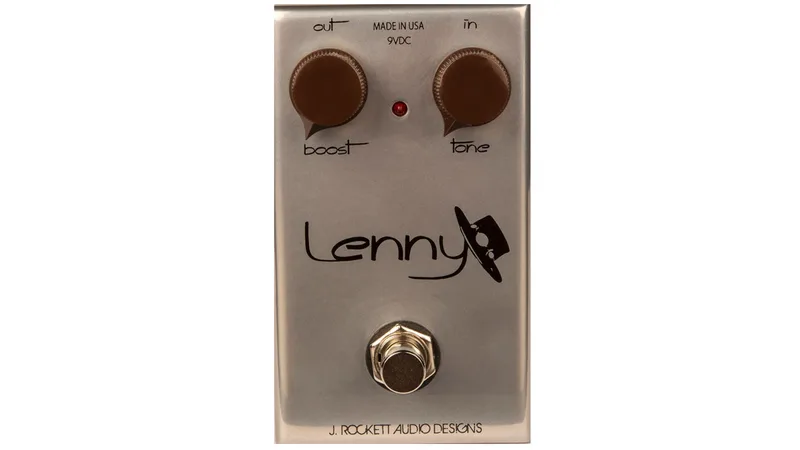
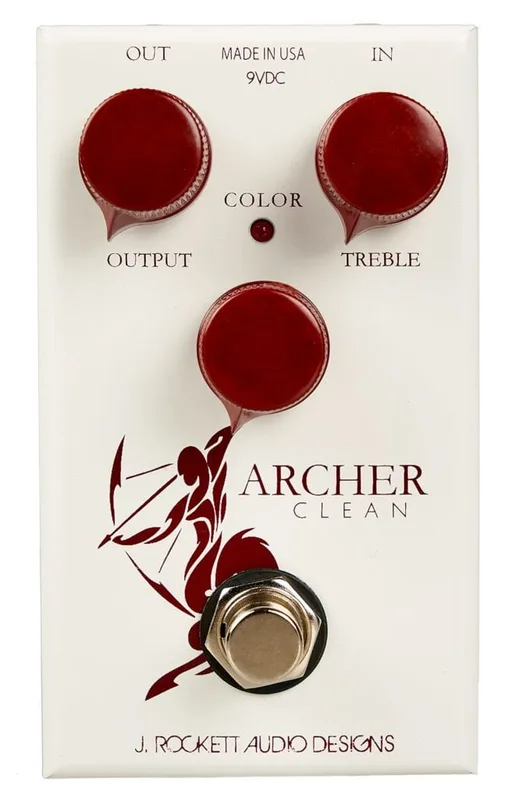
The Hightop was the first release from the Sampson collaboration1. J. Rockett's wider lineup includes other boost-adjacent designs, such as the J. Rockett Archer overdrive/boost and the J. Rockett Lenny from the Tour Series, though the Hightop's transistor-based top boost approach and EF86 section set it apart from those circuits1.
Videos
J. Rockett Audio Designs
Prymaxe
musictoyznetwork rasch
Questions
Is the J. Rockett Hightop Boost/EQ true bypass?
Yes. The Hightop Boost/EQ uses true bypass switching, so when the pedal is off, your guitar's signal passes through without the circuit loading it. Both Premier Guitar's press release and Guitar Interactive Magazine list true bypass switching among the pedal's core specifications, alongside its 9V DC operation.
How much boost does the Hightop Boost/EQ give?
The Hightop provides approximately 15 dB of boost, according to the press material announcing the pedal. That boost works alongside separate bass and treble EQ controls and a cut control, so you can shape the boosted signal rather than simply raising its level.
What does the cut control do on the Hightop?
The cut control trims out the extreme high-end frequencies. It sits alongside the separate bass and treble controls, letting you take the edge off a boosted top end without darkening the whole signal, which is useful when stacking the Hightop into an already bright amp or drive pedal.
What power does the J. Rockett Hightop Boost/EQ need?
The Hightop runs on 9V DC with a standard 9V input sleeve, so it works with a typical pedalboard power supply. The published specifications do not list a current draw figure or battery operation, so a regulated 9V DC center-negative supply is the safe assumption for board planning.
How big is the J. Rockett Hightop Boost/EQ?
The Hightop measures approximately 5 inches by 3 inches, according to the announcement coverage. That is a compact footprint for a pedal with six controls, though it is larger than many single-knob boost pedals because of the extra EQ and EF86 sections.
Sources (2)
- J. Rockett & Mark Sampson Launch Hightop Boost/EQ, Premier Guitar, 2013-08-15
- J.Rockett Audio Designs & Mark Sampson Announce Hightop Boost/EQ, Guitar Interactive Magazine, 2013-08-16