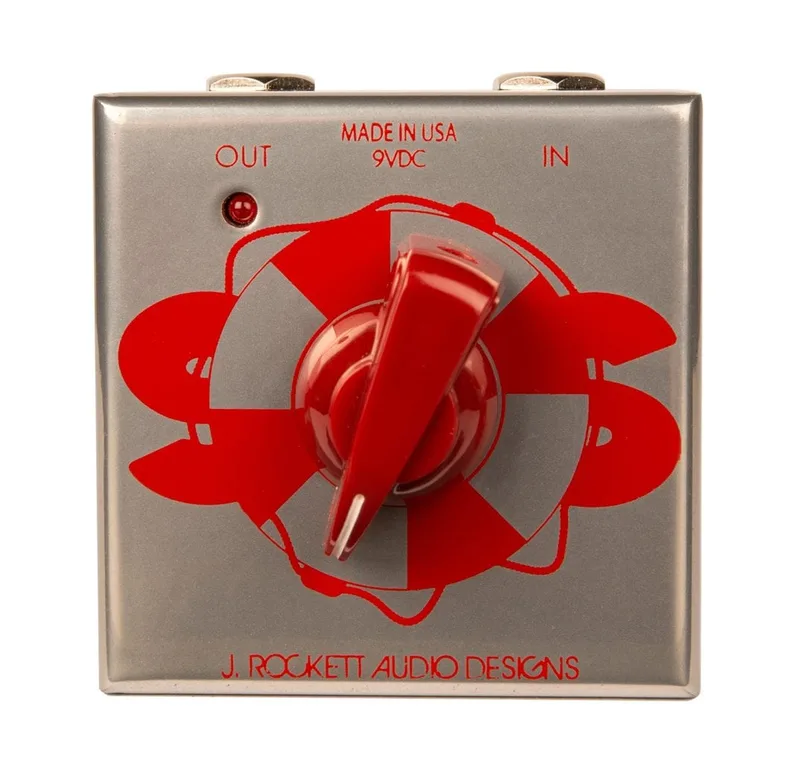


The J. Rockett SOS, from J Rockett, is a compact buffer pedal added to the company's Tour Series range in October 20161. The name stands for "Save Our Signal," and the pedal has one job: to keep your guitar's signal intact as it travels through a pedalboard and down long cables1.
A buffer addresses a practical problem. Long cable lengths and many pedals in a chain can load down a guitar's signal and dull the top end. The SOS Buffer is designed to balance impedance issues on a pedalboard and lets you add some treble back when driving longer cable runs1. Gearnews described it as a "fix it" pedal that should not color your tone in any unwanted way1.
A buffer for big boards and long cable runs
The SOS Buffer is aimed at players with larger pedalboards or longer guitar cable lengths, where signal loss shows up as a dull, lifeless top end1. It sits in the signal chain as a "set and forget" box: plug it in, set the knob, and leave it1.
The single knob on the front adjusts the amount of subtle high frequencies added back into your signal1. That makes it more than a straight buffer: if your cables have already eaten some treble, you can dial a little brightness back in rather than just locking in a flat response.
| Control | What it does |
|---|---|
| Knob | Adjusts the amount of subtle high frequencies added back into the signal1 |
The enclosure is what Gearnews called a "dinky sized, minute unit" that should fit easily on a pedalboard1, roughly 2.65 by 2.65 inches3. An LED on the unit shows it is working1.
"This dinky sized unit has one job: to keep your guitar's signal intact."
Power and connections
The SOS Buffer runs on 9V DC with a standard power supply, using a negative tip and positive sleeve connector31. There is no battery option; it powers directly from a 9V power input2.
The SOS Buffer uses a 9V DC input with center-negative-style wiring (negative tip, positive sleeve)3, so it needs a spot on a standard pedalboard power supply rather than a battery.
Both the input and output jacks are top-mounted1. Top-mounted jacks save horizontal space on a board, since cables run up and away rather than out the sides, which suits the pedal's small footprint.
Price and availability
At launch in October 2016, the SOS Buffer was available now at $79 in the US2. Premier Guitar's press release gave it a $79 street price3, and in the UK it carried a £75 RRP1.
Videos
Premier Guitar
Dzika Astronomia
Questions
What does the knob on the J Rockett SOS Buffer do?
The single front-panel knob adjusts the amount of subtle high frequencies added back into your signal1. Since long cable runs and large pedalboards can roll off treble, the knob lets you dial in how much brightness is restored.
Does the J Rockett SOS Buffer take a battery?
No. It powers from a 9V power input only, running on a standard 9V DC supply with negative tip and positive sleeve23.
What is the J Rockett SOS Buffer's list price in the US?
It launched at $79 in the US in October 2016, described both as an available-now price and a street price23. In the UK it carried a £75 RRP1.
Which J Rockett series is the SOS Buffer part of?
It sits in J Rockett Audio Designs' Tour Series range of guitar effects pedals1.
Where are the jacks on the SOS Buffer?
Both input and output jacks are top-mounted, along with an LED showing the pedal is working1.
Sources (3)
- J Rockett's SOS Buffer pedal aims to rescue your tone, gearnews.com, 2016-10-09
- J Rockett Audio Designs wants to rescue your tone with its SOS Buffer pedal, MusicRadar, 2016-10-07
- J. Rockett Audio Designs Releases the SOS Buffer, Premier Guitar, 2016-10-07