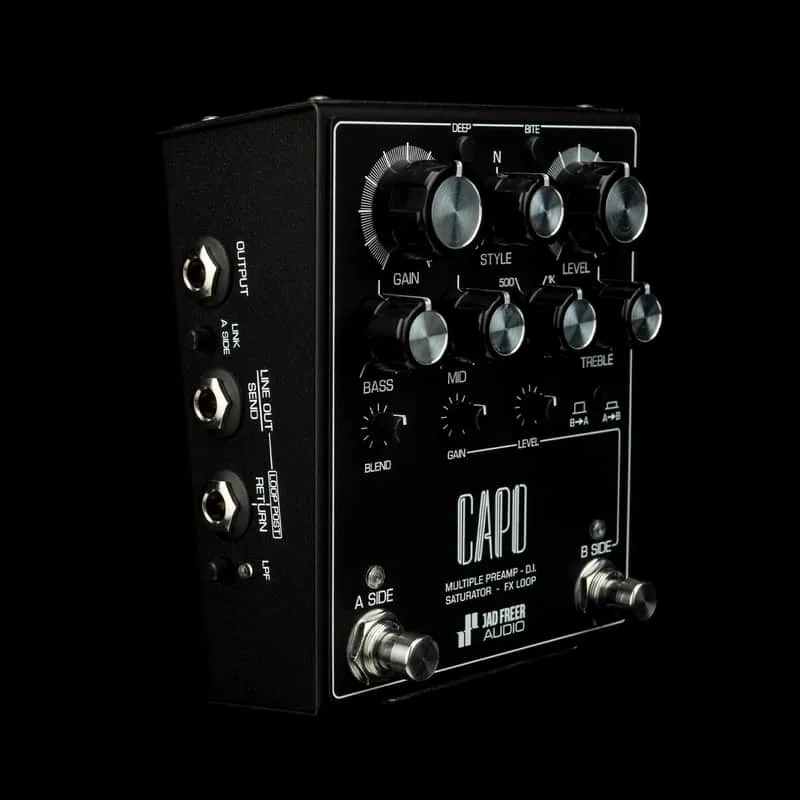


The Jad Freer Audio CAPO is a preamp pedal for bass that puts four different preamps in a single box, in a format the maker describes as pedalboard friendly and "a real studio-in-a-box"1. It is organized into two sides, A and B, each with its own footswitch, and both sides can be used at once. The A Side combines a clean high-impedance preamp with two saturators, J and F, that can be mixed in parallel; the B Side is a FET preamp reminiscent of classic tube designs1. Around the preamps sit a three-band EQ, two send-return loops, a low pass filter and balanced outputs, which makes the CAPO as much a small studio front end as a bass pedal.
Bass Magazine's reviewer, Jonathan Herrera, framed what the pedal fundamentally does: "It's essentially a preamp, meaning it buffers an incoming instrument-level signal and boosts it to line level"2. Bass Musician Magazine has called it "the company's flagship CAPO preamp" and noted that products like it have established Jad Freer Audio's credentials among discerning bassists3.
What it does: four bass preamps in one pedal
The CAPO's core is its A Side, which the maker describes as "based on three very different preamps that can be used in parallel": a clean high-impedance preamp with fixed gain and lots of headroom, plus the two saturators, J and F, mixed into that clean signal with the BLEND control1. The maker says the range runs "from studio-grade clean sounds up to heavy saturations, passing through endless overdrive flavors with amp-like dynamics"1. The B Side adds a fourth preamp, and the two footswitches control which side is active, with both usable simultaneously2.
What sets the CAPO apart from most overdrive and distortion pedals is how it generates its dirt. Bass Magazine's reviewer put it plainly: "The Capo gets its dirty sounds from pure preamp saturation, not clipping diodes, so the gain control has a major impact" on the character2. Jad Freer Audio confirms the design choice: "No clipping diodes are used in both saturators, providing a dynamic feeling comparable to a real amplifier"1.
A Side: clean preamp with the J and F saturators
The A Side is where most of the tonal shaping happens. The clean preamp provides the high-headroom foundation, and the two saturators sit alongside it in parallel1.
| Control | What it does |
|---|---|
| BLEND | Mixes the J and F saturators into the clean preamp1 |
| STYLE | Changes the mix ratio between J and F; central position N is the neutral balance1 |
| GAIN and LEVEL | Shared by the J and F saturators; both have a lot of clean headroom before saturation1 |
| BASS | ±12dB at 80Hz, shelving1 |
| Semi-parametric MID | ±9dB, 100Hz to 10KHz, band pass1 |
The two saturators have distinct voices. The maker describes the J Saturator as having "huge bottom, aggressive highs that brings the note attack upfront in the mix," and the F Saturator as "sound focused on mid frequencies, more vintage inspired"1. Herrera heard the same split: "The J circuit has big lows and forward highs, sort of a 'scooped' vibe, while F is much more midrange focused"2. Of the neutral STYLE position he wrote that "it captures the best of both worlds, offering a full-spectrum grit that is super-responsive to the position of the gain" knob, like a tube amp2.
B Side: a FET tube-style preamp
Side B is, in the maker's words, "a linear response FET preamp with dedicated volume and gain controls," reminiscent of some classic tube preamps, with a dynamic range that runs from clean to various saturation stages1. Herrera described it as "another saturated circuit, designed to emulate the sound of an overdriven amp," and found "It has a very tube-y character, somewhat like an old Fender Bassman pushed hard"2.
The B Side can run in two relationships to the A Side1:
- Stand-alone: as an alternative preamp to the A Side, its own sound at the press of its footswitch.
- In series with the A Side: the order is set with the PRE / POST switch. In the POST position, the maker says, the B Side works "either as a simple volume boost available at your feet, or as a preamp base to build your own sound"1.
Loops, outputs and the low pass filter
Beyond the preamps, the CAPO carries the routing features that make it a studio-in-a-box. With both sides switched off, Herrera noted, "the Capo simply behaves like a clean buffer, rendering the controls inoperable"2.
- LOOP PRE: a passive send-return loop before the pedal's preamps, for pedals you want to use before the CAPO while keeping the DIRECT OUT unprocessed1.
- LOOP POST: a send-return loop after all the CAPO preamps, affecting both PREAMP OUT and OUTPUT; it can be always active or linked to the A Side with the LOOP LINK switch1.
- DIRECT OUT: the natural sound of your instrument without any preamp stage1.
- PREAMP OUT: a balanced signal after all the pedal preamps, EQ and loops1.
- LPF: a low pass filter, a treble cut, designed to remove harsh frequencies at high gain levels and useful with full-range sound systems. It affects both PREAMP OUT and OUTPUT, stays on even when the pedal is bypassed, and lets the CAPO work as a cabinet simulator for drive and fuzz pedals1.
The Tim Lefebvre Edition
Jad Freer Audio also offers the CAPO Tim Lefebvre Edition, a special version built around a routing option Tim Lefebvre himself requested: "the ability to effortlessly switch two different sounds out of the DIs"4. The maker describes it as "a powerful preamp and D.I. capable of studio-grade clean sounds, harmonic saturations" and more, with "three different preamps wired in parallel, two XLR balanced outputs and endless routing possibilities" in a pedalboard-friendly format4. Its channels are listed as LOOP and PREAMP4.
What reviewers said
Published reaction to the CAPO has been positive. Bass Musician Magazine's Cláudio Ribeiro wrote that products like the CAPO have "established the company's credentials among discerning bassists"3. The reviewer found it "a phenomenal piece of gear, especially for those seeking harmonically rich, saturated sounds," and of the EQ wrote:
"I've found that the Capo is a phenomenal piece of gear, especially for those seeking harmonically rich, saturated sounds"2
"The EQ is musical, sweet, and well voiced."2
His one reservation was the price: "If you have the money (it ain't cheap at about $600)"2.
Who plays one
Rob Mullarkey keeps a CAPO at the end of his signal chain for Jacob Collier. In his own words on his Jad Freer Audio artist page: "The Capo is currently the final stop on my pedalboard for Jacob Collier"5. Tim Lefebvre's involvement goes further than an endorsement, since the Tim Lefebvre Edition exists because he asked for its routing option4.
Videos
JAD FREER AUDIO
JAD FREER AUDIO
JAD FREER AUDIO
Questions
Does the Jad Freer CAPO use clipping diodes?
No. Jad Freer Audio states that no clipping diodes are used in either of the J and F saturators, and Bass Magazine's reviewer noted the dirty sounds come from pure preamp saturation instead. The result is a dynamic feel comparable to a real amplifier, where the gain control has a major impact on the character.
What does the CAPO do with both sides off?
With both the A Side and B Side switched off, the CAPO behaves like a clean buffer, and the controls become inoperable, as Bass Magazine's reviewer described. The signal still passes through, and the low pass filter can remain active on the outputs even when the pedal is bypassed, if its switch is on.
How long is the wait for a Jad Freer Audio CAPO?
Jad Freer Audio lists a delivery time of 20 weeks from order for the CAPO. The pedal is built to order rather than stocked, so players planning a pedalboard around it should factor that lead time in.
How much does the Jad Freer CAPO cost in the US?
Jad Freer Audio lists the CAPO at 549,00 € on its product page, and the Tim Lefebvre Edition at the same price. Bass Magazine put the street price at about $600 in its September 2024 review, the only US dollar figure published.
Who uses the Jad Freer Audio CAPO?
Rob Mullarkey uses the CAPO as the final stop on his pedalboard for Jacob Collier, according to his artist page on the Jad Freer Audio site. Tim Lefebvre has his own edition of the pedal, the CAPO Tim Lefebvre Edition, built around a routing option he requested.
Sources (5)
- CAPO - Multiple Preamp | Jad Freer Audio, Jad Freer Audio
- Review: Jad Freer Audio Sisma Head & Capo Multi-Preamp Pedal, Bass Magazine, 2024-09-04
- Review: Jad Freer SARTO Compact Bass Preamp, Bass Musician Magazine, 2026-08-03
- CAPO - Tim Lefebvre Edition | Jad Freer Audio, Jad Freer Audio
- Rob Mullarkey, Jad Freer Audio