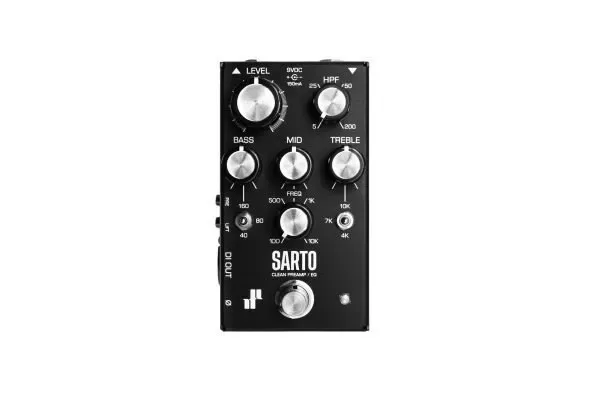

The Jad Freer SARTO is a clean preamp and EQ pedal with a studio-grade DI output, made by the Italian manufacturer Jad Freer Audio. The company describes it as a "studio-quality preamp and DI pedal designed for any musical instrument that requires precise clean tone shaping"1. Bass Musician Magazine reviewed it in August 2026 as a compact bass preamp, noting that it preserves the natural voice of the instrument while providing tone shaping and professional connectivity2.
The name comes from the Italian word for tailor, and the design follows the same idea: the pedal is built to fit the instrument's sound rather than change it. Jad Freer Audio says the SARTO's "pristine transparency and surgical precision make it the perfect match for character-rich D.I. boxes"1.
What it does and where it came from
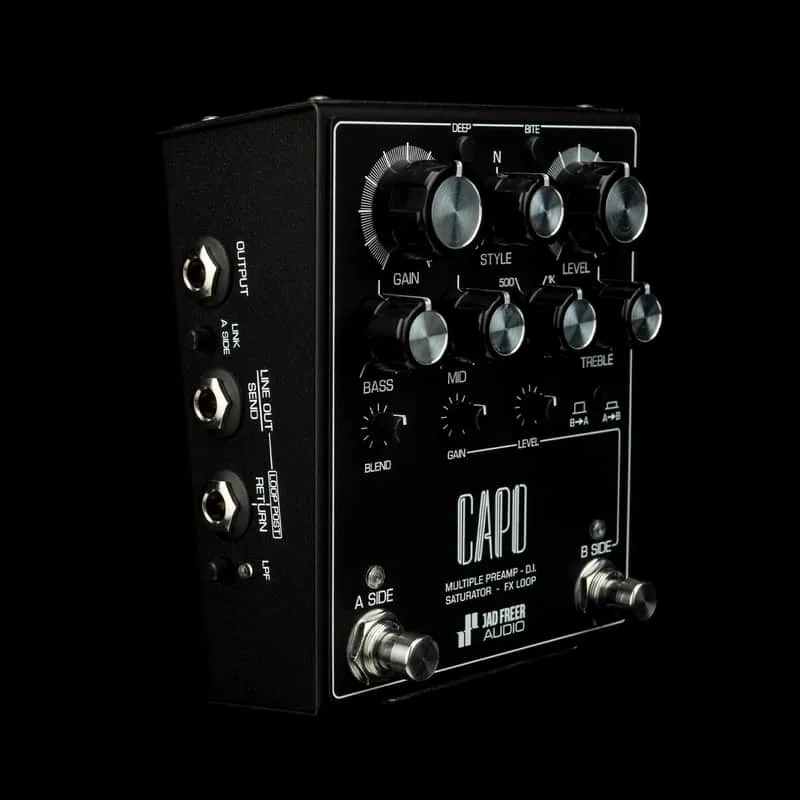
The SARTO is built around the clean preamp circuit Jad Freer Audio developed for the CAPO1. It comes in a compact pedal format with top-mounted jacks and power1, and its expanded tone shaping features selectable shelving frequencies for both the Bass and Treble controls1.
In use, the review found the preamp stays out of the way of the instrument. Ribeiro wrote2:
"In practical use, the preamp remains remarkably neutral. Rather than introducing additional compression or tonal coloration"2
That neutrality is the point of the design: where an overdrive or fuzz pedal reshapes the signal, a clean preamp like the SARTO conditions it, giving level, EQ and a balanced output for the desk without adding gain-stage character. For bassists comparing options, it sits at the transparent end of the bass pedal spectrum21.
Controls and features
The SARTO's tone shaping centers on Bass and Treble controls with selectable shelving frequencies, so the player can move where each shelf begins to suit the instrument, cabinet or room12. The maker also lists selectable EQ filtering and a phase-inversion button among the core features1.
| Feature | What it does |
|---|---|
| Bass and Treble controls | Shelving EQ with selectable shelving frequencies for each band1 |
| High-pass filter | Resonant, adjustable from 5 Hz to 200 Hz1 |
| Phase inversion | Button that inverts polarity1 |
| DI output | Balanced XLR with ground lift and pre/post EQ selection12 |
Bass Musician Magazine highlighted the filter in particular: "Among the SARTO's most valuable features is its integrated 12 dB/octave high-pass filter" with selectable cutoff frequencies2. For bass players, a high-pass filter removes subsonic rumble before it reaches the amp or PA, tightening the low end without touching the playable part of the range.
Connectivity and power
The pedal uses a compact format with top-mounted jacks and power, which the review found maximizes pedalboard efficiency12. The enclosure is described as solidly built with a clean layout2.
Power comes from a 9 VDC supply drawing 150 mA1.
At 150 mA, the SARTO draws more current than many compact analog pedals. Players using a daisy-chain supply should check that their power unit can deliver this on one output.
Input impedance
Jad Freer Audio lists the input impedance as 10 MOhm, an ultra-high figure that preserves the instrument's natural voice, particularly with piezo pickups on upright bass1. Bass Musician Magazine instead describes "a 10 ohm input impedance" as one of the pedal's defining specifications2. The two sources disagree on the figure, and the maker's specification page is the authoritative one for the number.
Upright bass and players
The SARTO's design suits acoustic and upright bass. Bassist Logan Kane is quoted on the maker's product page12:
"Sarto has improved my amplified sound on the upright bass so much that I now bring it to every gig I play."1
The SARTO's bass and treble controls feature selectable shelving frequencies, which Bass Musician Magazine's reviewer noted allow the player to tailor the equalization to the instrument, cabinet or room2. That adjustability is what lets one preamp serve different basses and setups.
What reviewers said
Bass Musician Magazine's review of the SARTO, by Cláudio Ribeiro, described the compact enclosure as solidly built, with top-mounted connections that maximize pedalboard efficiency2. The reviewer also highlighted the bass and treble controls' selectable shelving frequencies, which allow the equalization to be tailored to the instrument, cabinet or room2.
Videos
Bass Gear Demos by Dawghouse
Questions
What does SARTO mean?
SARTO is the Italian word for tailor. The name fits the pedal's purpose: it is designed to shape and refine an instrument's clean tone rather than add color, tailoring the sound to the instrument, cabinet or room through its selectable EQ and filtering.
What is the input impedance of the Jad Freer SARTO?
Jad Freer Audio lists the SARTO's input impedance as 10 MOhm, an ultra-high figure that keeps the instrument's natural voice intact. The Bass Musician Magazine review describes it as a 10 ohm input impedance, so the two sources disagree on the figure.
Does the SARTO work with upright bass?
Yes. Bassist Logan Kane is quoted by Jad Freer Audio saying the SARTO improved his amplified upright bass sound so much that he brings it to every gig. The ultra-high input impedance and clean preamp stage suit piezo and acoustic pickups.
Does the SARTO have an XLR output?
Yes. The SARTO has a professional studio-grade DI output with a balanced XLR connection, along with ground lift, phase inversion and a pre/post EQ selection, giving it the connectivity expected from dedicated DI boxes.
Does the SARTO have a phase invert switch?
Yes. A phase-inversion button is one of the pedal's listed features, alongside the ultra-high input impedance and selectable EQ filtering. It is useful for correcting phase issues between amps, PA systems or multiple pickups.
Sources (2)
- SARTO - Clean Preamp / Eq | Jad Freer Audio, Jad Freer Audio
- Review: Jad Freer SARTO Compact Bass Preamp, Bass Musician Magazine, 2026-08-03