

The Keeley Bassist Limiting Amplifier, also sold as the Keeley Bassist Compressor, is a compressor pedal designed specifically for bass players, released by Keeley Electronics on October 17, 2014 at $1991. Robert Keeley, the company's founder and chief engineer, described the aim plainly: "we feel we have created a top-flight studio grade compressor for bass players"1. What sets it apart from most pedalboard compressors is its core component, a THAT Corporation 4320 "Analog Engine" integrated circuit, the kind of high fidelity chip normally found in studio rack compressors rather than stompboxes23.
For a bassist, that means a pedal that tames volume spikes, even out attack transients, and can push the output level up for a boost, all while leaving the low end of the instrument alone. Bass Musician Magazine's reviewer Eric Parsons found that it "doesn't add noticeable tonal coloration, loss of low end or unwanted sustain"3.
A studio-style compressor for bass
Keeley positioned the Bassist as studio compression in a pedal. The press release announcing it said the pedal "delivers studio quality compression for bass players in stomp box format," with "ultra-low noise and distortion, 1:1 to 1:infinity compression, and up to 30dB boost"1. The design uses "advanced VCAs and True-RMS detection coupled with ultra low noise op-amps," an approach Robert Keeley described as dbx-inspired circuitry1.
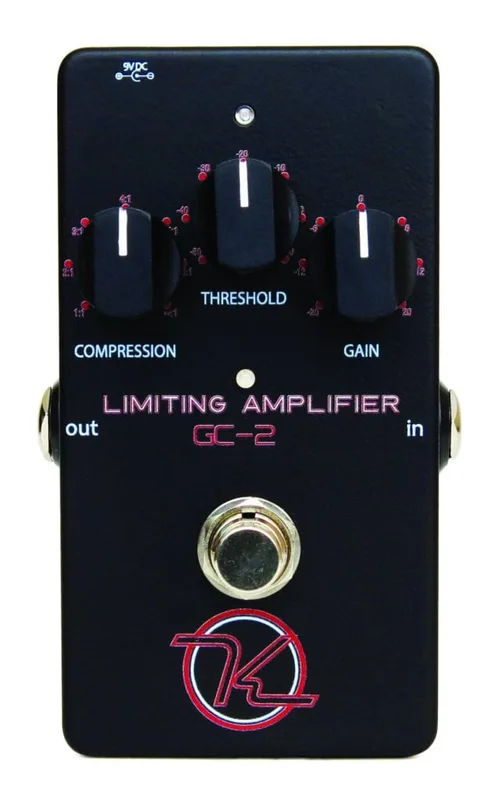
The heart of the pedal is the THAT Corp. 4320 "Analog Engine" integrated circuit2. THAT Corporation announced in December 2014 that Robert Keeley chose the THAT4320 for the Bassist Compressor and its guitar-focused sibling, the GC-2 Limiting Amplifier4. Bass Musician Magazine's reviewer explained what that chip means in practice: "This is a high fidelity integrated circuit that provides the electronics that you would normally find in a studio grade compressor, now small enough to fit in a stomp box"3.
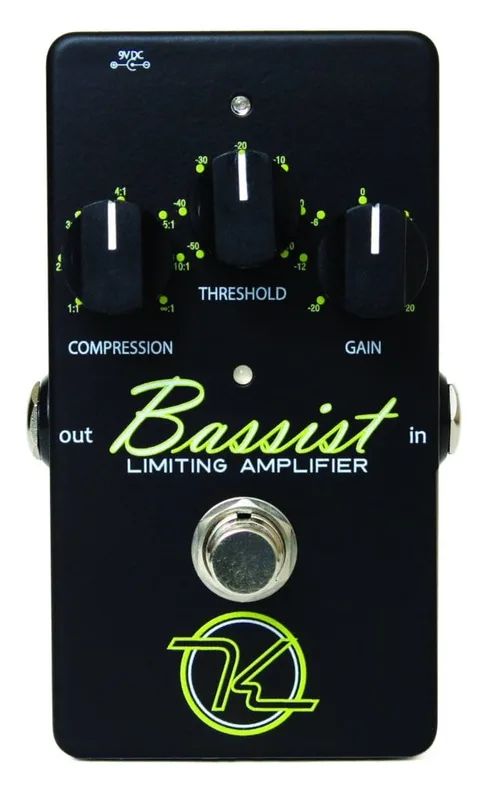
The pedal is hand-built in the USA, housed in a powder-coated and rugged enclosure, and carries a 2-year limited lifetime warranty1. Bass Musician Magazine described the box itself as "a sturdy metal stomp box with a black matte finish and attractive graphics"3.
Because the compression ratio goes all the way to infinity, the Bassist can serve as more than a compressor. At the infinity setting it functions as a limiter, and Parsons noted a practical use for bass players: "the limiter function will keep you from overdriving your speaker cabinet to distortion and/or damage"3. The gain control can also be turned up above unity to use the pedal as a boost3.
The controls
The Bassist keeps its control set to three knobs plus an indicator, which reviewers found quick to learn. Premier Guitar's reviewer summed it up as "Super easy to dial in. No noticeable tone coloration or sustain issues"2.
| Control | What it does |
|---|---|
| Compression | Sets the compression ratio, from 1:1 (no compression) to infinity (functions as a limiter)23 |
| Threshold | Sets the level at which compression kicks in; turn counterclockwise for compression to engage at lower levels3 |
| Gain | Adjusts output level; compensates for compression reduction, or turns up higher for a boost3 |
| Threshold indicator | Shows when the compressor is working5 |
The threshold control has a very wide range to help tame spikes in volume, and the gain control regulates volume between the pedal's engaged and off positions2. Parsons offered practical advice on setting the threshold: "The threshold control is basically set using your eyes and ears. Turn the threshold knob counterclockwise to have compression kick in at lower levels"3.
Two LEDs sit around the threshold knob: a green indicator below the dial shows the pedal is powered up, and a blue LED above the knob lights when the pedal is engaged via the true-bypass footswitch2. The single on/off stomp button handles the switching3.
Power and bypass
The Bassist runs on a 9 volt battery or a nine volt power supply, which is not included3. It uses true bypass switching, so the circuit drops out of the signal path entirely when the pedal is off1.
What reviewers said
Published reviews were positive. Premier Guitar's reviewer called it "Super easy to dial in. No noticeable tone coloration or sustain issues"2. Bass Musician Magazine's Eric Parsons found it "does not add noticeable tonal coloration, loss of low end or unwanted sustain," leaving the tone alone and focusing only on taming unwanted volume spikes3. In its launch coverage, Pro Sound Web reported that THAT Corp, whose 4320 chip the pedal is built on, ran it through the paces "saying it was a fantastic compressor and fun to play"12.
"It doesn't add noticeable tonal coloration, loss of low end or unwanted sustain."
Related pedals
The same THAT 4320 circuit appeared in the Keeley GC-2 Limiting Amplifier, announced in December 2014 as a guitar-focused companion to the Bassist4. The Bassist itself is also documented on the site as the Keeley Bassist Compressor, the name under which it was originally released4. Players comparing it against other options can start with the site's coverage of bass pedals and compressor pedals generally.
Videos
Premier Guitar
Premier Guitar
Mike Hermans
Questions
Does the Keeley Bassist work on guitar?
Yes. Keeley's own press material describes the Bassist as delivering studio quality compression for bass and guitar players in stompbox format, so it is not limited to bass. The same THAT 4320 circuit also appeared in Keeley's GC-2 Limiting Amplifier, a pedal marketed at guitar players.
Is the Keeley Bassist Compressor true bypass?
Yes. The pedal includes true bypass switching, so with the footswitch off your signal passes through without the circuit. A blue LED above the threshold knob lights up when the pedal is engaged.
Is the Keeley Bassist based on a dbx compressor?
Not directly, but the design is dbx-inspired. Keeley described using dbx-inspired circuitry built around advanced VCAs and True-RMS detection with ultra low noise op-amps. The core of the pedal is the THAT Corporation 4320 Analog Engine integrated circuit.
Where is the Keeley Bassist made?
The Bassist Compressor is hand-built in the USA by Keeley Electronics, using what the company described as the finest components and construction techniques. Keeley pedals are 100% hand-built.
What compression ratio does the Keeley Bassist go up to?
The compression control ranges from 1:1, which is no compression at all, to infinity, where the pedal functions as a limiter. At the infinity setting it can act as a hard-knee limiter to protect a speaker cabinet from overdriving into distortion or damage.
Does the Keeley Bassist take a 9V battery?
Yes. The compressor is powered by a 9 volt battery or by a nine volt power supply, which is not provided with the pedal. Either option runs the same circuit.
Sources (5)
- Keeley Electronics Releases the Bassist Compressor, Premier Guitar, 2014-10-17
- Keeley Bassist Compressor Review, Premier Guitar, 2015-04-07
- Keeley Bassist Compressor Review, Bass Musician Magazine, 2015-01-08
- Keeley Selects THAT4320, THAT Corporation, 2014-12-30
- Keeley Electronics Launches Bassist Compressor Pedal, Vintage Guitar magazine, 2014-10-17