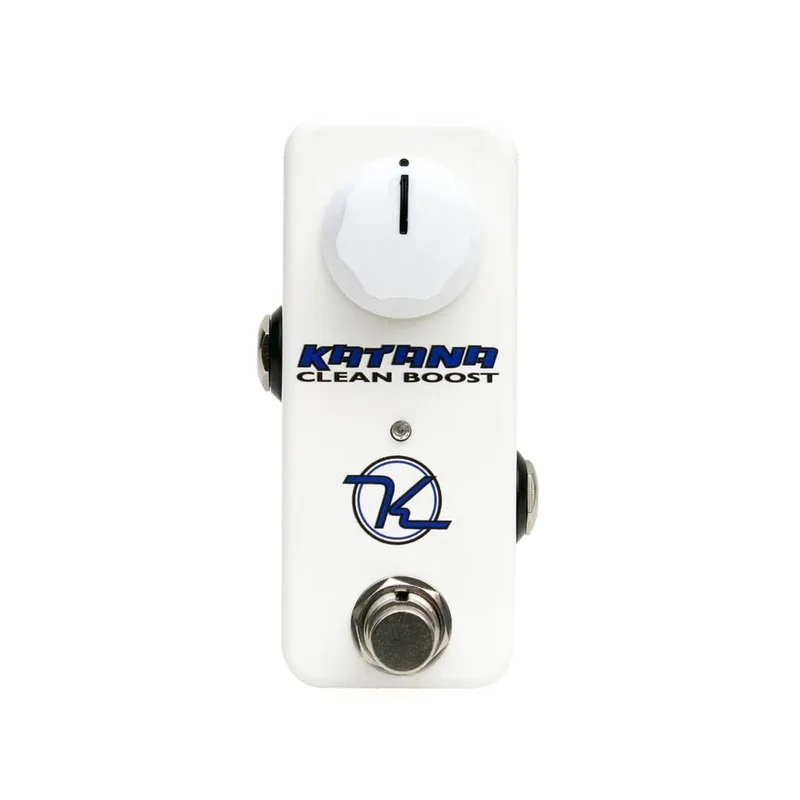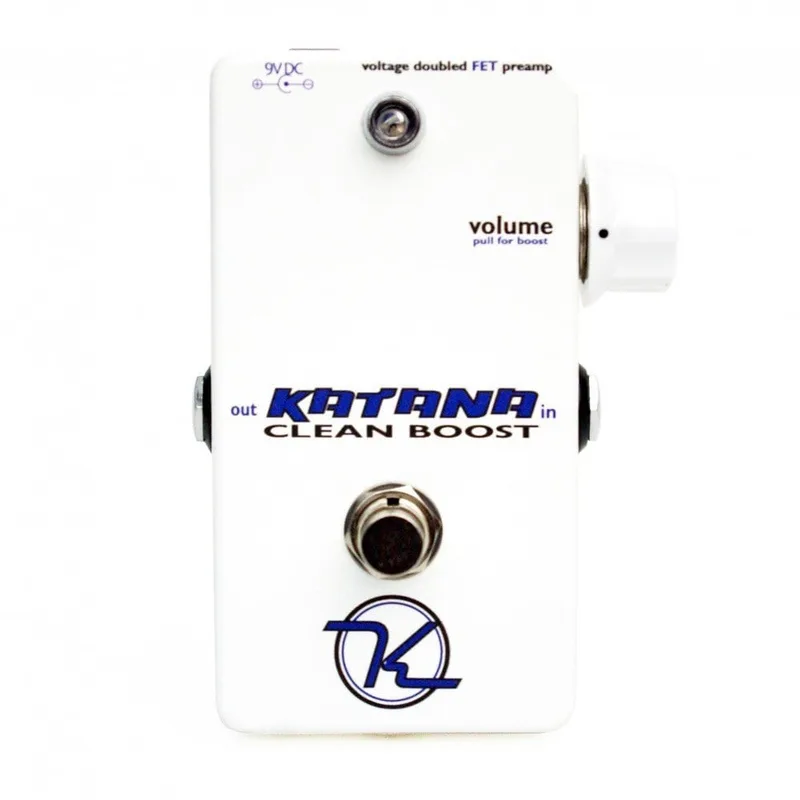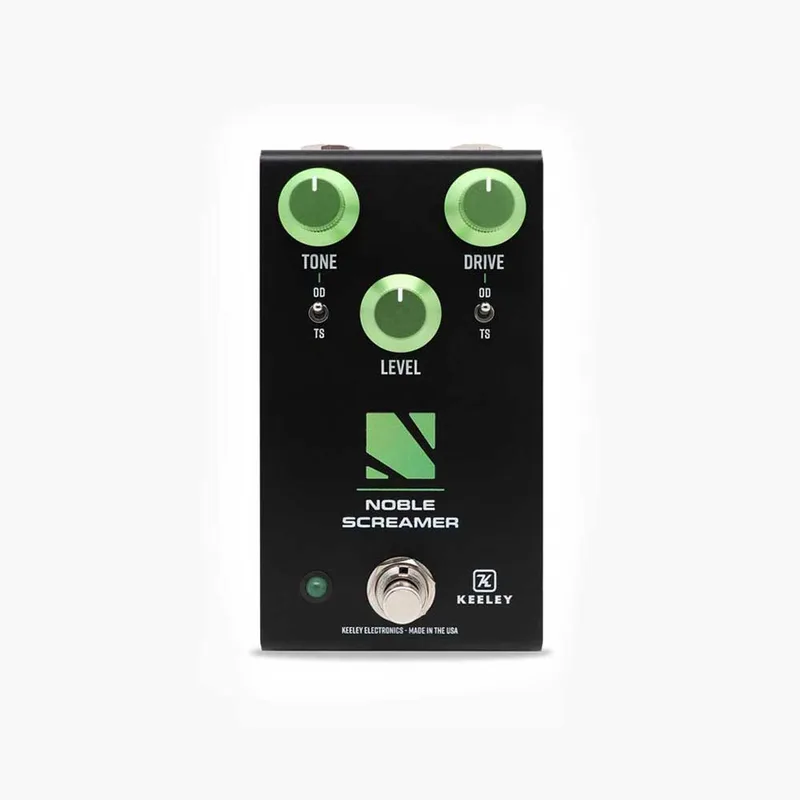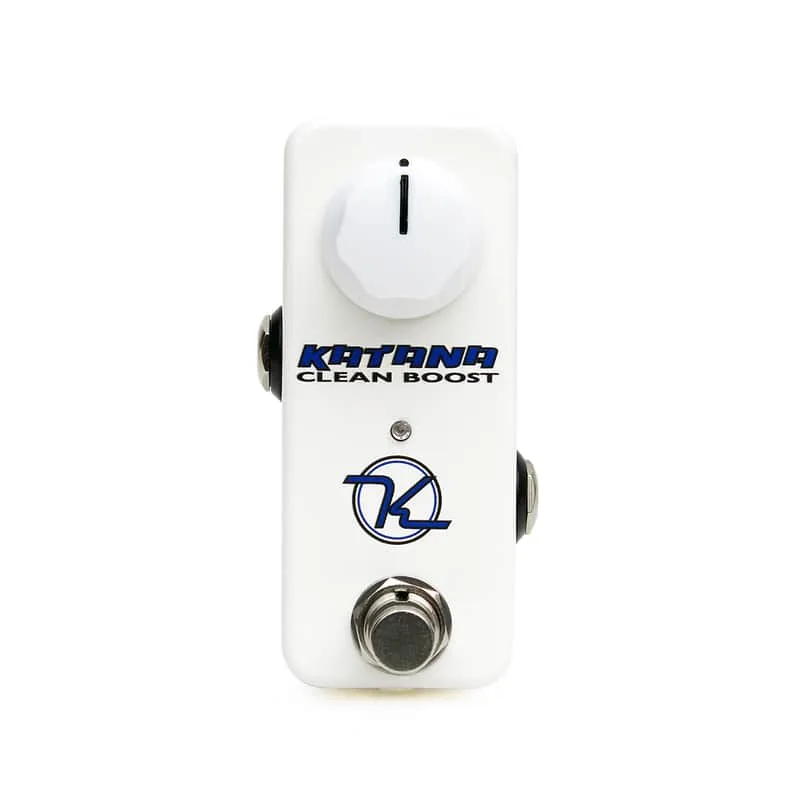


The Keeley Katana is a one-knob boost pedal from Keeley Electronics, built around dual cascaded JFET (junction field-effect transistor) stages running in Class A. Pushed in, the knob works as a plain volume control: it boosts your signal without coloring the tone. Pulled out, it switches the pedal into a second mode that adds gain and saturated, high-gain character, which Keeley describes as "not quite an overdrive"123.
It is a compact pedal, housed in a 4 3/8" x 2 3/8" x 1 1/4" chassis that fits just about anywhere on a pedalboard, with true-bypass switching and Keeley's signature blue LED indicator4.
What the Katana does to your sound
With the volume knob pushed in, the Katana is what Pedal of the Day calls a "fat, harmonically rich boost": it raises the level of your signal while leaving the tone alone. One reviewer found that "there are very few boost pedals out there that add less to your tone while still significantly boosting your volume"81. Vintage Guitar's reviewer, testing it into a Budda Superdrive 45, reported "exceptionally clear, transparent tone" that "parlayed every nuance the Budda offered at greater volume"4.
Pull the knob out and the character changes. Guitar World's original review describes the pulled mode as "High Gain mode, giving your tone a little tube grit just this side of overdriven"5. Sweetwater's demo puts it more strongly: pulling the knob out "gives you an entire additional palette of saturated high-gain tones"6. Either way, the second mode is where the Katana stops being a pure volume control and starts driving the front of your amp harder.
"When it's time to kick your amp into harmonically rich overdrive, turn to the Keeley Katana clean boost pedal."
The pedal suits two working styles. You can keep it on all the time to push an amp harder, or use it as an occasional boost to cut through the mix for a solo1. One Pedal of the Day reviewer ran it at the beginning of his pedal chain as an always-on tone shaping tool8.
The push-pull volume knob
The Katana's single control is an oversized "Speed knob" mounted on the side of the enclosure rather than the top, which means you can adjust the level with your foot while playing36. Rolling it forward adds what MusicRadar calls a "fat, harmonically rich boost"3.
| Knob position | What it does |
|---|---|
| Pushed in | Conventional volume control, clean boost without coloring the tone38 |
| Pulled out | Extra gain mode, saturated high-gain tones, "a little tube grit just this side of overdriven"65 |
The pull-out position does two things at once. It engages the higher-gain mode, and on the Throwback White version it also engages the pedal's voltage doubling, raising the internal supply voltage for increased headroom7. The volume pot sits at the output of the circuit, so it can take the level all the way down to nothing9.
How much boost does it give?
The reviews disagree on the exact figure, and both are worth knowing. Vintage Guitar's review states the push/pull knob "acts as a level control, giving the user up to 23 db of boost"4. Sweetwater's demo describes pulling the knob out as "an instant +30dB boost"2, and MusicRadar likewise describes the pull-out position as "the extra +30db mode"3. The 23 dB and +30 dB figures come from different outlets reviewing the pedal at different times.
Power: 9V in, 18V inside
The Katana runs from a nine-volt input, but a charge pump circuit inside doubles that to an 18V internal rail5. DIY builders tracing the circuit have confirmed this, measuring 18V at the bias trimmers, and identified the charge pump IC as an ICL7660S9. The doubled rail is what gives the JFET stages their headroom, and it is the same "vintage doubler" approach Premier Guitar describes in its builder profile of Robert Keeley, "a circuit with an AC input and a DC output of roughly twice the peak input voltage"10.
The 18V rail is generated internally from the 9V input. You do not feed the pedal 18V; the charge pump makes it.
What JFETs are in the Katana?
The original Katana circuit uses 2N5484 JFETs, with the two stages cascaded9. The 2N5484 is marked obsolete on the Fairchild product sheet but has been available from surplus sellers; DIY builders have also substituted the 2N5485 and reported it works well9. Later versions keep the original recipe: the Throwback White reissue uses "the same JFETs as the original circuits," and Pedal of the Day's 2024 review of the updated version notes it "uses the original JFETs that made the first Katana so special"13.
For builders experimenting with substitutes, the DIY community has ranked the options: J201s were found to work but could not bias below about 14 volts, while the 2N5484 remained the favorite, described as sounding "really rich, round and power[ful]" with a sweet spot around 9.5V9. The JFET stages are what give the Katana what Keeley's own press materials call their "legendary tube clarity"11.
History: Robert Keeley's first design
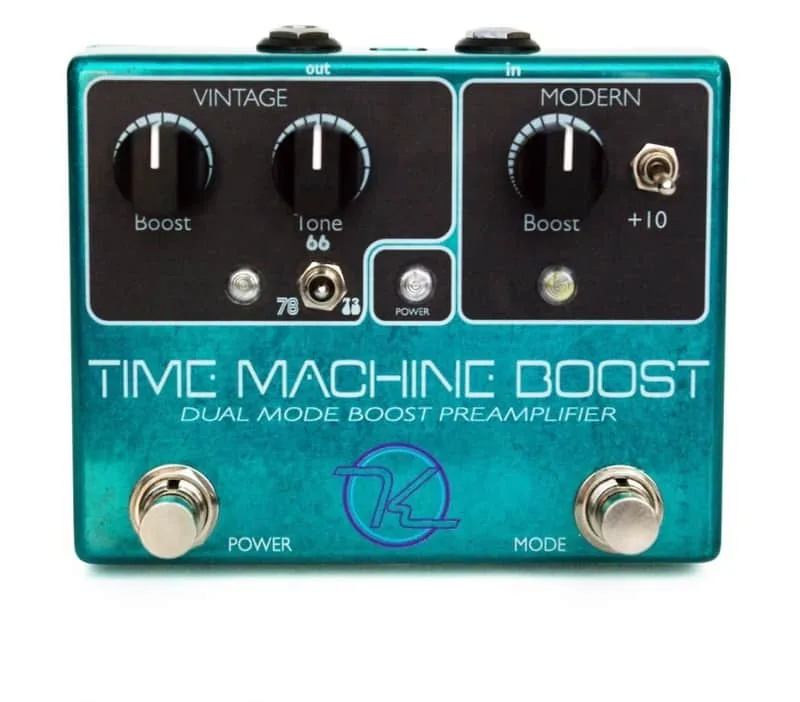
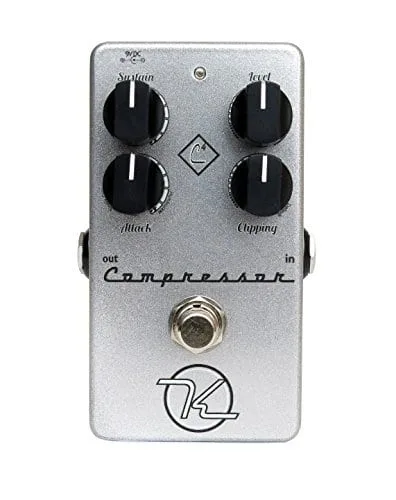
The Katana circuit is Robert Keeley's first guitar effect design for Keeley Electronics1. It did not start out as a Keeley product: it was originally designed for Legendary Tones, appearing as part of the two-channel Time Machine Boost, and only became an independent product under the Keeley name after the Compressor came out139.
Keeley had built his reputation before that on modification work. As he told Guitar World, "I could take a popular pedal, say, the [Ibanez] Tube Screamer, and look at the list of complaints about it... Then I'd c[reate mods]" to address issues like more gain and less midrange12. The Katana was his first original circuit rather than a mod, and Premier Guitar's builder profile calls it "his very first unique design," "a pedal that many players love for both the cleanness of its boost and its harmonic richness"10.
The pedal has been around for over 20 years, and the 2024 version keeps the same component values while updating the build construction with modern techniques1. Along the way it has appeared in several finishes:
- Throwback White: a 2021 reissue in a retro white colorway, with period-accurate JFETs and an updated Boost mode, which Guitar World called "the best Katana ever"7
- New Light Pink: a custom shop limited edition, sold exclusively through Sweetwater2
- Arlon Prince custom finishes: custom-finish versions offered by Keeley for the Katana among other pedals13
A smaller Katana Mini also exists, made with cascading FETs, with the full-sized pedal's Pull Boost mode integrated into the upper ranges of its volume knob14.
Who uses it
The Stompbox Book's interview with Robert Keeley describes the Katana Clean Boost as "favored by Billy Gibbons"15. Beyond named players, the pedal has a long following among working guitarists: one Pedal of the Day reviewer used it as an always-on tone shaping tool at the front of his chain8, and DIY builders have reported it "works wonders on solid state amps," making one builder's Valvestate clean channel work like a "real" amp9.
Videos
ProGuitarShopDemos
Sweetwater
Reverb
Questions
Is the Keeley Katana true bypass?
Yes. Vintage Guitar's review notes that the Katana employs true-bypass switching, along with Keeley's signature blue LED indicator4.
How much boost does the Keeley Katana give?
Vintage Guitar measured up to 23 dB of boost from the side-mounted push/pull level knob4, while Sweetwater's demo describes pulling the knob out as an instant +30 dB boost2, and MusicRadar calls it "the extra +30db mode"3. The two figures come from different reviews.
What JFETs are in the Keeley Katana?
The original circuit uses 2N5484 JFETs, now marked obsolete on the Fairchild product sheet but available from surplus sellers; builders have substituted 2N5485 and J201 with workable results9. The Throwback White and 2024 versions use the same JFETs as the original circuits13.
Is the Katana good as an always-on boost?
Yes. Pedal of the Day notes you can keep it on all the time to push your amp harder, or use it as an occasional boost to cut through the mix1, and one reviewer ran it at the start of his chain as an always-on tone shaping tool8.
What was the Sweetwater pink Katana?
A custom shop limited edition of the Katana Clean Boost in a New Light Pink finish, a dual FET Class A clean boost sold exclusively through Sweetwater2.
Sources (15)
- Keeley Electronics Katana Clean Boost, Pedal of the Day, 2024-03-02
- Keeley Katana Clean Boost Sweetwater Exclusive, Sweetwater, 2021-09-01
- Keeley Electronics brings back the Katana Clean Boost in 'Throwback White', MusicRadar, 2021-05-28
- Two Tickets to the Top, Vintage Guitar magazine, 2021-03-01
- Keeley Electronics Katana Clean Boost pedal, Guitar World, 2008-02-07
- Keeley Katana Clean Boost Demo, Sweetwater, 2021-10-21
- Keeley Electronics reintroduces the Katana Clean Boost in sleek Throwback White colorway, Guitar World, 2021-06-02
- Keeley Electronics Katana Boost, Pedal of the Day, 2015-07-21
- Guitar FX Layouts: Keeley Katana Boost Layout Rev 2, Guitar FX Layouts (tagboardeffects.blogspot.com), 2014-02-26
- Builder Profile: Keeley Electronics' Robert Keeley, Premier Guitar, 2011-10-18
- Keeley Electronics Releases the Katana Blues Drive, Premier Guitar, 2014-09-22
- Robert Keeley on the rise of Keeley Electronics, Guitar World, 2025-09-11
- Killer New Arlon Prince Custom Finishes Now Available, Keeley Electronics Guitar Effects Pedals, 2012-02-22
- Need a lift in signal? Boost pedals explained, Guitar.com, 2025-08-28
- Keeley Electronics, Stompbox Book (stompboxbook.com), 2019-01-13