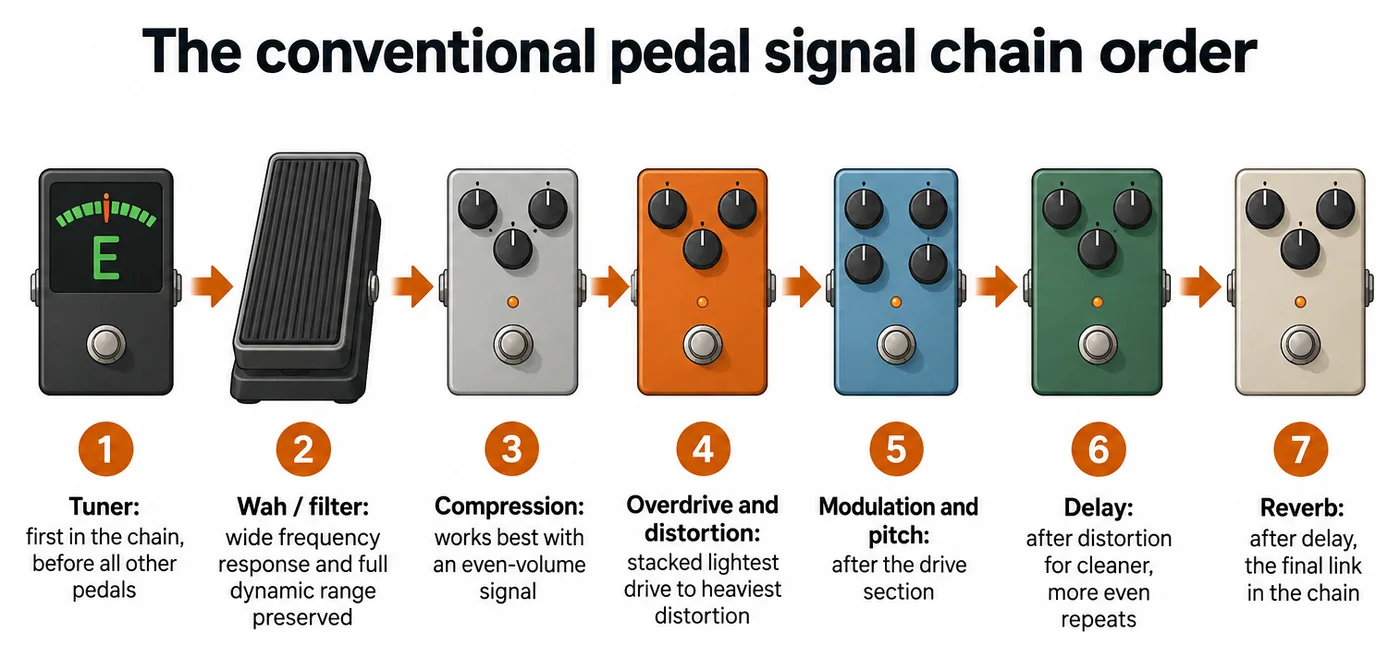
| Conventional order | wah/filter, compression, overdrive, modulation and pitch, delay, reverb1 |
| Tuner | first in the chain, before all other pedals2 |
| Drive stacking | lightest drive first, heaviest distortion last2 |
| Reverb | after delay, as the final link in the chain, or in the amp's effects loop2 |
| Noise gate | in the drive section, or after all your gain and EQ pedals23 |
Pedal signal chain order is the sequence in which your guitar's signal passes through the pedals on your board, from the guitar to the amp. Two players with identical pedals can get noticeably different sounds purely from the order they plug them in, because each pedal reacts to the signal it receives. A wah fed a clean, full-range signal from the guitar behaves differently from one fed an already-distorted signal, and a delay placed before a distortion pedal produces different repeats than one placed after it.
There is a conventional order that most guides describe, and it follows the logic of how a real amplifier and a real room work: the guitar feeds filters and dynamics, then gain, then modulation, then the time-based effects that mimic the ambience of a space. But every maker whose advice is collected here says some version of the same thing: the conventional order is a starting point, not a rule. Some pedals even exist to let you flip the order of two effects with a switch, which tells you how much placement matters.
What pedal order is and why it changes your sound
Every pedal processes the signal it is handed. A distortion pedal clips the waveform, and everything downstream of it receives a clipped, compressed signal. A modulation pedal after that distortion modulates the distorted sound; the same modulation pedal before the distortion has its sweep clipped and reshaped by the drive pedal instead. Neither is wrong, they are just different, and knowing which you want is the whole point of thinking about order.
EarthQuaker Devices' guide "Get In Line: Pedal Order 101" states the conventional sequence plainly1:
"Conventional wisdom suggests that the ideal pedal order is wah/filter, compression, overdrive, modulation and pitch-based effects, delay, and reverb1."
Aaron Rogers, EarthQuaker Devices1
The reasoning behind each placement is usually about preserving what a pedal needs to see. Wahs and filters sit at the front because, as EarthQuaker Devices puts it, they have a wide frequency response and full dynamic range that most players want to preserve1. Compression sits close to the guitar because, in BOSS's words, these units work best with an even-volume signal2. Ambient effects sit last because they replicate the natural ambience of an acoustic space, and a room's reverb is the last thing a sound passes through before it reaches your ears1.
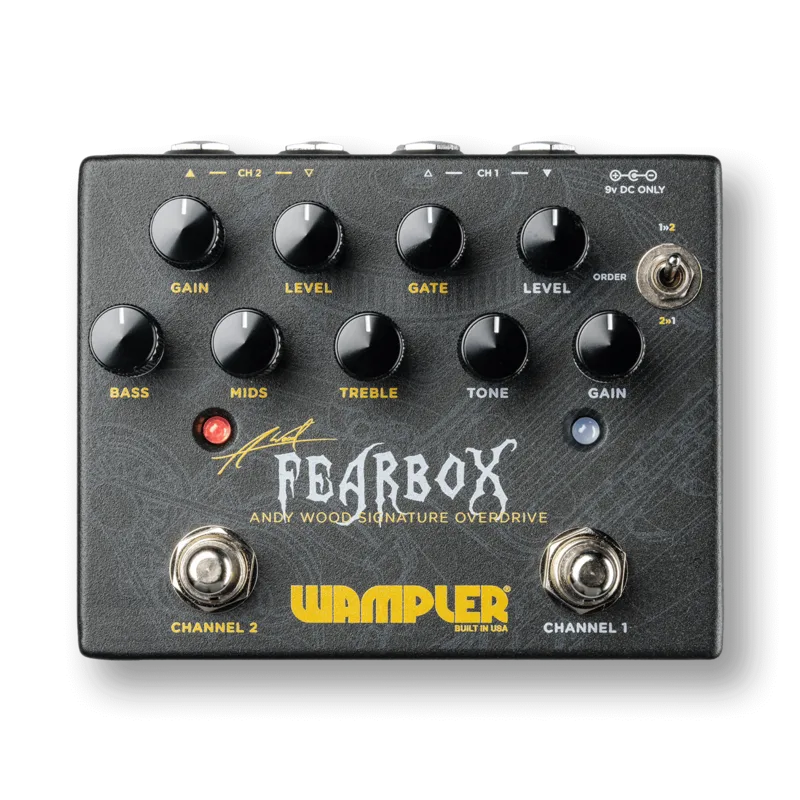
Some pedals make the order question explicit. Wampler's The Fearbox and the Andy Wood Gearbox each carry an Order switch that lets you select which of the pedal's two channels comes first in the signal chain45. Saturnworks builds a dedicated Pedal Order Switcher with a bi-color LED indicating which order your pedals are in6. When makers sell you the ability to swap order on the fly, that is the strongest hint that order is a real tonal variable, not a formality.
The pedal families in a typical chain
Thinking in families makes order easier to plan. Each family has a conventional neighborhood, and the reasons are consistent across makers' advice.
| Family | Conventional position | Why, according to makers |
|---|---|---|
| Tuner | First, before everything | Tuning needs the cleanest signal2 |
| Wah and filters | After the tuner, before drive | Wide frequency response and full dynamic range to preserve21 |
| Compression | Close to the guitar, before drive | Works best with an even-volume signal27 |
| Overdrive and distortion | After tuner, pitch, compression and wah | Stack lightest drive to heaviest distortion2 |
| Modulation | After the drive section | Stands out in the mix placed after drive2 |
| Delay | After distortion, before reverb | Cleaner and more even repeats2 |
| Reverb | Last, or in the amp's effects loop | Replicates natural ambience, so it comes last21 |
A few families have their own quirks worth knowing:
- Vintage fuzz and buffers. Union Tube & Transistor says its Sone Bender fuzz "is happier before your buffered pedals"8. Buffer-incompatible vintage fuzz is exactly why Origin Effects carves out an exception for compression placement: first in the chain is the most common spot for guitar compression, but after any buffer-incompatible vintage fuzz and wah pedals and the tuner7. See true bypass and buffers for why.
- Envelope filters. EarthQuaker Devices says conventional wisdom puts an envelope filter at the beginning of the chain, though it can sound good after a dirt or modulation pedal9.
- Octave and pitch. EBS says of its OctaBass that a good rule of thumb is to start as early as possible, when the note information is cleanest, with drive pedals or filters after it10. Pitch tracking needs a clean signal to read the note.
- Volume pedals. BOSS notes this one is debated: a popular approach places a volume pedal at the start of the chain, while others run only reverb and delay after it2.
The usual order: dynamics, drive, modulation, time
Dynamics and filters up front
The front of the chain is where pedals that need to read your playing go. Strymon's FAQ for the Canoga says to position it as the first pedal in the signal chain to maximize interaction with the instrument's pickups and volume knob11. Dunlop's manuals recommend the same for both the DVP4 Volume (X) Mini and the DVP5 Volume (X)8: place them first in the signal chain1213. Strymon described its OB.1 compressor/clean boost as suited to the first pedal in your pedalboard signal chain14.
The drive section
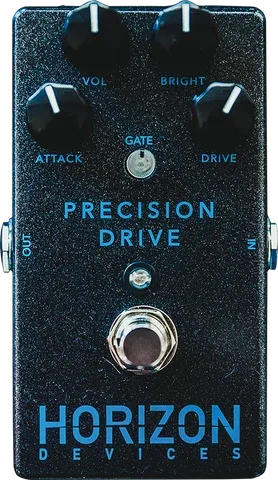
BOSS's guide puts overdrive and distortion after the tuner, pitch, compression and wah section, and gives the stacking rule: with multiple pedals in this category, stack them from the lightest drive to the heaviest distortion2. Horizon Devices' Precision Drive manual is consistent with this: when using it in front of a preamp or distortion pedal like the 5150OD, the Precision Drive goes before that pedal in the chain15.
Modulation
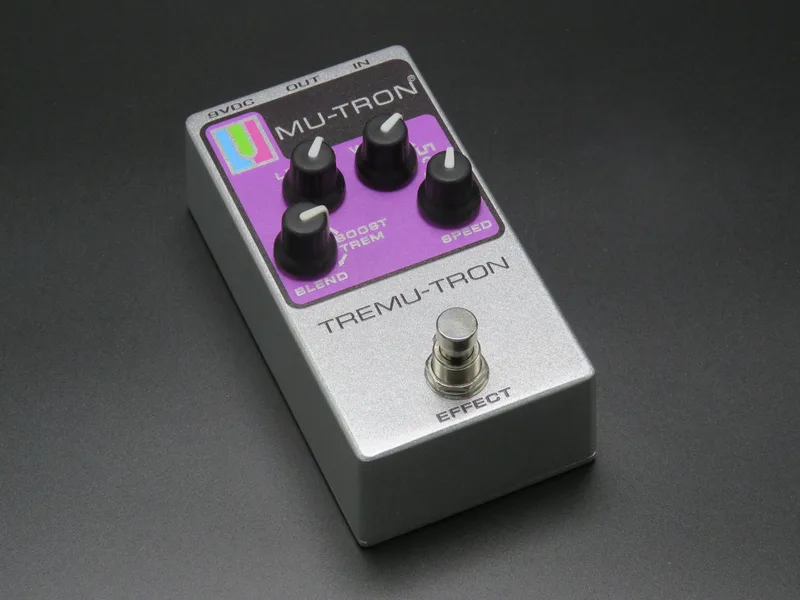
Modulation goes after the drive section, though BOSS is careful to say positioning is not set in stone; placing a modulation effect after drive is a way to accentuate it and make it stand out in the mix2. Musitronics gives a concrete example for its Tremu-Tron tremolo: it should be placed after overdrive and before reverb in the signal chain16.
Time effects last
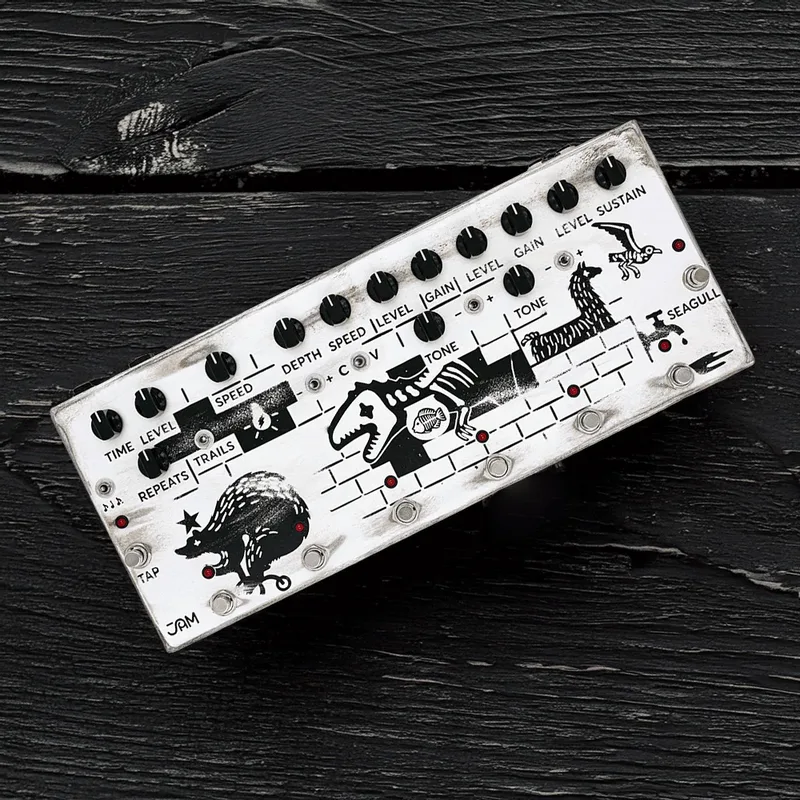
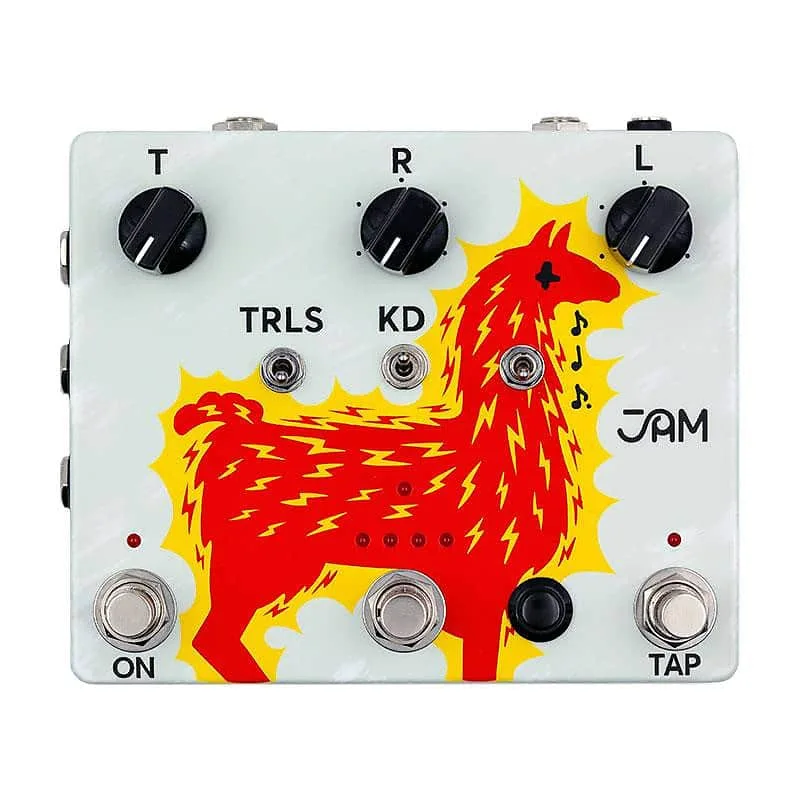
Delay after distortion delivers cleaner and more even repeats, and reverb after delay, because delayed reverb can sound muddy2. JAM Pedals even prints its recommended internal order on the Pink Flow multi-pedal: Seagull, then Dyna-ssoR, then Tubedreamer, then Red Muck, then a send/return loop, then WaterFall, then Ripple, then Delay Llama17. That is the whole conventional chain in one enclosure: filter, compressor, drives, then modulation and delay.
Boost before or after overdrive
The boost question is the one most players hit first, and Vein-Tap.com's guide gives the clearest explanation of the two options:
- Boost before overdrive: the boost beefs up the overdrive pedal, making it sound fatter and heavier, but with not that much volume increase. Your tone stays roughly the same volume but sounds more overdriven18.
- Boost after overdrive: you get about the same level of overdrive, but the signal is louder18.
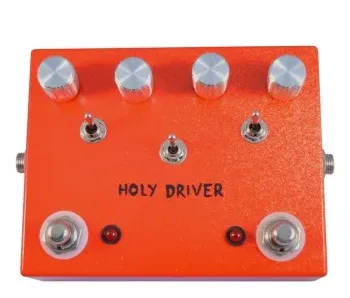
In other words, a boost in front pushes the drive pedal harder; a boost behind raises the finished sound. Some pedals build the choice in: Vein-Tap's Holy Driver has a Pre/Post switch that lets you choose whether the boost cascades into the overdrive, or vice versa18. See boost pedals for more on the family.
Where noise gates, loopers and amp-recreation pedals sit
Noise gates
BOSS's signal chain guide puts a noise gate like the NS in the drive section spot, to control that unruly section of the pedalboard2. Its separate noise gate guide adds a refinement: if you are running several gain or EQ pedals, it is best to position the noise gate after all of them, so it reduces the noise of any pedals in front of it3. In an amplifier's effects loop, the gate sits after the preamp and gain stage but before the power section, acting as the last effect source ahead of the speaker3. ART's SGX rack unit follows the same logic internally: its noise gate is located last in the analog effects chain19.
GUP Tech's MWAC gate takes this further with a loop design: wire the guitar in early, after the tuner, and come back for the gate via the top jacks as late as possible in the signal chain, in the FX loop or just before the amp if you do not have a loop2021. The guitar input and thru jacks are on the right side of the pedal, with the gate return jacks on top21. GOKKO describes its KULT Noise Gate as a pedal that can help reduce the hum and buzz of other pedals, especially high-gain distortion, in your chain22. See noise gate pedals.
Loopers
BOSS's looper guide recommends placing a looper last in the chain, after delay and reverb, so all effects are recorded within the loop and will not be altered when you switch settings mid-performance23. But it also lays out the alternative: placed before delay and reverb, the entire loop is affected by delay, creating an ambient, spacey feel; placed after, each looped layer keeps its original effect setting for more clarity and separation23. BOSS's signal chain guide takes a middle position, saying the looper should come before the delay, with the exact spot depending on how you want looped phrases affected2. The honest answer is that it depends on whether you want your time effects to process the whole loop or stay independent of it. See looping pedals.
Amp and cab simulators
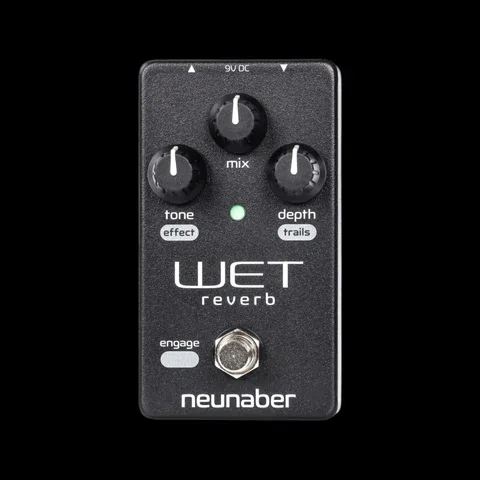
Amp and cabinet simulator pedals most commonly go at the end of the chain, where the signal is then routed to a PA system, audio interface or headphones2. Quilter Labs' manuals are consistent: the Neunaber Wet Reverb v5 and Immerse Reverberator are recommended at the end of the chain after all other effects, or in the amp's effects loop if you are using the overdrive channel2425. The Neunaber Iconoclast goes at the end of the signal chain after your pedals and/or preamp, and the manual is firm that it is not a load box and must not be connected to an amplifier's speaker output26. See speaker simulation pedals and preamp pedals.
Power, plates and pedalboard layout
Order and layout are practical cousins. EarthQuaker Devices' pedalboard guide from Joe Golden gives assembly advice that saves debugging time later: label each power output of the supply with its corresponding pedal, and test solderless cables one at a time, working from the last pedal in the chain toward the beginning27.
Power choices interact with noise, which interacts with where you need that gate:
- Wren and Cuff says daisy chains are fine for very simple setups involving four pedals or less, and notes that often the chain's main source is the extra female jack on the good old tuner pedal28.
- Strymon's FAQ warns that ground loops are commonly caused when using a daisy chain power cable to power multiple pedals, creating a ground loop between every pedal in the chain29.
See how to power a pedalboard for the full picture on isolated supplies versus daisy chains, and how to build a pedalboard for layout.
Common chain problems and what sources say
When a board misbehaves, the cause is often not the pedals. 3 LEAF AUDIO's support page says half the pedals received for repair are working fine, with the most common issue being a bad 1/4" cable and the second most common a bad power supply output30. Swap cables and power before assuming a pedal is broken.
Tone loss along a long chain is usually a frequency problem, not a volume problem. Champion Leccy's technical analysis of pedal chain impedance explains that it is the top end frequencies that usually get lost31. That is the case for buffers on long boards, covered in true bypass and buffers.
Gain staging matters too. GuitarPCB's technical paper explains that inside a pedal, gain is created by active components, most commonly JFET and MOSFET transistors32. How hard you feed one gain stage into the next is exactly what the lightest-to-heaviest stacking rule is managing2.
And order is not only about tone. Scott Hansen of Tycho told Origin Effects33:
"I typically just set my amp to a clean tone and do all the sculpting right in the pedals as they afford far more sonic breadth than the amps themselves."33
Scott Hansen, Origin Effects artist profile33
A clean amp plus a deliberately ordered pedal chain is a working method, not just a preference. For players running modelers instead, the same logic applies; see using pedals with amp modelers.
Pedals on this page

Questions
Should overdrive go before or after distortion?
BOSS's guide puts both in the same drive section, after the tuner, pitch, compression and wah, and recommends stacking them from the lightest drive to the heaviest distortion. So a low-gain overdrive feeds the heavier distortion pedal. Horizon Devices says the same for its Precision Drive: it goes before a preamp or distortion pedal in the chain.
Does a boost pedal go before or after overdrive?
It depends what you want the boost to do. Vein-Tap.com explains that a boost before an overdrive makes the tone sound more overdriven at roughly the same volume, while a boost after keeps the overdrive level the same but makes the signal louder. Some pedals, like the Holy Driver, have a Pre/Post switch so you can choose either.
Where does a noise gate go in a pedal chain?
BOSS's guide puts a noise gate in the drive section spot, to control that unruly part of the board. If you run several gain or EQ pedals, BOSS advises positioning the gate after all of them. In an amp's effects loop, the gate sits after the preamp and gain stage but before the power section.
Should the looper be last in the signal chain?
BOSS recommends placing a looper last, after delay and reverb, so all effects are recorded within the loop and will not be altered when you change settings mid-performance. The trade-off is that a loop placed before delay and reverb gets an ambient, spacey feel from those effects, while a loop placed after keeps each layer's original effect settings.
Do delay and reverb go in the effects loop?
They can. BOSS's guide places reverb after the delay as the final link in the chain, or via the amp's effects loop. Quilter Labs' manuals for the Neunaber Wet Reverb v5 and Immerse Reverberator recommend the end of the chain, or the amp's effects loop if you are using the amp's overdrive channel.
Does pedal order matter with a modeling amp?
It still matters. Scott Hansen of Tycho told Origin Effects he typically sets his amp to a clean tone and does all the sculpting in the pedals, because they afford far more sonic control. With a clean platform, the same ordering logic for your pedals applies as with any other amp.
Sources (33)
- Get In Line: Pedal Order 101, EarthQuaker Devices, 2017-11-30
- The Ultimate Guide to Guitar Effects Pedal Order and Signal Chain, BOSS (articles.boss.info), 2023-03-01
- The Complete Guide to Noise Gate and Suppressor Pedals, BOSS (articles.boss.info), 2023-11-30
- The Fearbox, Wampler Pedals, 2026-05-27
- Andy Wood: Gearbox, Wampler Pedals, 2026-08-31
- Pedal Order & Effects Loop Switcher, Saturnworks, 2026-08-29
- Tech Tips: Where in the Chain, Origin Effects, 2024-05-17
- Sone Bender, Union Tube & Transistor
- Five Surprising Uses For An Envelope Filter, EarthQuaker Devices, 2024-05-02
- Octabass, EBS Professional Bass Equipment
- Where should I use Canoga in my effects chain?, Strymon
- DVP4.pdf, Dunlop Manufacturing, Inc., 2025
- DVP5.pdf, Jim Dunlop, 2021
- Introducing the OB.1 Optical Compressor, Strymon, 2009-07-07
- PRECISION DRIVE, Horizon Devices
- Tremu-Tron, Musitronics Mu-Tron
- Pink Flow, JAM Pedals (jampedals.com)
- Boost Before Overdrive or Overdrive Before Boost?, Vein-Tap.com, 2016-06-13
- 500MAN.PDF, ART, 2025
- MWAC Noise Gate Pedal Douche Edition, GUP Tech (guptech.ca)
- MWAC Gate, guptech.ca
- KULT Noise Gate, GOKKO AUDIO
- The Complete Guide to Loop Pedals for Electric Guitarists, BOSS (articles.boss.info), 2025-04-04
- Wet Reverb v5 User Guide, Quilter Labs
- Immerse User Guide (Original), Quilter Labs / Neunaber Technology LLC, 2016
- Iconoclast User Guide, Quilter Labs
- Tech Talk with Joe Golden, EarthQuaker Devices, 2017-02-28
- Power Supplies, Wren and Cuff Effects
- Can I use a daisy chain power supply?, www.strymon.net, 2026-06-17
- Support - 3 LEAF AUDIO, 3 LEAF AUDIO
- Get outta my way! Understanding Impedance!, Champion Leccy, 2017-02-03
- How-Gain-Headroom-and-Clipping-Shape-Your-Tone.pdf, GuitarPCB, 2026
- Artist Profile: Scott Hansen (Tycho), Origin Effects, 2022-09-02