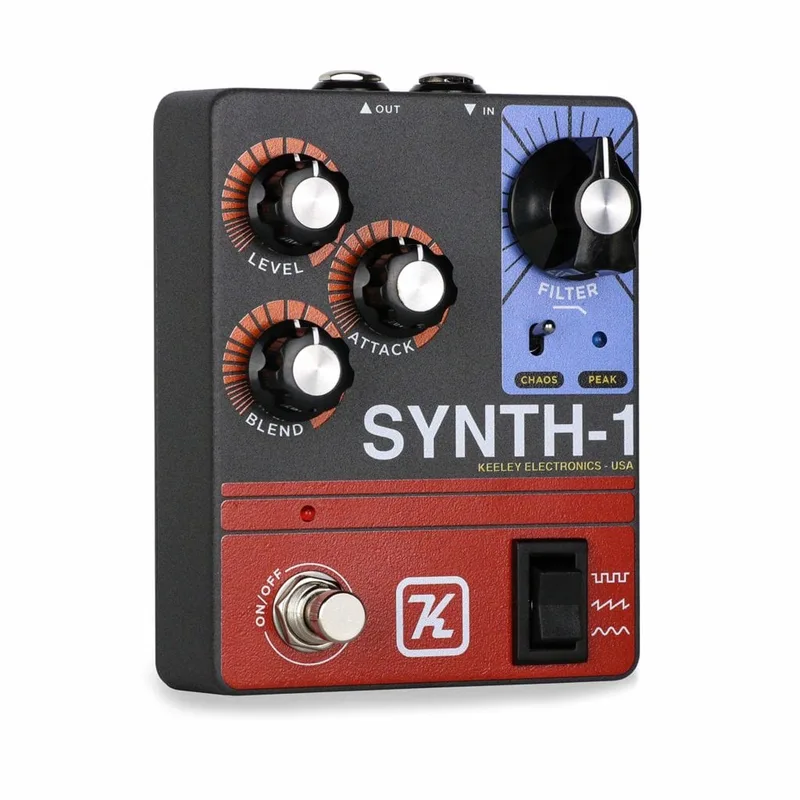


The Keeley Synth-1, full name the Synth-1 Reverse Attack Fuzz Wave Generator, is a digital synth pedal made by Keeley Electronics and first released in 201912. It is a guitar-triggered, single-note wave generator: you play one note and the pedal produces a fuzzy synth wave in its place, which you can blend with your original guitar signal34. Keeley describes its range as running from "unnatural fuzz noises to pseudo-harmonic, random glitchy counterpoint"3.
Guitar.com's reviewer summed up the sound as monophonic, Moog-inspired synth tones with almost infinite sustain and solid tracking, calling it "a tidy collection of old-school synth tones in one small box" and scoring it 8 out of 101.
What it does to your sound
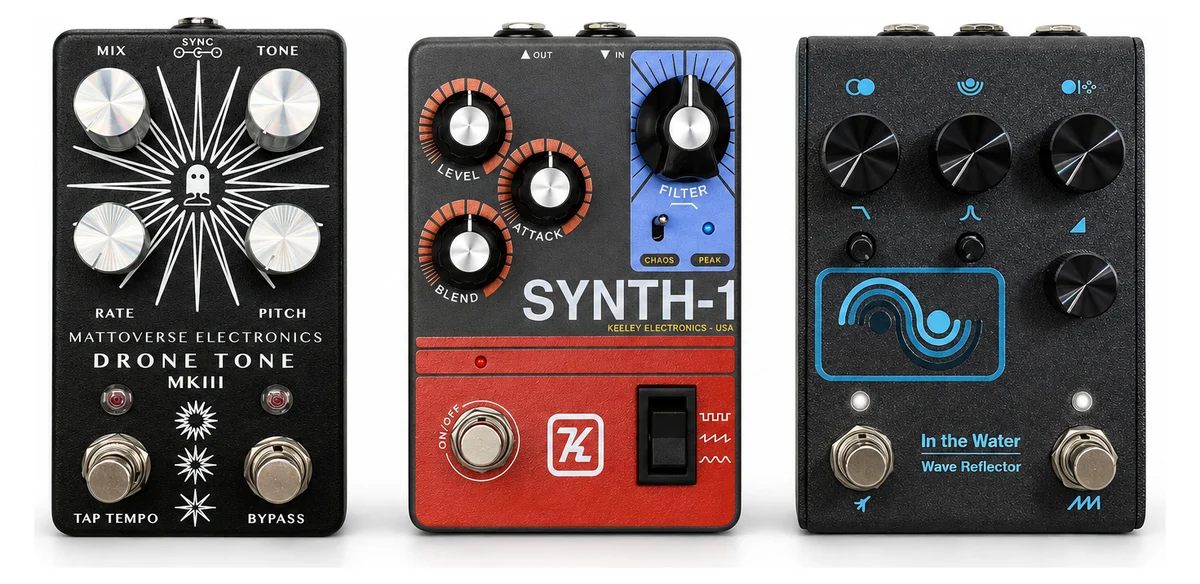
The Synth-1 takes a single note from your guitar and generates a synth wave from it. You choose the waveform, square, sawtooth or sine, and shape the result with a filter, an attack control that can produce slow reverse-style volume swells, and a blend knob that mixes the wave with your dry signal14. Because it is monophonic, it tracks one note at a time; Delicious Audio's buying guide describes it as "the rather uncomplicated monophonic Synth-1, a Synth Wave Generator providing three different waveforms (sine, saw and square, controllable through foot action)"2.
The attack control is a volume swell that ranges from 1500ms down to 4ms and is applied to both the wet and dry signals, so at its slowest it works like a slow-gear or reverse-volume effect43. MusicRadar's review of the pedal found it "thick, fuzzy and particularly tasty in the triangle mode with a slow attack"6.
The controls
The pedal keeps its control set small. Both the input and output sockets sit on the top of the enclosure1.
| Control | What it does |
|---|---|
| Level | Sets the overall output level4 |
| Blend | Sets the mix ratio between your dry signal and the wave generator34 |
| Filter | Sculpts the fuzz wave's EQ and tone; controls the cutoff frequency of the square waves, sweeping 50Hz to 5000Hz34 |
| Attack | Governs a reverse volume swell effect, 1500ms to 4ms, applied to wet and dry signals34 |
| Wave Selector | Three-way, foot-accessible switch toggling Square, Saw and Sine waves7 |
| Chaos switch | Changes the type of input detection used, adding octaves and what Keeley calls "dimensional triggering"37 |
| Peak light | Lets you know the signal is passing through the filter section, according to Keeley's site7 |
The Filter control is the heart of the tone shaping. Gearnews describes it as controlling the synth wave tone, while the Attack control sets the note lead-in time, "just like the attack on the ADSR section you seen on synthesizers"7. The frequency sweep is the same regardless of which mode you are in, ranging from 50Hz to 5000Hz4.
There is also an expression pedal jack on the side, allowing hands-free operation of the Filter control4. Guitar.com's news coverage describes the pairing as giving wah-like control over the filter3, and MusicRadar notes the expression pedal input makes the pedal "extra performance-friendly"8.
Normal and Chaos modes
The Chaos switch selects between two different ways of detecting your guitar's signal, and the difference between them is the core of the pedal's character.
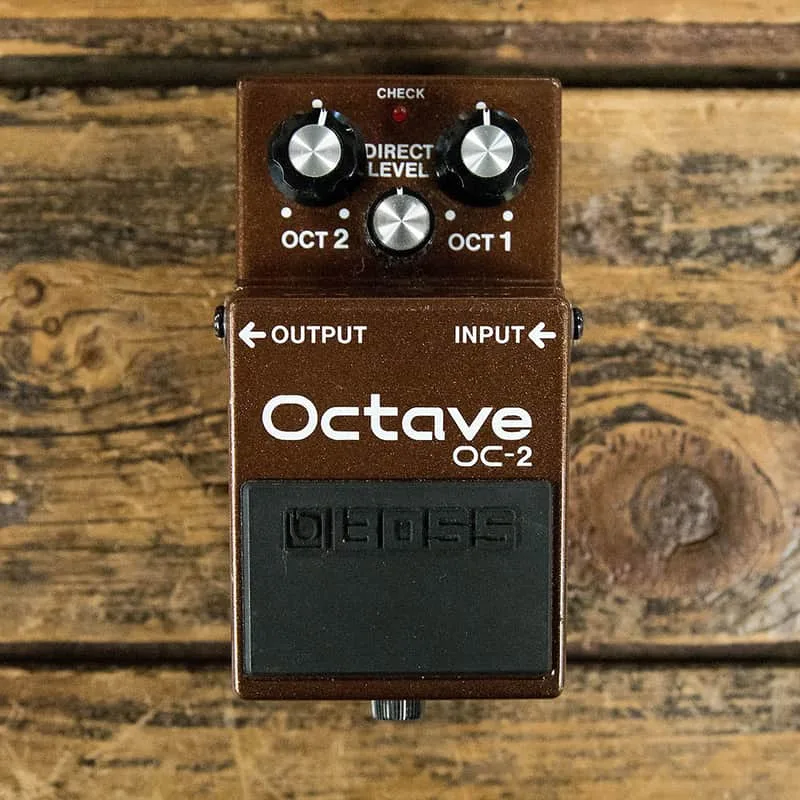
Normal mode uses positive and negative peak detectors, similar to the classic Boss OC-2, resulting in a stable and consistent output3. Pedal of the Day's review put it this way:
"In Normal mode, it sounds similar to the classic Boss OC-2, using positive and negative peak detectors, but with more stability and consistency."
Chaos mode changes the input detection to zero-cross detection, which is where the pedal gets its name. With saw or square waves, zero-cross detection is used to obtain the wave's pitch, but it does not isolate the fundamental from harmonics well, so the output is more unstable3. Pedal of the Day found that in Chaos mode "the possibilities open up, using zero-cross detection to obtain octaves, harmonics, distortion and even a bit of flanging modulation"4. With sine waves in Chaos mode, a standard octave down is employed alongside another slightly detuned octave to generate a flanging-like modulation3.
The Chaos switch, in Pedal of the Day's words, "gets nice and nasty, adding to the complexity of the Synth-1 by changing dimensional triggering and octaves"4.
Where it came from
The Synth-1 was first shown at the Keeley NAMM 2019 pedal line-up, where Guitar.com's news coverage called it one of the standouts from the show3. It was rolled out for pre-order at $179 in February 20193, and by March 2019 MusicRadar reported it cost $179 and could be ordered via the Keeley Electronics website5. Guitar World likewise listed the $179 price on Keeley's website in March 201991.
Keeley entered the synth pedal market with the Synth-1, its 2019 release, according to Delicious Audio's 2025 synth pedal buying guide2.
What reviewers said
Guitar.com's Richard Purvis reviewed the Synth-1, giving it 8 out of 10 and calling it "a tidy collection of old-school synth tones in one small box"1. He noted the three waveforms, the variable attack time for slow volume swells, and the Chaos switch that deliberately makes the note-tracking less stable1.
Pedal of the Day's review concluded that Keeley succeeded in creating the intended synth sound, from unnatural fuzz noises to pseudo-harmonic, random glitchy counterpoint, with unique, fuzzy synth waves and useful settings4.
"The goal was to create a synth sound that took you from unnatural fuzz noises to pseudo-harmonic, random glitchy counterpoint, and boy, did they ever succeed."
MusicRadar describes the Synth-1 as a favorite of Rabea Massaad's, and something of an inspiration for him having a fully operational synth on his signature Neural DSP plugin suite8.
Power and practical notes
The Synth-1 runs on a 9-volt mains supply only, with the power supply not included1. As a digital device drawing a stated 70mA, it needs a proper 9-volt supply1.
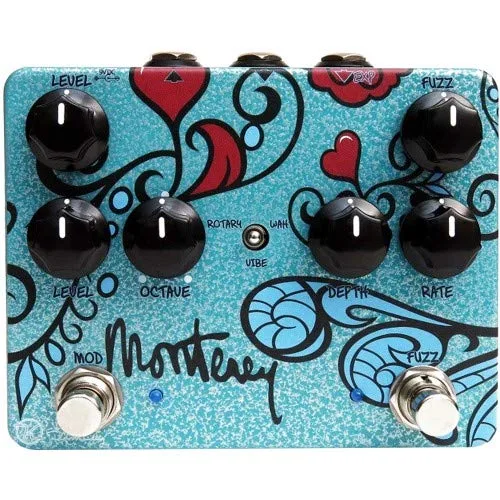
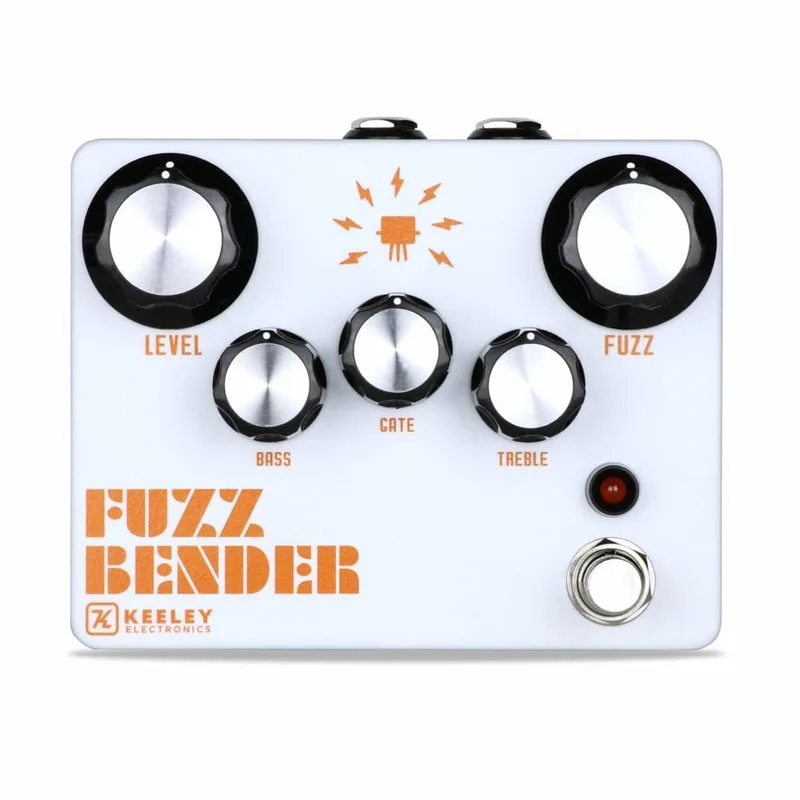
The pedal is true bypass, so your dry signal passes untouched when the effect is off1. It is made in the USA1, and its compact enclosure measures 123 x 98 x 52mm1. Players looking for other Keeley dirt and modulation options can compare it with pedals like the Keeley Monterey or the Keeley Fuzz Bender, or browse the wider fuzz pedal category, though the Synth-1's synth wave generation sets it apart from conventional fuzz circuits.
Videos
Sweetwater
Premier Guitar
Keeley Electronics
Questions
Does the Keeley Synth-1 run on a battery?
No. The Synth-1 is powered by a 9-volt mains supply only, with the power supply not included, and there is no battery option. As a digital device with a stated power consumption of 70mA, it needs a proper 9V supply rather than a battery.
Is the Keeley Synth-1 true bypass?
Yes. The Synth-1 uses true bypass switching, so when the effect is off your dry guitar signal passes through without the pedal's circuitry in the way.
Is the Keeley Synth-1 analog or digital?
It is a digital device. Keeley's Synth-1 generates its synth waves digitally, with a stated power consumption of 70mA, which is one reason it runs on a 9-volt mains supply only rather than a battery.
What expression pedal works with the Keeley Synth-1?
The Synth-1 has a TRS expression pedal input on the side that controls the Filter frequency. Paired with an expression pedal it gives wah-like control over the filter sweep, which runs from 50Hz to 5000Hz, and allows hands-free operation of the Filter control.
Does Rabea Massaad use the Keeley Synth-1?
MusicRadar describes the Synth-1 as a favourite of Rabea Massaad's, and something of an inspiration for him having a fully operational synth on his signature Neural DSP plugin suite.
Is the Keeley Synth-1 discontinued?
There is no statement in the available coverage that the Synth-1 has been discontinued. At launch in 2019 it was listed as out of stock on Keeley's website shortly after shipping began following its NAMM Show announcement, but no discontinuation has been reported.
Sources (9)
- Review: Keeley Synth-1, Guitar.com, 2019-04-10
- Best Synth Pedals For Guitar In 2025 (Monophonic & Polyphonic), Delicious Audio, 2025-02-21
- Keeley debuts Synth-1 Reverse Attack Fuzz Wave Generator, Guitar.com, 2019-02-22
- Keeley Electronics Synth-1 Reverse Attack Fuzz Wave Generator, Pedal of the Day, 2019-05-02
- Guitarists can live out their electric dreams with Keeley Electronics' Synth-1 pedal, MusicRadar, 2019-03-18
- Atreides Analog Weirding Module review, MusicRadar, 2021-08-17
- Keeley Synth-1 Reverse Attack Fuzz Wave Generator: Synthesizer tones for your guitar, gearnews.com, 2019-03-17
- Electro-Harmonix String9 String Ensemble review, MusicRadar, 2023-01-03
- Keeley Electronics Unveils New Synth-1 Pedal, Guitar World, 2019-03-18