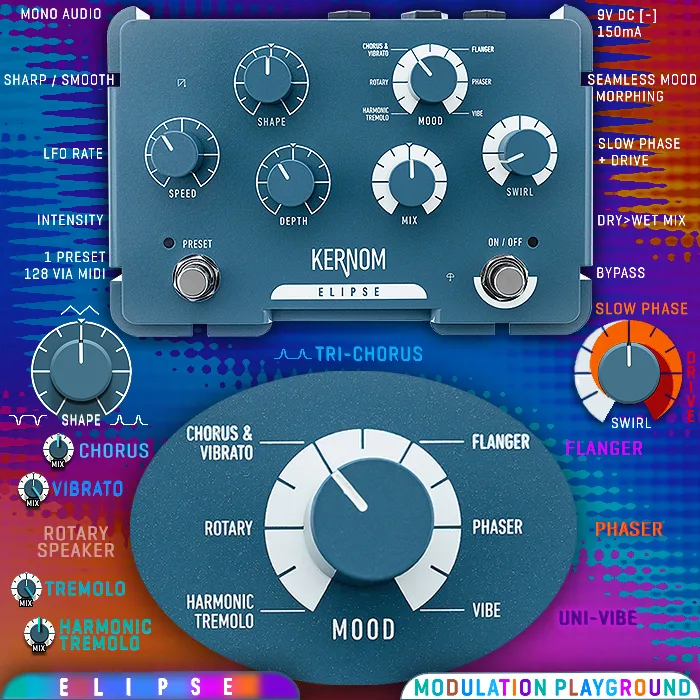



The Kernom Elipse Modulation Playground is an Analog Multi-Modulator pedal, the third release in Kernom's Dynamic Mood Morphing Analog Series, following the RIDGE and MOHO pedals1. It gathers the main modulation effect families in one box: the MOOD control morphs through Harmonic Tremolo, Amplitude Tremolo, Rotary Speaker, Vibrato, Chorus, Tri-Chorus, Flanger and Phaser1. Guitar Pedal X's Stefan Karlsson, announcing the pedal at its January 2025 NAMM launch, called it a box containing "all my favourite Modulations in the one box"1.
Controls and modulation types
The MOOD knob is the heart of the pedal, sweeping between the eight modulation positions listed above, so a player can move continuously from, say, chorus toward flanger rather than switching between fixed modes1. Alongside it, the Shape knob works as a Sharper to Smoother Response control, a kind of damping that sharpens or smooths the modulation waveforms1.
A second layer sits on top: the Swirl control. Kernom describes it as unlocking a secret weapon heard on countless legendary records, blending a slow phaser with any other modulation effect to create a rich, multidimensional sound1. In practice that means a phaser can run underneath a chorus, tremolo or flanger setting rather than replacing it.
Power and connections
The rear panel carries the following ports1:
- Audio In (mono)
- Audio Out
- EXP (expression pedal input)
- MIDI In, 1/8"
- MIDI Out, 1/8"
- 9V DC, center negative, 150nA
The EXP port accepts an expression pedal for hands-free control, and the 1/8-inch MIDI jacks let the Elipse connect to MIDI controllers and other MIDI-equipped gear1. Power is 9V DC center negative at 150nA1.
Onboard preset storage is limited. Stefan Karlsson wrote that he wished there were more presets onboard, and that you need an additional MIDI controller, connected through the MIDI ports, to get the full range out of the pedal1.
Stereo and the Rotary Speaker mode
The Elipse takes a mono input and delivers a single Audio Out1. One mode differs in character from the rest: Karlsson flagged that the Rotary Speaker mode is not in stereo, calling it "the one weakness with this device"1. Players drawn to the pedal mainly for rotary speaker sounds may want to weigh that against the other seven modes.
Price, availability and what reviewers said
The Elipse was launched at the January 2025 NAMM show and was available for pre-order at $369 / €369 / £3491. Karlsson's overall verdict on the announcement was warm: "this is yet another out-of-the park hit for Kernom - and perfect for on-the-go journeymen musicians and home and studio" players1.
As a multi-effects style pedal covering many modulation types at once, the Elipse sits in the wider field of Multi-effects Pedals, and its individual modes overlap with dedicated Chorus Pedals, Phaser Pedals, Flanger Pedals, Vibrato Pedals and Tremolo Pedals.
Videos
Kernom
Kernom
Kernom
Questions
What modulation types are in the Kernom Elipse?
The Elipse's MOOD control moves through Harmonic Tremolo, Amplitude Tremolo, Rotary Speaker, Vibrato, Chorus, Tri-Chorus, Flanger and Phaser positions, so one pedal covers the main modulation effect families. A separate Swirl control blends a slow phaser with any other modulation effect for a richer, more layered sound.
Is the Kernom Elipse stereo?
The Elipse has a mono Audio In and a single Audio Out on its rear panel. Guitar Pedal X's Stefan Karlsson noted that the Rotary Speaker mode is not in stereo, calling that the one weakness of the device.
Does the Kernom Elipse have an expression pedal input?
Yes. The rear panel carries a dedicated EXP port alongside the audio and MIDI connections, so an expression pedal can be connected for hands-free control.
Can you save presets on the Kernom Elipse?
Onboard preset storage is limited. Stefan Karlsson of Guitar Pedal X wished there were more presets onboard and noted that you need an additional MIDI controller to get the full range out of the pedal, connecting via its 1/8-inch MIDI In and MIDI Out jacks.
What power supply does the Kernom Elipse use?
The Elipse runs on 9V DC center negative, listed at 150nA on the rear port specification reported by Guitar Pedal X.
Sources (1)
- Guitar Pedal X, Guitar Pedal X, 2025-01-21