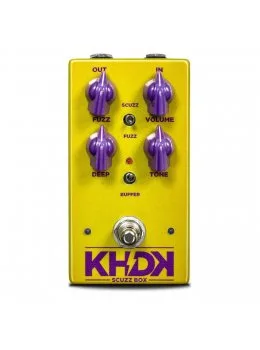


The KHDK Scuzz Box is a germanium-voiced fuzz pedal from KHDK Electronics, the company co-founded by Metallica's Kirk Hammett. Announced in July 2016 and housed in an acid-yellow and purple enclosure, it runs two distinct modes: Fuzz, a conventional high-quality fuzz, and Scuzz, a gated, velcro-type fuzz with what KHDK calls a "gnarly 8-bit twist"123. KHDK describes the overall character as "a powerfully crunchy, ripping tone that can scream and destroy but is clear enough for soloing"1.
The pedal is built on discrete transistors in what KHDK calls a high-precision circuit, and it is crafted and quality-tested in Kentucky, USA1. The name came from Hammett himself, chosen for the dirty, skuzzy vibe the pedal emits3.
Two modes: Fuzz and Scuzz
The Scuzz Box "shines in two distinct modes: Scuzz and Fuzz," according to KHDK1. The difference between them is the heart of the pedal.
- Fuzz mode is the everyday setting. Delicious Audio calls it "your go-to, highly listenable sound with top-notch fuzz"5, and Pedal of the Day's reviewer agreed, calling it "a go-to mode, highly listenable and a top-notch fuzz all-around"2.
- Scuzz mode is the extreme setting. Delicious Audio describes it as "a velcro-type gating fuzz with a highly distinct ripping texture and an 8-bit tone"5. Pedal of the Day put it more bluntly:
"When you switch to the Scuzz mode, your tone gets wicked gnarly, dangerous and unpredictable."
That gated, velcro character means notes decay into a sputtering, ripping texture rather than a smooth sustain, which suits staccato riffs and experimental playing more than singing leads. Pedal of the Day found the pedal "sounds incredible in a rhythm setting, as well as producing soaring lead tones for amazing solos, and even getting into weird and wild experimental territory"2.
The controls
Four knobs adjust what MusicRadar called "the aural assault": Fuzz, Volume, Deep and Tone4. A buffer switch sits alongside them.
| Control | What it does |
|---|---|
| Fuzz | Sets the gain. KHDK says it makes the signal "overdriven, dirty and massive"; higher settings add distortion and sustain, lower settings keep dynamics and pick sensitivity12 |
| Volume | Sets the output volume. Pedal of the Day warns "this pedal gets LOUD!"2 |
| Deep | Controls the amount of lows feeding into the pedal, shaping the character of the tone before the gain stage and dramatically affecting the dynamics2 |
| Tone | A natural hi-cut control with a wide range: clockwise for more high end, counterclockwise to cut highs2 |
The Deep control is worth attention from players used to simpler fuzzes. Because it shapes the low content hitting the gain stage rather than the output, it changes how the fuzz reacts to your picking, not just how bassy it sounds2.
The buffer switch
The Scuzz Box carries a bypassable buffer, switchable from the top of the pedal. KHDK says it "eliminates unwanted oscillation and helps retain clarity, reducing passive signal loss in longer cables"1. In practice, that addresses a common fuzz problem: pedals ahead in the chain, or long cable runs, can push a high-gain fuzz into squealing oscillation. MusicRadar noted at launch that the switch "sorts out any oscillation that may occur from effects placed in front of the pedal"4. Pedal of the Day described the same function, adding that the buffer helps retain clarity and eliminates passive signal loss in longer cables2.
Because the pedal is true bypass when the buffer is off1, players who want a completely untouched signal path when the pedal is disengaged can leave the buffer out, and switch it in only if oscillation or treble loss becomes a problem.
Power and connections
The Scuzz Box is best powered by an external 9V DC center-negative power supply1. It also runs on a single 9V battery, accessed by unscrewing the bottom plate of the enclosure1, so a battery swap is a screwdriver job rather than a quick change. Input and output are both standard 1/4" mono/TS jacks1.
The center-negative polarity matches most standard pedalboard power supplies. The battery compartment requires removing the bottom plate, so players who regularly run batteries should expect a few minutes with a screwdriver.
Where it came from
KHDK unveiled the Scuzz Box on July 26, 2016, as its germanium-voiced fuzz pedal, available for pre-order through select dealers at a US price of $199.9534. MusicRadar reported that the circuit was "inspired by iconic '60s fuzzboxes"4. At launch, two KHDK figures spoke about the design goals. Dave Catching said:
"Most fuzz pedals I've tried sound cool on high notes, but once you get into a rhythm you can't tell the notes apart any more."
David Karon of KHDK said the company "created the Scuzz Box to shine through in the mix; it can be used for soloing and long, wailing tones," with clarity that holds up under power chords3. Ricky Tillo, of Lady Gaga, thebandknives and SATE, is named by KHDK as a player already using the pedal in new thebandknives and SATE songs1.
The Scuzz Box was shown in demo videos, including one by Gearman Dude and another by Pete Thorn5. In that demo material, the pedals were put through their paces using a Fender American Professional Stratocaster HSS and a Vox AC156.
The Scuzz Box and the Unicorn Blood line
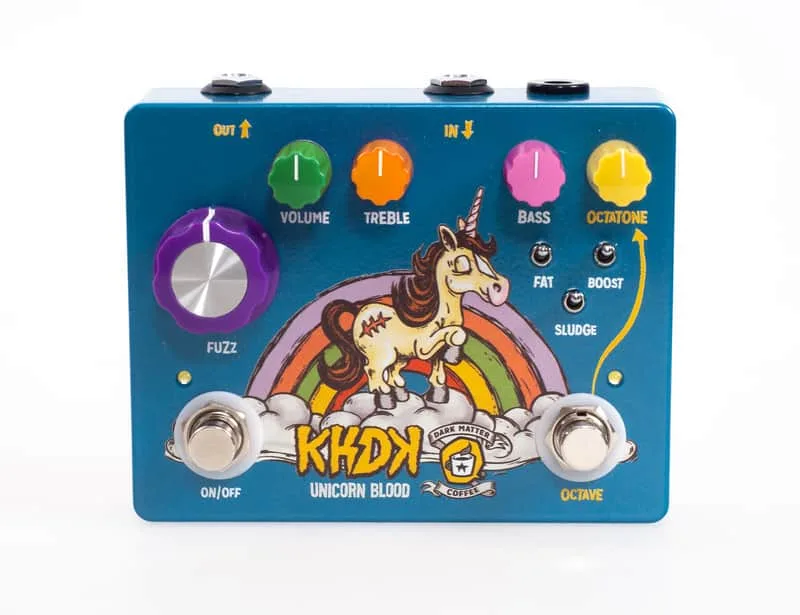
The Scuzz Box sits in KHDK's fuzz lineup next to the Unicorn Blood and Unicorn Blood II. KHDK's David Karon describes the intent behind it: "We created the Scuzz Box to shine through in the mix; it can be used for soloing and long, wailing tones"3.
Where the Unicorn Blood pedals take a different approach, the Scuzz Box is a straight fuzz housed in an acid-yellow and purple enclosure31. Karon says it was built to shine through in the mix, usable for soloing, long wailing tones and power chords3. Dave Catching found that it doesn't mute any notes and maintains clarity, where most fuzz pedals he has tried become a wash of fuzz in rhythm playing3.
Videos
Pete Thorn
KHDK
KHDK
Questions
What is the difference between Fuzz and Scuzz mode on the KHDK Scuzz Box?
Fuzz mode is the more conventional setting: KHDK and reviewers describe it as a highly listenable, go-to fuzz that works for chords and leads. Scuzz mode is the extreme one, a gated, velcro-type fuzz with an 8-bit tone that Pedal of the Day called wicked, gnarly, dangerous and unpredictable. The same four knobs shape both modes.
Does the KHDK Scuzz Box run on a battery?
Yes. KHDK says the pedal is best powered by an external 9V DC center-negative supply, but it also takes a single 9V battery. To reach the battery connection you unscrew the bottom plate of the enclosure, so swapping a battery is not a quick job mid-gig.
What does the buffer switch on the Scuzz Box do?
It switches in a bypassable buffer that eliminates unwanted oscillation from effects placed in front of the pedal, and reduces passive signal loss in longer cables. If your chain ahead of the Scuzz Box is causing the fuzz to squeal or oscillate, engaging the buffer is the fix.
Is the Scuzz Box related to the KHDK Unicorn Blood?
They are siblings in the KHDK fuzz lineup rather than versions of the same pedal. Pedal of the Day notes the Scuzz Box shares the intensity and distortive prowess of the Unicorn Blood II octave fuzz, in a smaller enclosure with fewer controls. The Unicorn Blood line adds an octave-up element the Scuzz Box does not have.
Where is the KHDK Scuzz Box made?
Like all KHDK pedals, the Scuzz Box is crafted and quality-tested in Kentucky, USA, according to the company's product page. KHDK Electronics is the gear company co-founded by Metallica's Kirk Hammett, and the Scuzz Box name came from Hammett himself.
Sources (6)
- Scuzz Box, KHDK Electronics
- KHDK Electronics Scuzz Box Fuzz, Pedal of the Day, 2021-10-04
- KHDK Electronics Unveils the Scuzz Box, Premier Guitar, 2016-07-26
- Kirk Hammett's KHDK Electronics unleashes Scuzz Box fuzz pedal, MusicRadar, 2016-07-26
- KHDK Scuzz Box Fuzz, Delicious Audio, 2017-08-16
- MusicRadar hands-on: DOD Carcosa Fuzz & KHDK Scuzz Box pedals, MusicRadar, 2017-03-01