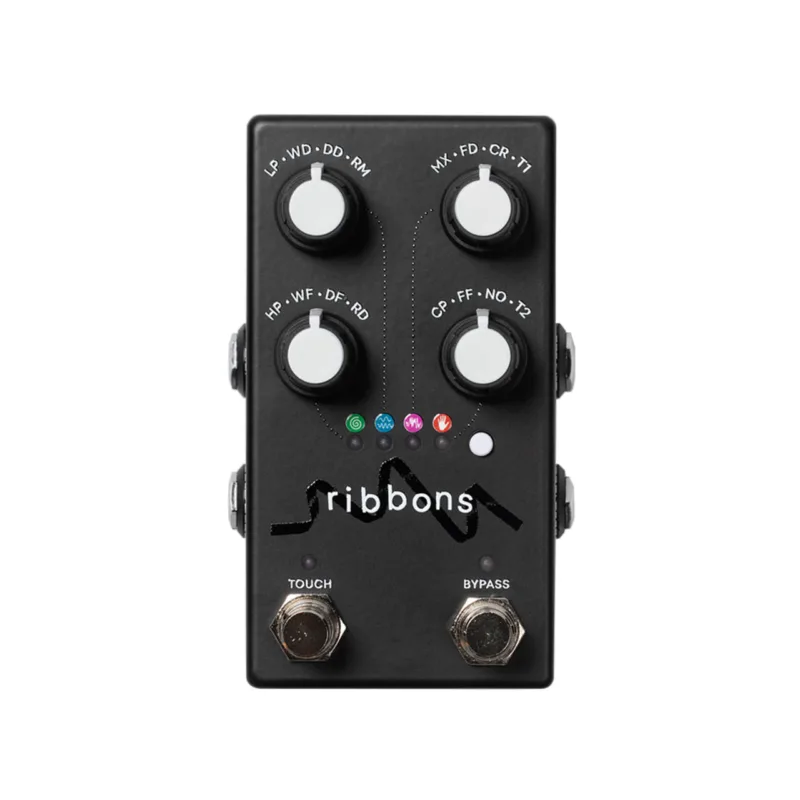


The Kinotone Ribbons is a compact stereo multi-effects pedal that emulates magnetic tape: the wow, flutter, dropouts, crinkle, hiss, clicks and pops of worn cassettes, reel-to-reels and dictaphones, all under real-time control. Kinotone Audio describes it as a toolkit that "celebrates the idiosyncrasies of imperfect mediums"1. Alongside the tape effects it carries a reverb, a 4-track stereo looper, an internal 4-voice sine wave synth, and a set of performance Touch Modes, making it a lo-fi multi-effects unit aimed at players who want to degrade, mangle and age their sound deliberately.
Delicious Audio's Paolo De Gregorio described it as a unit that "can degrade, mangle, and age incoming audio in real-time just like that old reel-to-reel you found at the thrift store," but with more control and flexibility2.
What Ribbons does: tape effects, reverb and looping
Ribbons' tape emulation is built from measured behavior, not guesswork. Kinotone says the random wow and flutter parameters are "modeled after spectral and waveform data collected from all kinds of tape players," from perfectly functioning machines to completely broken ones, including four-track cassette machines, reel-to-reels, dictaphones, mangled cassette loops and tape delays1. The compression algorithm is modeled after the Vinyl Sim compressor used on iconic hip hop records in the early 2000s5, and the filters are modeled after the filter from a very famous 1970s synthesizer1. Delicious Audio notes these are four-pole (24dB/octave) virtual analog low-pass and high-pass filters2.
The main blocks of the pedal:
- Tape effects: wow, flutter, unpredictable dropouts, tape crinkle, and static hiss, clicks and pops6. Dropouts and crinkle process the left and right channels separately, so the stereo image shifts as the tape degrades1.
- Reverb: a stereo reverb whose algorithm draws inspiration from the famous rack reverb units of the 70s and 80s, with what Kinotone calls a simple, elegant and modern-sounding structure1. Pedal of the Day notes it is capable of infinite sustain and decay6.
- 4-track looper: records up to 4 separate stereo loops with infinite overdubs, each track with its own loop speed, speed scale, direction and volume controls4. Looped sounds run through the tape effects6. Track direction works like a tape player capable of bi-directional recording, so any loop can play backwards4.
- Sine wave synth: an internal 4-voice sine wave synthesizer that can be processed through all of the tape effects, Touch Modes and the 4-track looper46.
The controls
The pedal has four knobs whose functions change across four pages of controls7:
| Page | Controls |
|---|---|
| 1 | Mix, LP + HP filters, Compression |
| 2 | Wow and Flutter |
| 3 | Dropouts, Crinkle, Noise |
| 4 | Reverb, Touch Mode Controls |
The compression control (CP) shapes the dynamics of incoming audio and attenuates the loudest sounds4. Crinkle (CR) emulates surface-level imperfections on a wrinkly piece of cassette tape4. A looper volume knob gives a volume control for each looper track1.
Two footswitches run the pedal: the Bypass footswitch engages or disengages the effects, and the Touch footswitch's action depends on which Touch Mode is selected4.
The Touch Modes
Touch Modes are the performance heart of Ribbons. They can be activated momentarily or latched, and some add extra lo-fi character3. At launch there were 4 Touch Modes; there are now 74. As of firmware 2.0, any Touch Mode can be used while 4-track loops are playing back4.
| Touch Mode | LED | What it does |
|---|---|---|
| Magnetic Dance | solid green | Granular micro-looper, tunable to chords, playable forward or backwards; constantly records a one second loop, and pressing Touch starts 4 stereo tape heads dancing around it17 |
| Tape Stop | solid dark blue | Slows down and bends the pitch of audio, then picks it back up, with stop and start times up to 10 seconds17 |
| Broken Machine | solid light blue | Makes a garbled mess of incoming audio, from subtle tape modulation to rewind effects17 |
| Repeater | flickering green | Endlessly repeats a tiny slice of audio, inspired by DJ mixer-style roll and slip effects; loop length set by tap tempo, 1.2 seconds max14 |
| Crushed Cassette | flickering dark blue | μ-law companding prioritizes quiet parts of the signal, giving a bit-crushed sound without gating, so the signal decays more naturally47 |
| Disintegration Loop | flickering light blue | Experimental looper with decay, speed and direction controls; effects are re-applied each time the loop repeats17 |
| UnrealPlayer | solid red | Kinotone calls it "blurry, grainy, bubbly, and strangely reverberous," and says it is "basically the sound of Windowlicker in a pedal"4 |
"Blurry, grainy, bubbly, and strangely reverberous. This Touch Mode feels unmistakably modern. It's basically the sound of Windowlicker in a pedal."
Hardware revisions and firmware
Ribbons has gone through two hardware revisions, and the differences matter if you are buying used3:
| 2022/2023 Revision | 2024 Revision | |
|---|---|---|
| Audio codec | Cirrus Audio 4271 | Burr Brown PCM3060 |
| Max input level | Fixed +2dBu | Instrument level (+3dBu) or line level (+12dBu) |
| Input impedance | 400kΩ | 1MegΩ |
| Current draw | 160 mA | 180 mA |
| Bypass | True bypass (relay), buffered, buffered with trails | High headroom (+18dBu) buffered bypass, with or without trails |
| Power supply protection | Up to +20V, reverse polarity to -20V | Up to +14V, reverse polarity to -20V |
Shared specifications include 32-bit floating point processing on a 480MHz ARM processor, 1 msec latency, 24Hz to 20kHz frequency response, 1kΩ output impedance, and dimensions of 12.1 cm x 6.6 cm x 6.2 cm3.
Firmware has evolved alongside the hardware. The current manual reflects firmware version 2.04, and units made in 2024 onward ship with firmware 2.03. Under firmware 2.0, Ribbons responds to MIDI CC messages 14 through 81 covering all controls, looper tracks, synth parameters, and footswitches4. A factory reset option, introduced in firmware 1.2, restores the default input level, mixing, and bypass options, and preset slots 1-324. The pedal holds 8 factory presets3.
Ribbons needs an isolated +9VDC center-negative supply rated for at least 180 mA4. That rules out a battery, and the isolation requirement means a simple daisy chain with other pedals is not recommended.
MIDI, expression and connections
When MIDI clock is applied, the looper's speed scale knob is disabled, the speed knob offers 0.5x, 1x or 2x, and the looper Tape Stop effect is disabled1. The CV/EXP input has a range of 0-5 volts4.
Where it is made and what reviewers said
Ribbons is built in the United States: circuit boards are assembled in Minneapolis, MN, enclosures are drilled, painted and printed in the USA, and final assembly and testing are performed in Minneapolis3.
On Guitar Pedal X, Stefan Karlsson wrote a very favourable review of the Ribbons in October 2022, calling it possibly the superstar player in its category while admitting he was still unsure where to slot it in his chain overall8. Pedal of the Day highlighted the four playful performance modes that can be activated momentarily or latched, and the fact that both looped sounds and synth voices are affected by the tape effect6.
Videos
The Pedal Zone
Pedal of the Day
BachelorMachinesTV
Questions
Is the Kinotone Ribbons true bypass?
Yes, by default. The 2022/2023 revision offers true bypass using a mechanical relay, plus buffered bypass and buffered bypass with trails. The 2024 revision replaces true bypass with high headroom (+18dBu) buffered bypass, with or without trails.
Does Kinotone Ribbons work in stereo?
Yes. Ribbons passes a stereo in / stereo out signal by default through its TRS input and output jacks, and the dropouts and crinkle effects process the left and right channels separately. The 4-track looper records separate stereo loops.
Which TRS MIDI type does the Ribbons use?
The default is TRS Type A, the standard used by Korg and Make Noise. Internal jumpers let you switch to Type B, used by Arturia, Novation and 1010music, or the CBA type used with the Chase Bliss Audio MIDI Box.
Where is the Kinotone Ribbons made?
In the United States. Circuit boards are assembled in Minneapolis, Minnesota, enclosures are drilled, painted and printed in the USA, and final assembly and testing are also performed in Minneapolis.
Sources (8)
- Ribbons User Manual V1.3, Kinotone Audio, 2024-10-12
- Kinotone Ribbons Magnetic Tape Emulator, Delicious Audio, 2023-02-10
- Ribbons - Kinotone, Kinotone Audio, 2021-09-22
- Ribbons User Manual, Kinotone Audio, 2023-04-03
- Ribbons2.0PaperManual_V10, Kinotone Audio, 2024
- Kinotone Audio Ribbons Lo-Fi Stereo Magnetic Tape Emulator, Pedal of the Day, 2022-09-12
- 2.0ButtonComboCard, Kino Tone Audio, 2024
- Guitar Pedal X, Guitar Pedal X, 2024-07-03