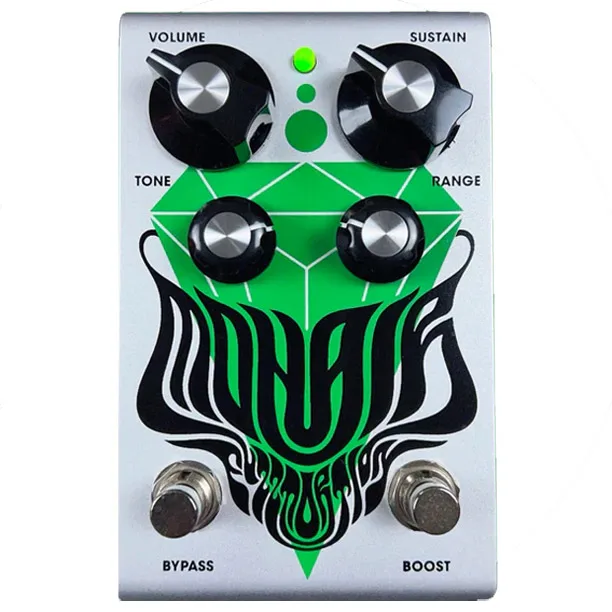


The KittycasterFX Mohair is a fuzz/distortion pedal from KittycasterFX, a small builder based in Portland, Oregon, where the pedal is designed and hand-built. Delicious Audio's Paolo De Gregorio describes it as "a high quality five-transistor fuzz/distortion that offers a modern take on the classic muff sound, providing thick, sustaining leads with a more open, responsive feel"1. MusicRadar, covering its launch, called it "a luxurious and refined take on a classic circuit"2.
What sets the Mohair apart from other muff-style pedals is the second circuit inside the box: a Rangemaster-style treble booster sitting in front of the fuzz, on its own footswitch. That combination, fuzz plus treble booster, is the whole idea of the pedal, which MusicRadar reported under the name Mohair Fuzzstortion2.
A modern take on the muff sound
The Mohair sits in the territory of the fuzz and distortion families, but it is not a straight copy of anything. Delicious Audio states plainly that "It's not a direct clone of any specific design but is fine-tuned for a unique sound and plenty of flexibility"1. MusicRadar's account is that designer Howard Gee landed close to the Ram's Head Big Muff style of fuzz, with the Rangemaster-inspired treble booster in front of it2. There is a small irony in the design: MusicRadar notes that "KittycasterFX mastermind Howard Gee is not a fan of Muff-style fuzz but he has made one anyway"2.
As for what that covers in practice, MusicRadar says the pedal "takes you from 'early '70s classic rock leads to to later '70s treble-boosted overdriven amp riffs to '90s shoegaze walls of sound'"2.
The Range control and boost footswitch
The Mohair has two footswitches: one activates the pedal and the other activates the boost2. The boost circuit is a Rangemaster-style design, the same basic idea as the vintage treble booster, and it is placed in front of the fuzz and footswitchable, so you can move between the plain fuzz and the boosted sound mid-song2.
The Range control belongs to the boost side of the pedal. Delicious Audio explains: "The Range control adjusts the boost thickness, allowing you to switch between tight riffs and sustaining notes"1. MusicRadar adds the detail of how it works and when it is live:
"Range is only active in Boost mode, in which the LED illuminates red and this gives you a variable high-pass filter to c..."2
In other words, the Range knob shapes the low-frequency response of the boost, getting thicker the further clockwise you turn it, and it does nothing when the boost is off2.
Circuit and build
The fuzz side runs on five silicon transistors, and the circuit is put together from discrete, through-hole components, the kind of construction associated with hand-built pedals2. The pedal comes in a wedge-style enclosure2.
MusicRadar reported the Mohair as available in April 20242. KittycasterFX builds it from discrete, through-hole components with five silicon transistors, and describes it as not a direct clone of any specific design but fine-tuned for a unique sound with plenty of flexibility12.
Videos
kittycasterFX
AndyDemos
Mike Hermans
News
Questions
Is the KittycasterFX Mohair a Big Muff clone?
No. MusicRadar reports that designer Howard Gee took the circuit somewhere close to the Ram's Head Big Muff style of fuzz, but Delicious Audio notes it is not a direct clone of any specific design and is fine-tuned for a unique sound. It pairs that fuzz with a Rangemaster-inspired treble booster in front, which sets it apart from a stock muff-style pedal.
What does the Range control do on the Mohair?
The Range control is only active in Boost mode. MusicRadar describes it as a variable high-pass filter that changes the low-frequency response, with the sound getting thicker the further clockwise you turn it. Delicious Audio puts it more simply: it adjusts the boost thickness, letting you switch between tight riffs and sustaining notes. The LED illuminates red in Boost mode.
Does the KittycasterFX Mohair have a separate boost?
Yes. The Mohair has two footswitches: one activates the pedal and the other activates the boost. The boost is a Rangemaster-style circuit placed in front of the fuzz, and it is footswitchable, so you can move between the non-boosted fuzz and the boosted sound on the fly.
Where is the KittycasterFX Mohair built?
The Mohair is designed and built in Portland, Oregon, and Delicious Audio describes it as hand-built there. MusicRadar reported it as available as of April 2024.