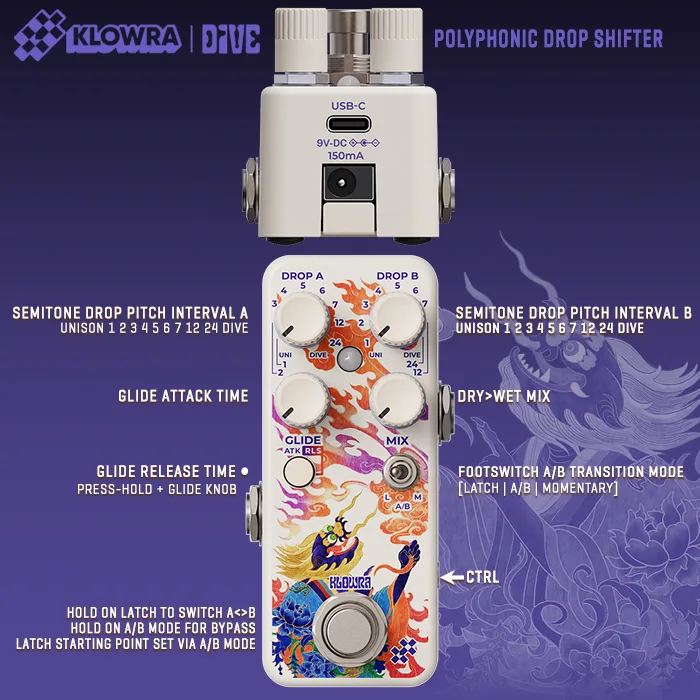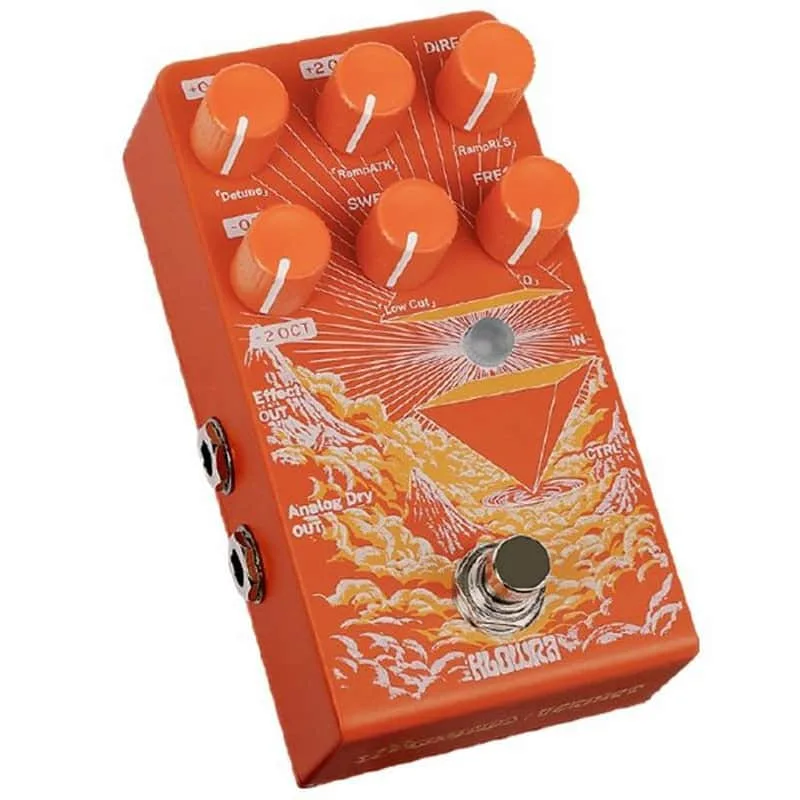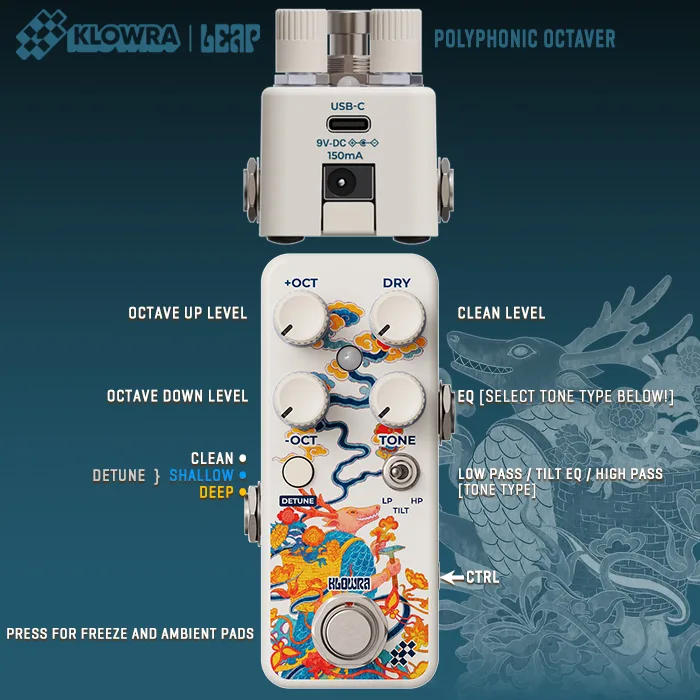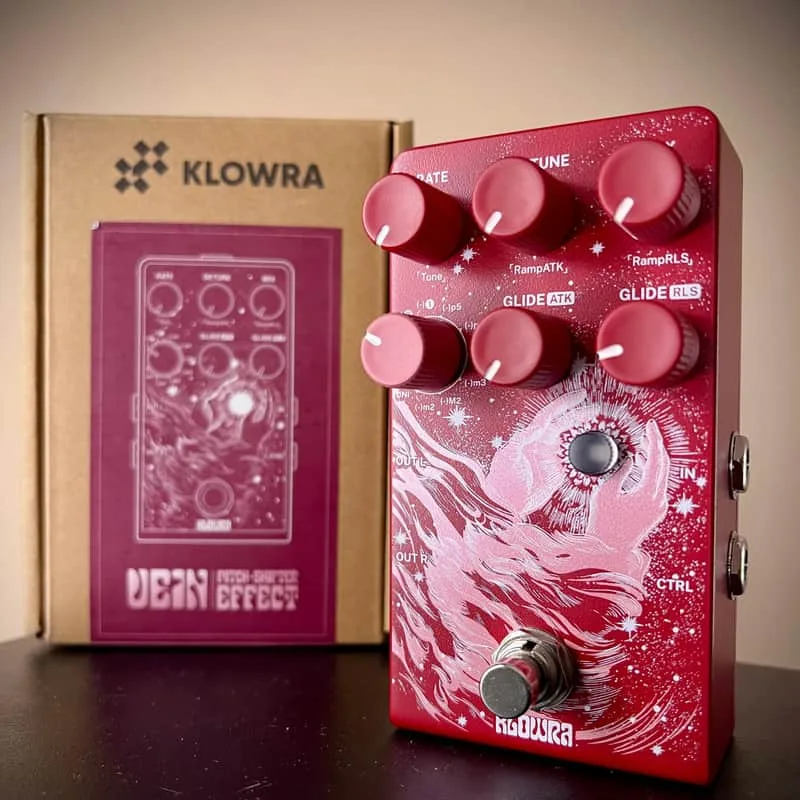


The Klowra Vein is a polyphonic pitch-shifter pedal: it reads the chords and single notes you play and re-voices them at another pitch, from subtle detuning up to two octaves up or down. It is part of Klowra's Bloom Infinity Series, the line with original artist hand-painted silkscreen artwork, and it carries 17 shift and drop types covering detuning, semitone shifts and octave shifts in both directions1. It sits alongside other Klowra pitch and octave pedals such as the Klowra Dive Polyphonic Drop-Shifter, the Klowra Verdict and the Klowra Leap Polyphonic Octaver.
What sets the Vein apart from a basic harmonizer or drop pedal is its ramping and glissando behavior. Rather than snapping instantly to a new interval, it can glide there and back at speeds you set, which opens up whammy-style dives, momentary octave jumps and slow bends without an expression pedal. Guitar Pedal X's Stefan Karlsson called it "a compelling microtonal true stereo shifter with 17 intervals and cool ramping and glissando"1.
The controls and shift modes
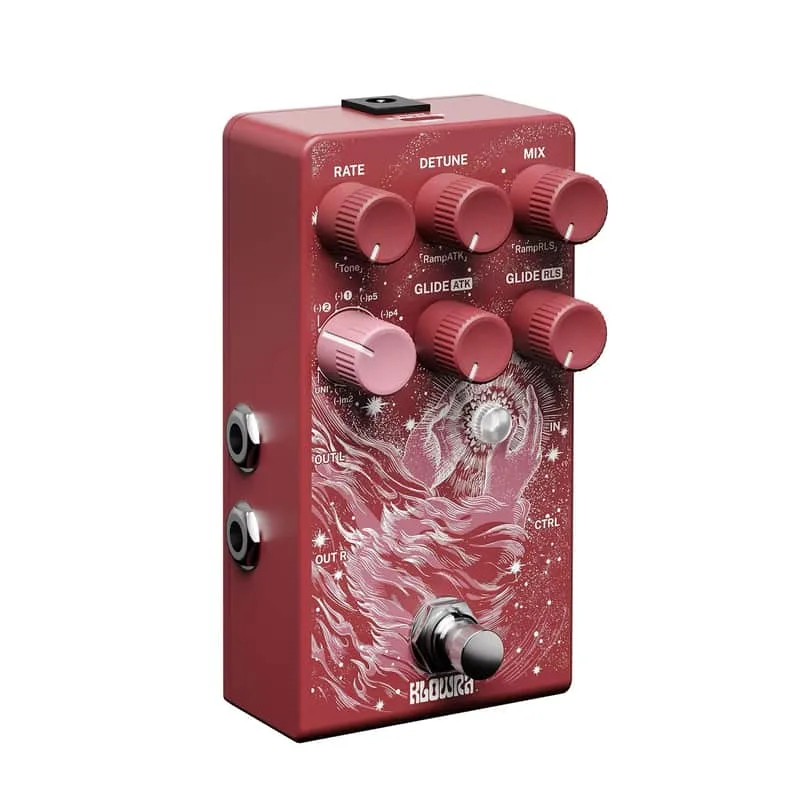
The front panel is built around three knobs that do double duty, a MODE selector, two glide knobs and a footswitch with a press-hold function12.
| Control | What it does |
|---|---|
| RATE [tone] | Sets the tone in normal use; also selects dry/wet separation for the outputs1 |
| DETUNE [ramp attack time] | Sets the detune amount; in ramp mode it sets how fast the ramp attacks12 |
| MIX [ramp release time] | Sets the wet/dry blend; in ramp mode it sets how fast the ramp releases12 |
| MODE | Selects the interval: ±(2), ±(1), ±p5, ±p4, ±M3, ±m3, ±M2, ±m2, UNI1 |
| GLIDE ATK | Sets how quickly the pitch glides up to the target interval1 |
| GLIDE RLS | Sets how quickly the pitch glides back down1 |
| LED button | Accesses the ALT layer of controls2 |
| Footswitch (press-hold) | Triggers glide or ramp momentarily2 |
The MODE positions are worth decoding for anyone new to interval names. ±(2) is up or down 24 semitones, two full octaves, and ±(1) is up or down 12 semitones, one octave12. From there the intervals narrow through perfect fifth (p5), perfect fourth (p4), major third (M3), minor third (m3), major second (M2) and minor second (m2), down to UNI, which puts the shifted voice at the same pitch as your original note1. Pedal of the Day describes the KBS-04 Vein as offering dual-preset interval switching spanning 4 octaves, with independent attack and release controls and a dedicated ramp function3.
The glide and ramp functions are where the pedal gets expressive. Set a wide interval on MODE, dial in a fast GLIDE ATK, and the press-hold footswitch gives you a momentary two-octave jump that swoops in and out on demand. Slow the attack down and the same setting becomes a gradual bend. Guitar Pedal X's reviewer noted that he personally mostly uses pitch-shifters for exactly this move321:
"I personally mostly use Pitch-Shifters for that Tom Morello 2-Octave Momentary and Fast Glide-Up - which this one accomplishes"1
Power and connections
The Vein runs on a 9V DC center negative power supply drawing 250 mA, and a supply is required: there is no battery option1. At 250 mA it is a hungrier pedal than most analog drives, so it is worth checking that your power supply's isolated outputs can cover it before it goes on the board.
The connection layout is straightforward1:
- Left input (1/4" TS)
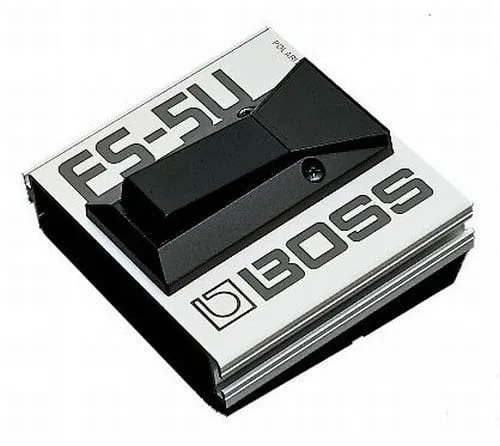
- CTRL / EXP socket for a TS or TRS momentary footswitch or a TRS expression pedal
- Left output (1/4" TS)
- Right output (1/4" TS)
- 9V DC center negative power
The CTRL / EXP socket is the hands-free route into the pedal's pitch behavior: an expression pedal sweeps the shift, while a momentary footswitch duplicates the press-hold glide and ramp triggering1. For more on that side of things, see expression pedals.
On the output side you can run true stereo, with the two outputs carrying a proper stereo image, or switch to dry/wet separation via the RATE knob so one output carries your clean signal and the other the shifted signal1. Pedal of the Day highlights the microtonal true stereo engine's ability to simulate Automatic Double Tracking, the studio effect of doubling a part with slight pitch and timing differences for width3. Bypass is switchable between true bypass and buffered bypass with analog dry-through, so your dry signal can stay fully analog even when the effect is engaged13.
Latency
Every digital pitch-shifter has some delay between what you play and what you hear, and the Vein's numbers are reported two ways. Guitar Pedal X measured it at 10 to 12 ms in June and July 202645. Pedal of the Day's October 2026 review of the KBS-04 Vein instead describes an 8 ms ultra-low latency polyphonic tracking algorithm, calling it industry-lowest3.
What reviewers said
"I feel it's a very precise and elegant effect - and in its output quality it's right up there with the Limbo and Everlast"1
Pedal of the Day's October 2026 review of the KBS-04 Vein was warmer still, opening with a broad endorsement of the maker3:
"Everything so far from our friends at Klowra has been impressive…MOST impressive"3
That review covers the pedal's polyphonic tracking, its four effect modes, the stereo features and the bypass options, and it echoes the same selectable true or buffered bypass and dual-preset interval switching described above3. The reviewer calls the Vein "a very precise and elegant effect" whose "output quality it's right up there with the Limbo and Everlast"1, and neither review reports a significant criticism of the pedal itself, though the latency figures above show the two outlets do not agree on the tracking number.
Where it sits in the Klowra lineup
The Vein is one of several Klowra pedals covering pitch and octave territory. The Klowra Dive Polyphonic Drop-Shifter is the company's take on drop tuning. The Klowra Verdict is a four-voice polyphonic octave generator, and the Klowra Leap Polyphonic Octaver covers compact polyphonic octave ground. The Vein is the interval-shifting member of the family, the one for harmonized intervals, detuning and glide effects rather than straight octave doubling or drop tuning. Within the Bloom Infinity Series, it sits at $149 versus the $129 of the others21. For the wider category, see octave and pitch pedals.
Videos
KLOWRA
KLOWRA
KLOWRA
Questions
How much latency does the Klowra Vein have?
Guitar Pedal X measured the Vein at 10 to 12 ms in two separate 2026 articles. Pedal of the Day's October 2026 review of the KBS-04 Vein instead describes an 8 ms ultra-low latency polyphonic tracking algorithm, calling it industry-lowest.
Is the Klowra Vein true bypass?
It is switchable. You can run it in true bypass or in buffered bypass with analog dry-through, meaning your unprocessed signal stays in the analog domain while the shifted signal is added. Pedal of the Day lists the same selectable true or buffered bypass options for the KBS-04 Vein.
Can the Klowra Vein do a momentary two-octave glide?
Yes. The MODE control includes plus or minus two octaves, and the press-hold footswitch triggers glide or ramp, with GLIDE ATK and GLIDE RLS knobs setting how fast the pitch arrives and leaves. Guitar Pedal X's reviewer specifically uses it for a Tom Morello style two-octave momentary fast glide-up.
Does the Klowra Vein take an expression pedal?
Yes. The CTRL / EXP socket on the side accepts a TRS expression pedal, or a TS or TRS momentary footswitch. That gives you hands-free control over the shift, ramp or glide behavior while you play.
Is the Klowra Vein stereo?
Yes. It has two 1/4 inch TS inputs and two 1/4 inch TS outputs, with true stereo outputs selectable, or dry/wet separation via the RATE knob. Pedal of the Day describes a microtonal true stereo engine that can simulate Automatic Double Tracking.
Sources (5)
- Guitar Pedal X, Guitar Pedal X, 2025-07-25
- Guitar Pedal X, Guitar Pedal X, 2025-12-09
- Klowra KBS-04 Vein Stereo Polyphonic Pitch Shifter, Pedal of the Day, 2026-10-18
- Guitar Pedal X, Guitar Pedal X, 2026-06-18
- Guitar Pedal X, Guitar Pedal X, 2026-07-01