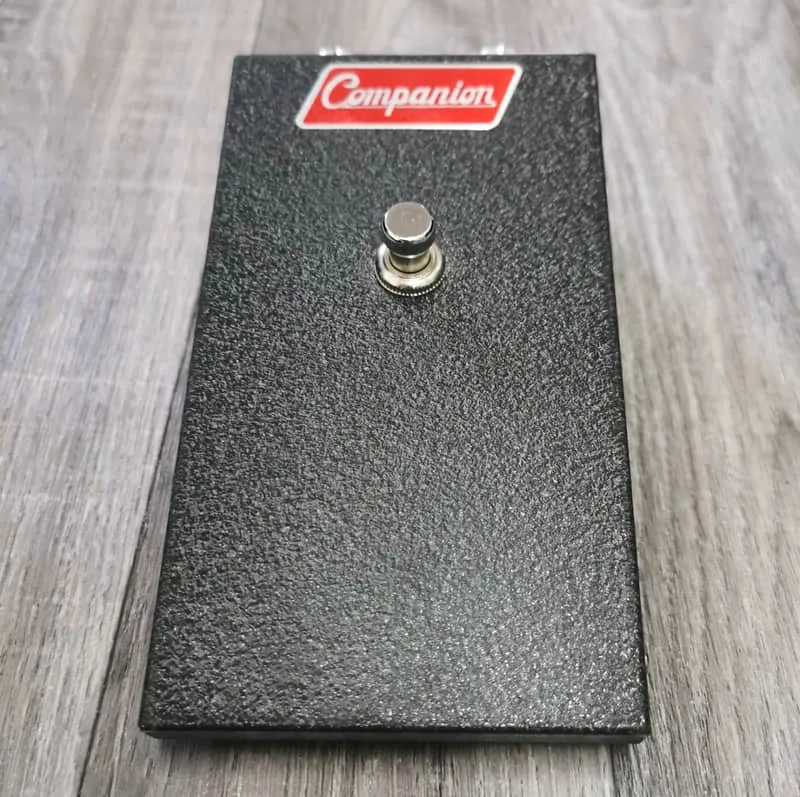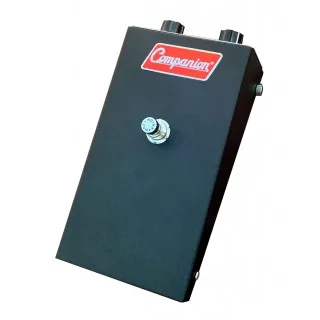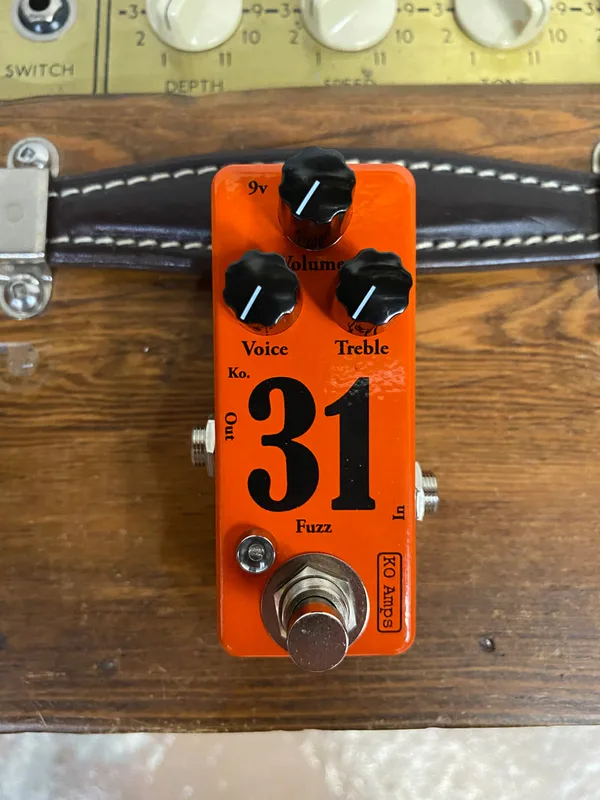
The KO Amps Ko. 31 Fuzz - Orange is an analog fuzz pedal from KO Amps that runs full fuzz all the time, with a built-in volume boost to push above unity volume. RockBoard's PedalPedia describes it as a highly modified Shin-ei Companion fuzz, a circuit that dates back to 1970, and lists it as a fuzz booster: two functions in one enclosure1.
What it does
The Ko. 31 keeps the fuzz on at all times and uses the boost stage to set how loud it sits in the mix. The same approach appears in the General Guitar Gadgets Shin-Ei Companion Fuzz replica project, which adds a transparent booster stage on the output to greatly increase the volume output without altering the sound of the fuzz2. On the Ko. 31, RockBoard's PedalPedia describes the boost as a built-in volume boost to go above unity volume1.
Two controls shape the fuzz itself:
The voice control is the pedal's main tonal tool. A midrange scoop cuts a band out of the middle of the sound, and being able to move where that scoop sits changes how the fuzz sits against the rest of a band, or how much low end survives on bass1.
Bass and the Companion circuit
RockBoard's PedalPedia says the Ko. 31 shines on bass1, which is worth noting for a fuzz, since many fuzz designs thin out badly on bass guitar. Between the voice control and the treble control, a bass player has two ways to keep fundamentals intact under the fuzz.
The circuit it modifies has history. Coda Effects traces the Companion Fuzz to 1970, created by Shin Ei3. Shin-ei today sells a reproduction of the original as the Shin-ei Companion FY-2 Fuzz Box Reproduction, available in Woodstock White, Sea Foam Fuzz and Metallic Green, with vintage style labels including the Official Companion Foil Emblem4. The Ko. 31 takes that circuit as its starting point and modifies it heavily, adding the boost stage and the tone shaping the original FY-2 did not have.
The Ko. 31 Fuzz runs on 9V DC, center negative, and draws 8mA1. That is a modest draw, but the polarity protection does not replace correct wiring: use a center negative supply as specified.
Related pedals
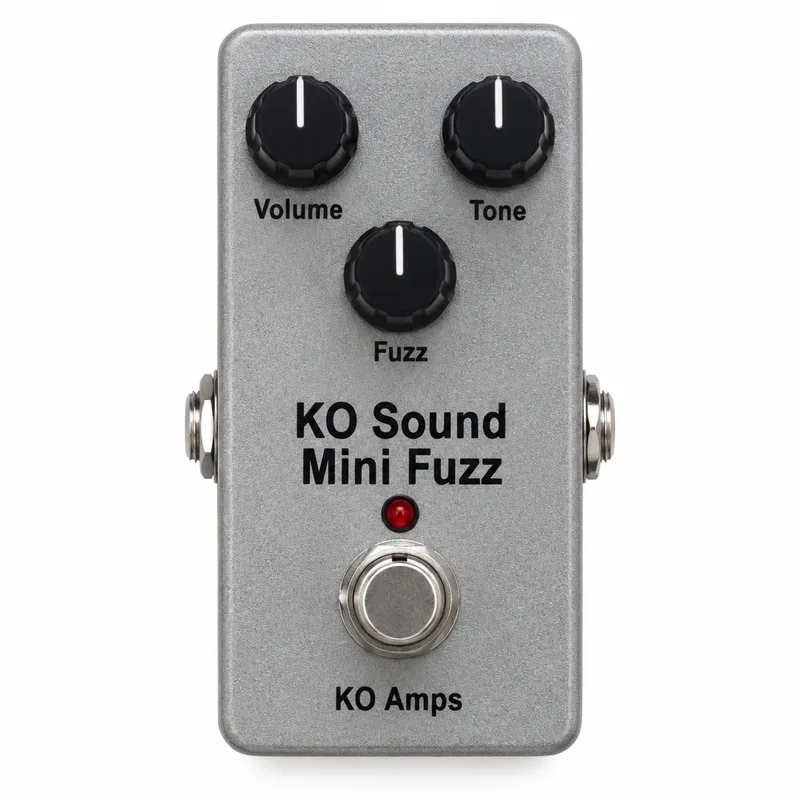
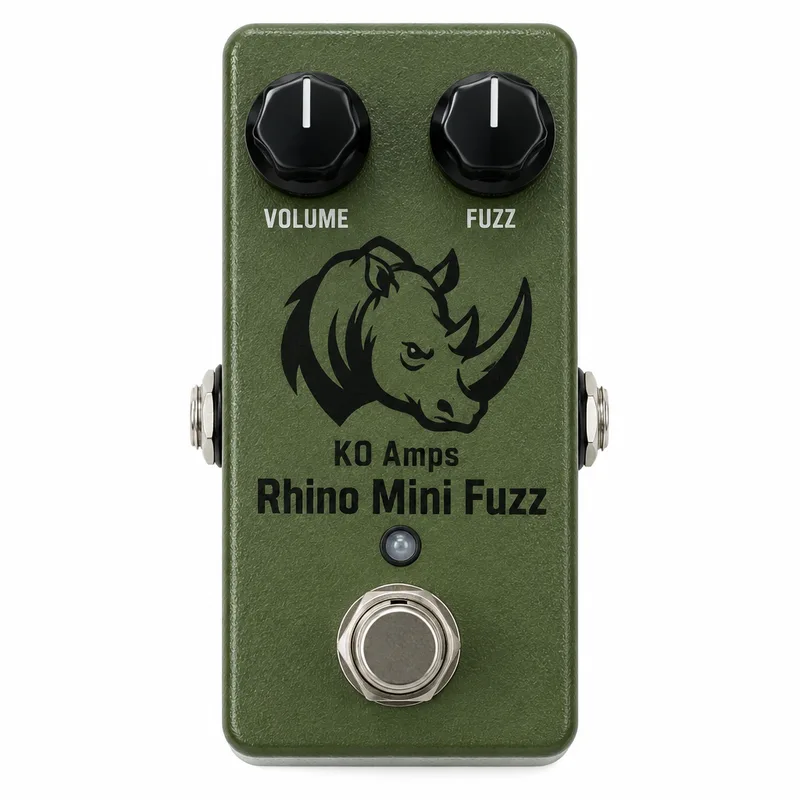
KO Amps also builds other fuzzes, including the KO Sound Mini Fuzz and the Rhino Mini Fuzz. For the unmodified take on the original circuit, see the Shin-ei Companion FY-2. For more circuits in this family, see Fuzz Pedals45.
Questions
Is the KO Amps Ko. 31 Fuzz true bypass?
Yes. KO Amps lists the Ko. 31 Fuzz as true bypass with polarity protection, so the pedal is out of the signal path when switched off and the polarity protection adds a measure of safety against a wrongly wired power supply.
What power does the KO Amps Ko. 31 Fuzz need?
The Ko. 31 Fuzz runs on 9V DC with a center negative plug, the same standard supply most pedalboards use. It draws 8mA, a small enough draw that it sits comfortably on a shared supply with other pedals.
How much current does the Ko. 31 Fuzz draw?
KO Amps lists the current draw at 8mA, which is low for a fuzz pedal and easy to accommodate on any standard 9V DC center negative supply.
Is the Ko. 31 Fuzz analog?
Yes. The circuit is analog, in keeping with the Shin-ei Companion fuzz design it is based on, a circuit that dates back to 1970.
Does the Ko. 31 Fuzz work well on bass?
KO Amps says the pedal shines on bass. The voice control, which shifts the midrange frequency scoop, is the likely reason: adjusting where the scoop sits lets a bass player keep the low end and midrange fundamentals in place under the fuzz.
What is the Shin-ei Companion fuzz?
The Shin-ei Companion fuzz is a fuzz circuit created in 1970 by Shin Ei, originally sold as the Companion FY-2 Fuzz Box. Shin-ei today offers a reproduction of the FY-2, and the Ko. 31 Fuzz is described as a highly modified version of that circuit.
Sources (5)
- Ko. 31 Fuzz, RockBoard PedalPedia, 2026
- Shin-Ei™ Companion Fuzz™ Clone: DIY Kit, PCB & Schematic, General Guitar Gadgets, 2014-05-15
- Coda Effects, Coda Effects, 2015-08
- Shin-ei Companion FY-2 Fuzz Box, Shin-ei
- Earthquaker Devices Terminal Fuzz review | MusicRadar, MusicRadar, 2014-11-14