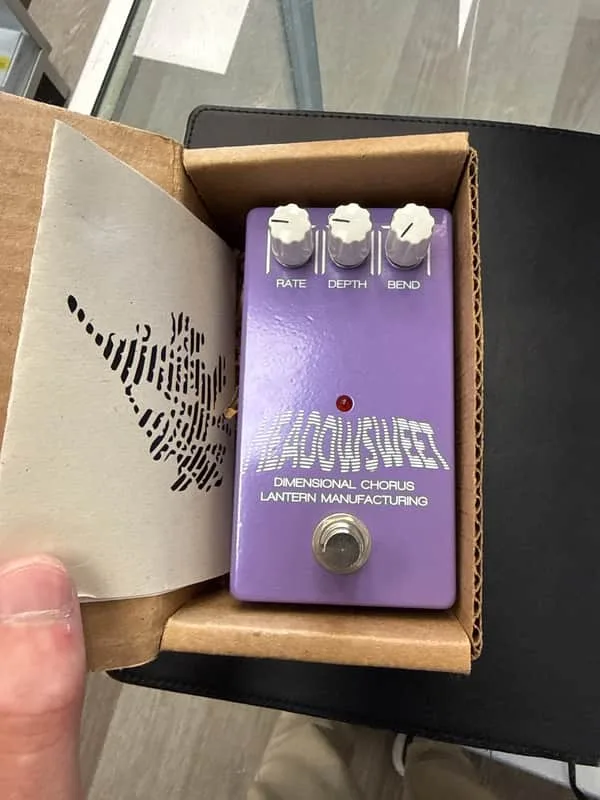


The Lantern Manufacturing Meadowsweet is a chorus pedal with an unusual engine: instead of the typical analog BBD chip or a digital circuit, it is built around four PT2399 chips, giving it four distinct voices, each with its own individual delay times, two shorter and two longer1. Delicious Audio's Paolo De Gregorio describes it as a very peculiar chorus effect, a "dimensional" chorus ensemble with a lush quality and a sense of motionlessness1.
The pedal drew wider attention at the end of 2022, when the JHS Show highlighted it among its picks for the year1.
How it works
Most chorus pedals use a single bucket-brigade device or a digital delay line. The Meadowsweet instead runs four PT2399 chips, the delay chip more often found in budget delay and reverb circuits, as the heart of the effect1. Each chip is a separate voice with its own delay time, and the pedal also employs a standard and an inverted LFO signal, with one of each set of PT2399s receiving a standard and inverted LFO signal1. That pairing of standard and inverted modulation is what gives the ensemble its described sense of motionlessness1.
The controls: Rate, Depth and Bend
| Control | What it does |
|---|---|
| Rate | Controls the speed of an LFO and its inverted signal; turn right or left to increase or decrease the speed1 |
| Depth | Controls the depth of the chorus effect; below noon is more subtle, beyond noon a lush soundscape opens up1 |
| Bend | Controls the delay time of the two PT2399 chipsets with longer delay times, one signal inverted from the other1 |
Bend is the control that sets the Meadowsweet apart from a conventional chorus pedal. Up to around noon it enriches the chorus; past noon it adds proportional reverb and delay just beyond slap back echo1.
"This control is called 'Bend' because of its ability to create a tape-like 'wow' effect when the Depth and Bend knobs are both set past noon clockwise."
Power
The Meadowsweet uses a standard 9VDC center negative power supply and does not take batteries1. It draws roughly 137mA during operation, and powering up may take more current1.
With no battery option and a current draw of roughly 137mA during operation, the Meadowsweet needs a dedicated supply output rather than a low-current daisy chain1.
Lantern Manufacturing's other pedals
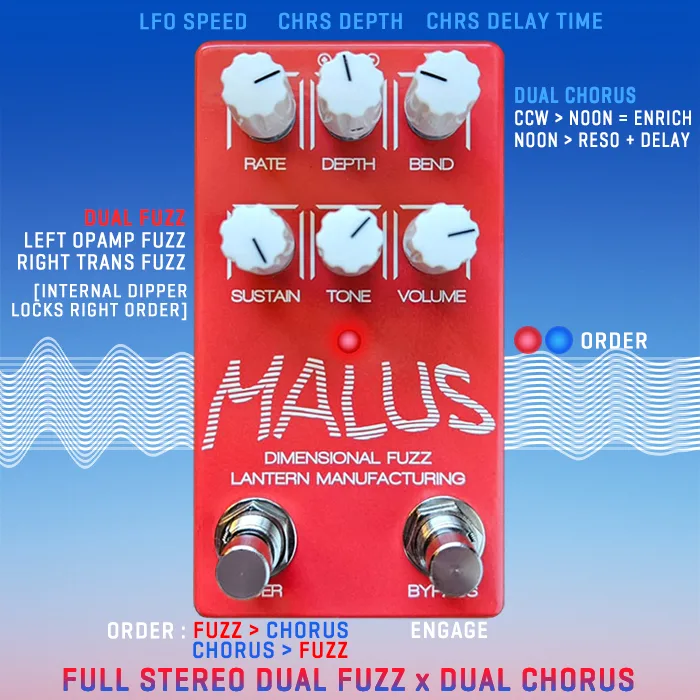
Lantern Manufacturing has since expanded its range of unusual modulation and fuzz designs with the Malus Dimensional Fuzz, a stereo dual fuzz and dual chorus pedal2.
Videos
Lantern Manufacturing
Lantern Manufacturing
collector//emitter
Questions
Is the Lantern Manufacturing Meadowsweet analog or digital?
Neither, in the usual sense. Instead of the typical analog BBD chip or a digital circuit, the Meadowsweet is built around four PT2399 chips, used as the core of the effect. Each chip carries its own voice with its own delay times, two shorter and two longer, which together produce the pedal's dimensional chorus ensemble.
Does the Meadowsweet take a battery?
No. The Meadowsweet uses a standard 9VDC center negative power supply and does not accept batteries, so plan your pedalboard power accordingly.
What polarity does the Meadowsweet power supply need?
A standard 9VDC center negative supply. The pedal draws roughly 137mA during operation, and powering up may take more current, so a supply with adequate headroom is worth having.
How do you get a tape-like wow sound from the Meadowsweet?
Set both the Depth and Bend knobs past noon, clockwise. The control is called Bend because of its ability to create a tape-like wow effect in that range, and more Depth means more wow.
What does the Bend knob do on the Meadowsweet?
Bend controls the delay time of the two PT2399 chipsets with longer delay times, one signal inverted from the other. Up to around noon it enriches the chorus; past noon it adds proportional reverb and delay just beyond slap back echo, and with Depth past noon it produces the tape-like wow.
Sources (2)
- Lantern Manufacturing Meadowsweet Chorus, Delicious Audio, 2023-04-08
- Guitar Pedal X, Guitar Pedal X