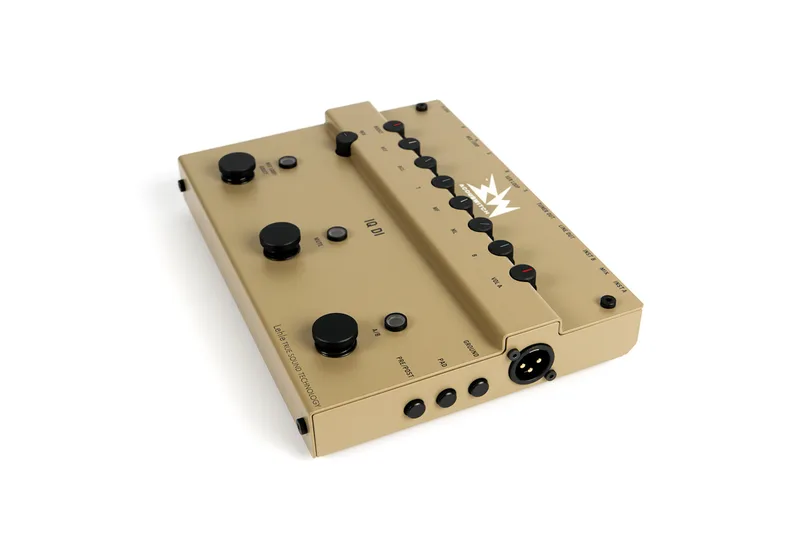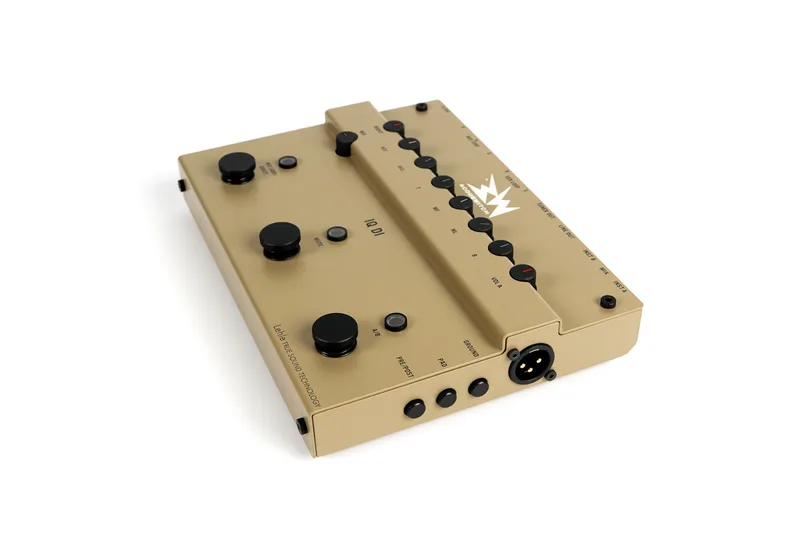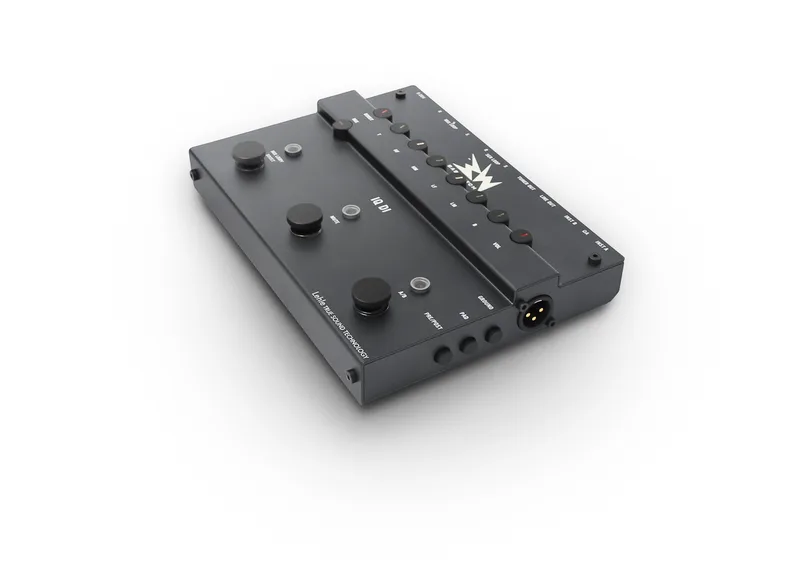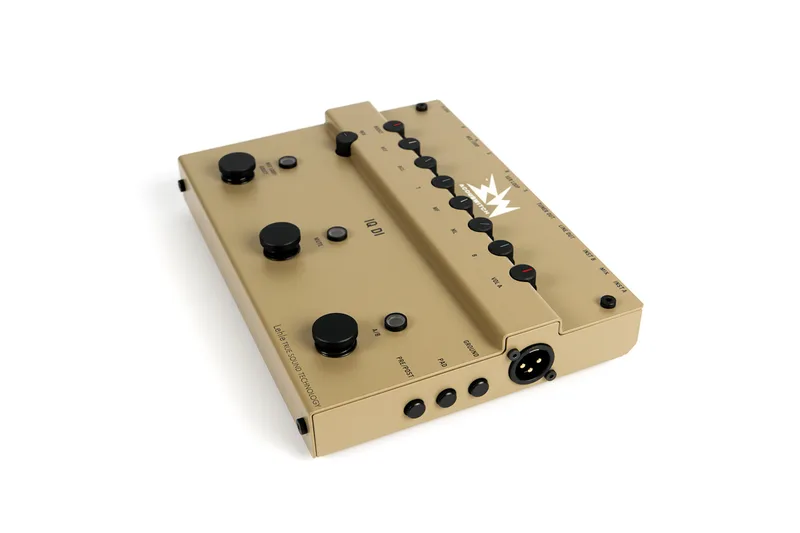



The RMI ACOUSWITCH IQ DI is a floor unit for acoustic players that packs several jobs into one box: an A/B input switcher, a high-end preamp, a clean booster, a parametric EQ, an FX looper and a DI box1. It was conceived by Jacques Ruppert of Ruppert Musical Instruments and manufactured, assembled and tested in Germany by Lehle on RMI's behalf21. Premier Guitar described the scale of it plainly: "it's home to two channels (through which you can run separate instruments), eight I/Os, nine knobs, three footswitches"3.
The unit is now discontinued; Lehle's product page is marked as such2.
A switcher, preamp and DI box for acoustic instruments
The core idea is that an acoustic player with one or two instruments can carry a single box to a gig and cover switching, shaping, boosting, effects routing and feeding the mixing desk. The two instrument inputs, A and B, each present a 5 MOhm input impedance, which Lehle states makes the unit suitable for piezo, magnetic and active pickups21.
The two channels treat the signal differently:
- Channel A runs through a high-end preamp and a 3-band EQ designed for acoustic instruments, with bass, semiparametric mids and treble controls1.
- Channel B has no preamp or EQ, keeping the signal pure and unprocessed1.
The EQ section includes a semiparametric mid band covering 100 Hz to 6 kHz with a gain range of +/-18 dB (peaking), set by the Mid Level control21. A separate Body-Contour-Control works two ways: as a narrow notch filter from 45 Hz to 500 Hz to reduce feedback, or as a broad low to low-mid boost2.
The DI output is a studio-grade XLR out with Pad, Pre/Post and ground lift switches, and it includes a Lehle LTMZ transformer for galvanic isolation2. The manual notes that both the DI Out and the Line Out can handle a frequency range from 20 Hz to 100 kHz (linear) and levels up to 16 dBU through the transformer1.
Effects routing is flexible. There is a serial loop plus a Mix Loop, and the Mix Control sets the ratio of effect added to the original sound, from 0% dry to 100% wet21. A dedicated TUNER OUT keeps the tuner out of the signal path, which the manual says prevents potential sound losses1.
The controls and footswitches
Premier Guitar counted nine knobs, three footswitches and two mini toggles across the unit3. The three footswitches and the main controls:
| Control | What it does |
|---|---|
| A/B footswitch | Toggles between input INST A and input INST B, and between channel A and channel B1 |
| MUTE footswitch | Activates MUTE for tuning or stand-by; mutes LINE OUT and D.I. OUT1 |
| MIX LOOP/BOOST footswitch | Third footswitch, listed with MUTE and A/B1 |
| PAD button | Attenuates the output signal to match the microphone input of a mixing desk1 |
| Mix Control | Sets the effects ratio from 0% (dry) to 100% (wet)2 |
| Mid Level (ML) | Sets the amount of mids, +/-18 dB at 100 Hz to 6 kHz (peaking)1 |
The MUTE function is worth noting for gigging: pressing it silences the LINE OUT and D.I. OUT so you can tune quietly between songs1.
Power: 9 to 20V AC or DC, 150 mA
The Acouswitch IQ DI accepts any power supply delivering not less than 9V, not more than 20V, and at least 150 mA2. Either alternating (AC) or direct current (DC) sources can be used, and the polarity is not relevant2. Internally the supplied voltage is rectified, filtered, stabilised and then brought to 18V1.
The unit is not suitable for battery operation. The manual states that its power consumption is too high for it to run satisfactorily on batteries, so plan on a mains or pedalboard power supply that can deliver at least 150 mA1.
Specifications
| Specification | Value |
|---|---|
| Input impedance | 5 MOhm per input (A and B)1 |
| Output impedance | 150 Ohm1 |
| Max. level | 4.5 V RMS (ca. 15 dBU)1 |
| Max. gain | +/- 15 dB1 |
| Distortion | 0.005 %1 |
| Frequency range | 50 Hz (low cut filter) to 100 kHz (+/- 0.2 dB)1 |
| Signal-to-noise ratio | -92 dB at 1 kHz, 0 dBU (A weighted)1 |
| Weight | 1,375g1 |
| Dimensions | Length 16.2 cm, width 22.0 cm, overall height 4.2 cm1 |
Lehle also describes the enclosure as an extremely robust design with protected controls2, which matters for a unit meant to sit at your feet with two instruments plugged into it.
Where it came from and what reviewers said
The Acouswitch IQ DI was conceived by Jacques Ruppert, described by Lehle as the mastermind of Ruppert Musical Instruments, and built in Germany to the company's quality standards21. Premier Guitar reviewed the unit in August 2021 and framed its density of features as its defining trait, counting the two channels, eight I/Os, nine knobs, three footswitches and mini toggles3.
"it's home to two channels (through which you can run separate instruments), eight I/Os, nine knobs, three footswitches"
For a player comparing options today, the closest categories on this site are preamp pedals, acoustic pedals and switching pedals, since the Acouswitch IQ DI combines all three functions along with a DI output. As a discontinued unit, it is one to look for on the second-hand market rather than new12.
Videos
Jacques channel
musikmachen.de
Jacques channel
Questions
Can the RMI Acouswitch IQ DI run on a battery?
No. The manual states that the power consumption of the Acouswitch IQ DI is too high for it to run satisfactorily on batteries. It needs an external power supply delivering 9 to 20 volts AC or DC and at least 150 mA, and the polarity of the supply is not relevant.
Who designed the RMI Acouswitch IQ DI?
The Acouswitch IQ DI was conceived by Jacques Ruppert, the designer behind Ruppert Musical Instruments. The unit is manufactured, assembled and tested in Germany by Lehle on behalf of RMI.
Is the RMI Acouswitch IQ DI discontinued?
Yes. Lehle's product page for the RMI ACOUSWITCH IQ DI is marked discontinued, so the unit is no longer in production. It may still be found on the second-hand market.
Can I run two acoustic pickups at the same time on the Acouswitch IQ DI?
You can connect two separate instruments or pickups to inputs INST A and INST B, each with a 5 MOhm input impedance, and toggle between them with the A/B footswitch. Channel A runs through the preamp and EQ while channel B stays unprocessed, so each input gets a different signal path.
Does the Acouswitch IQ DI work with piezo pickups?
Yes. Lehle states that thanks to its high input impedance of 5 MOhm the Acouswitch IQ DI is suitable for piezo, magnetic and active pickups. The high impedance loads a passive piezo lightly, which preserves its level and frequency response.
Sources (3)
- EN.indd, Ruppert Musical Instruments, 2023
- RMI ACOUSWITCH IQ DI (DISCONTINUED), Lehle GmbH
- Ruppert Musical Instruments Acouswitch IQ DI Review, Premier Guitar, 2013-04-15