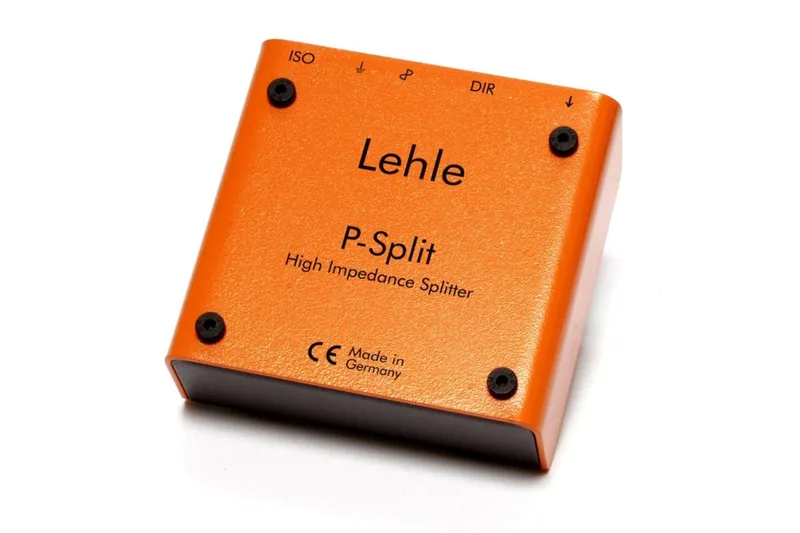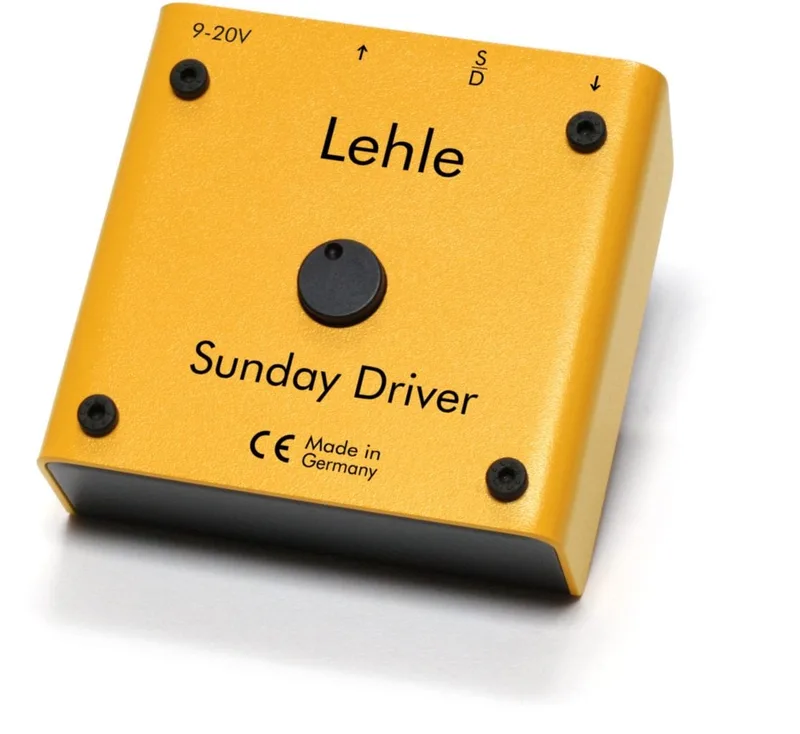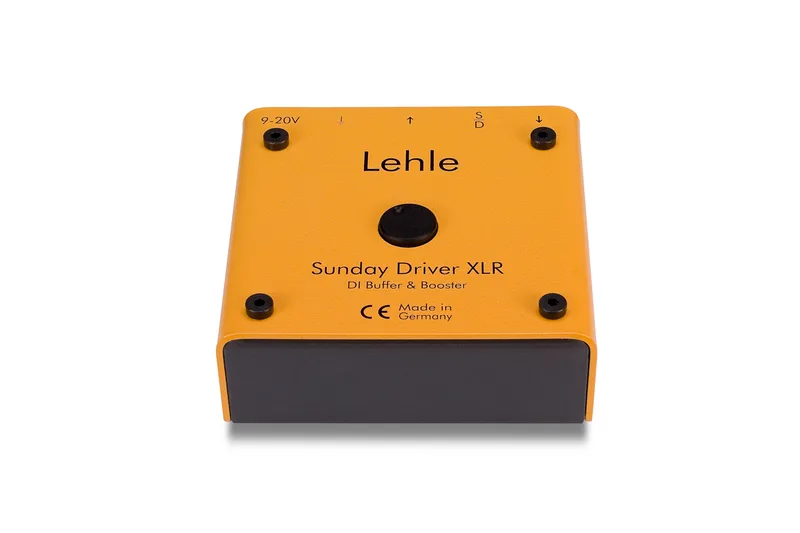
The Lehle Sunday Driver XLR is a compact-format high-end preamp pedal for all types of electric and acoustic instruments, built around JFET circuitry that does two jobs at once: it lowers the signal's impedance and boosts it1. Lehle describes it as staying clean throughout, with no distortion at any stage and a signal that remains clean even at the maximum gain setting of 15 dB1. On stage, Lehle positions it as a compact DI box and a line driver for long cable distances2.
The Sunday Driver XLR is discontinued; Lehle lists it as such on its product page2. It was made and tested in Germany1.
What the Sunday Driver XLR does
The JFET-based circuitry reduces signal impedance and boosts the signal simultaneously1. Lehle says the result is a studio-standard signal-to-noise ratio of better than -100 dB and a broad output range of 20 to 100,000 Hz2. Distortion is specified at 0.001 % at 1 kHz, 0 dBU, with a maximum level of 5.1 V RMS (approximately 16 dBU)1.
Because the output impedance is 110 Ohm, the unit can drive long cable runs without the losses that high-impedance passive pickups suffer over distance1. Lehle says that when used as a cable driver with a Lehle P-Split II, the signal sustains full sound quality even at cable runs of 100 meters (approximately 300 ft)1.
The controls: gain and the D and S modes
The pedal has two modes, D for "Driver" and S for "Sunday", selected by a switch with gold-plated contacts1.
| Control | What it does |
|---|---|
| Input socket (1) | Connect your instrument; processes signals from electric and acoustic stringed instruments1 |
| S/D selector switch (2) | Selects the sound mode; gold-plated-contact switch changes between the two modes1 |
| Gain controller (6) | Adjusts the intensity of the preamp, from a slightly refreshed sound level up to a powerful boost1 |
| External power supply socket (5) | Connect a power pack for 9 to 20 V when needed1 |
In mode D, the input signal is amplified with absolutely no modification, which Lehle says eliminates signal losses from long cable routings and impedance matching errors with high-impedance passive pickups21. Input impedance in D mode is 1 MOhm1.
Mode S multiplies the input impedance by four, to 4 MOhm, bringing out previously inaudible details21. Lehle says the sound takes on a characteristic warmth as gain increases, and that in S mode the unit amplifies less treble at higher boost settings so the resulting overdrive distortion sounds harmonious, from pleasant with no shrillness up to a silky, warm overdrive distortion on tube amplifiers1.
With the gain controller at the left-hand stop, the 0 or seven o'clock position, the unit operates purely as an impedance converter, refreshing the sound to equalize losses from long cables or effects cascades1. The gain knob is black anodized aluminum, recessed into the housing so the setting cannot be disturbed on stage or in transit1.
Power and connections
The Sunday Driver XLR runs on an external power supply of 9 to 20 V, and polarity is not important: both AC and DC sources can be used1. Internally, the input voltage is rectified, filtered, stabilized and then doubled to 18V2. Maximum battery consumption is 19 mA1.
It can also run on a 9V (PP3) block battery, installed by removing the cover, which is held by four screws1.
In battery mode, the battery circuit is automatically activated whenever a cable is connected to the input socket, so Lehle advises always pulling the plug after a session1.
The XLR output is balanced, with a ground-lift switch1. The pin assignment is standard: pin 1 shield, pin 2 signal in phase, pin 3 signal out of phase1.
How it differs from the Sunday Driver
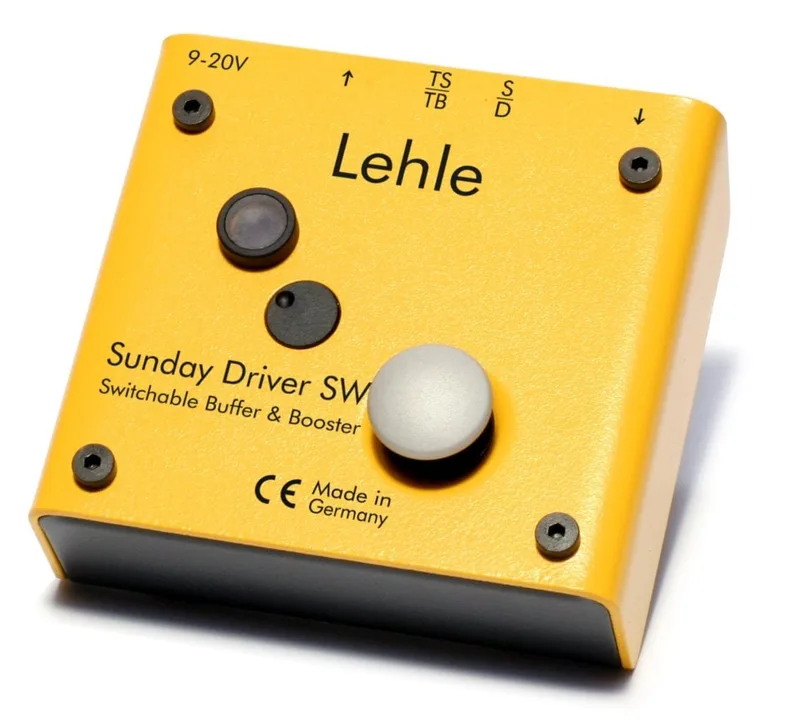
The XLR variant's defining feature is its balanced XLR output and ground-lift switch1. Lehle recommends the XLR version for cable runs longer than 20 m, and says unbalanced signals from the Sunday Driver and Sunday Driver SW are fine up to 20 m2. For players sending a signal to a mixing desk or over long stage runs, the balanced output is the practical difference; for short cable runs the standard versions cover the same ground.
Background
The Sunday Driver XLR comes from Lehle, the company of Burkhard Georg Lehle, who writes in the manual that he has been building units that switch, split and route signals with no technical compromises and with maximum musical fidelity since 19991.
Questions
Is the Lehle Sunday Driver XLR discontinued?
Yes. Lehle lists the Sunday Driver XLR as discontinued on its product page. The unit was made and tested in Germany, and the maker's manual and product page remain the reference for how it works. Lehle continues to build other Sunday Driver versions, including the Sunday Driver II and Sunday Driver SW II.
What is the difference between the Sunday Driver and the Sunday Driver XLR?
The XLR variant adds a balanced XLR output with a ground-lift switch, which the standard Sunday Driver does not have. Lehle recommends the XLR version for cable runs longer than 20 m, since unbalanced signals from the Sunday Driver and Sunday Driver SW are fine only up to about 20 m. Both share the same JFET preamp circuit and D and S modes.
Can I use the Sunday Driver XLR with an acoustic guitar?
Yes. Lehle's manual states that the input processes signals from electric and acoustic stringed instruments, and describes the unit as a preamp for all types of electrical and acoustic instruments. The balanced XLR output also makes it a practical way to send an acoustic straight to a mixing desk on stage.
Does the Sunday Driver XLR need phantom power?
No. The unit is powered from an external power supply of 9 to 20 V, with polarity unimportant and both AC and DC accepted, or from an internal 9V (PP3) block battery. The manual gives no phantom power requirement, and the input voltage is rectified, filtered, stabilized and doubled to 18V internally.
Can the Lehle Sunday Driver be used as a DI box?
Yes. Lehle states that on stage the Sunday Driver XLR can be used as a compact DI box and as a line driver for long cable distances. Its balanced XLR output, with pin 1 shield, pin 2 signal in phase and pin 3 signal out of phase, plus a ground-lift switch, gives it the connections a DI needs.
Sources (2)
- Lehle-Sunday-Driver-XLR_Manual_EN.pdf, Lehle GmbH, 2023
- LEHLE SUNDAY DRIVER XLR (DISCONTINUED), Lehle GmbH