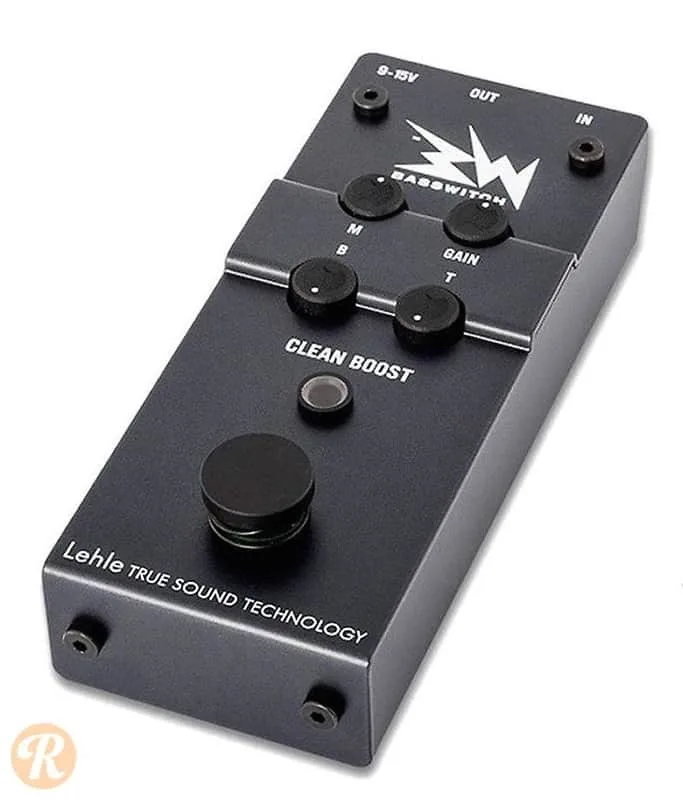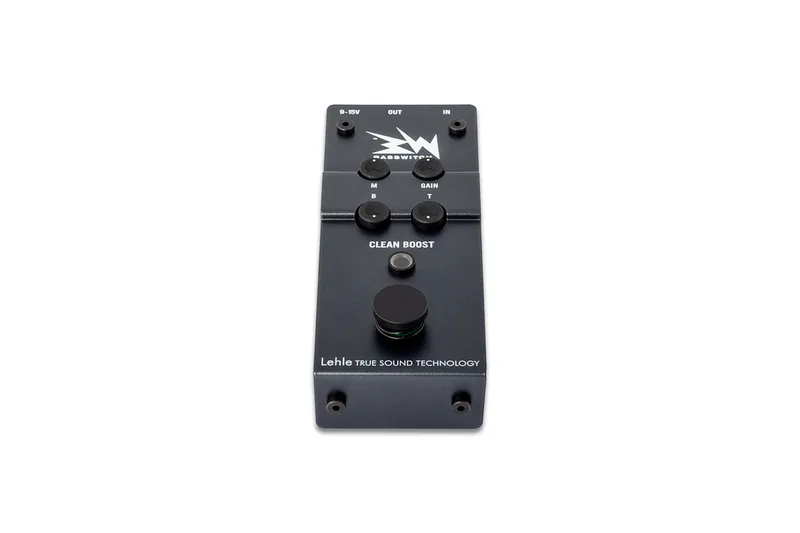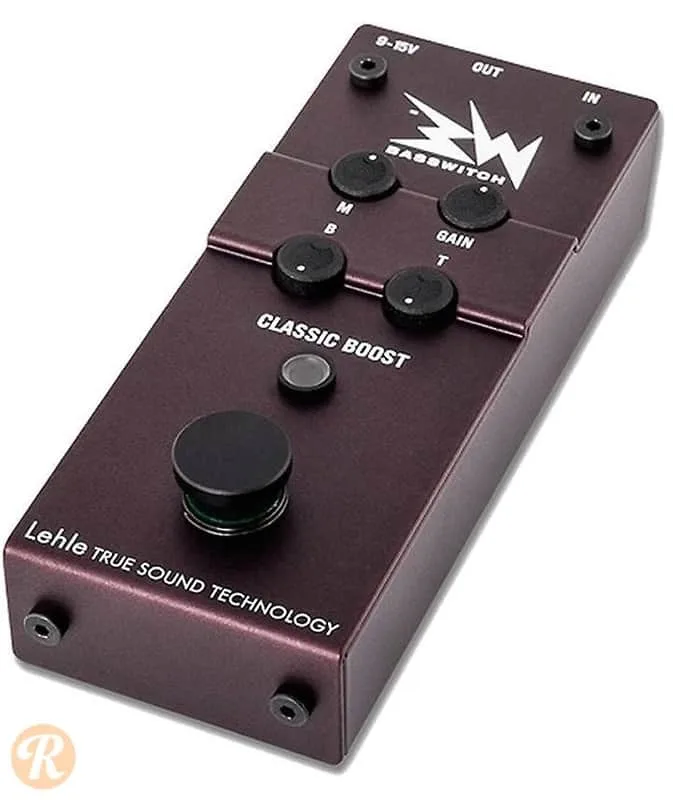


The Lehle RMI Basswitch Classic Boost is a high-end bass preamp and booster from Ruppert Musical Instruments (RMI), a company based in Luxembourg, with the hardware manufactured, assembled and tested in Germany1. Its main job is what the name says: boosting your bass signal with an adjustable EQ, up to a maximum gain of plus or minus 15 dB1. The maker describes it as a preamp "gently voiced for passive P, JJ and PJ type basses," and the input accepts both active and passive instruments1.
Instead of a conventional true bypass switch, the pedal uses what Lehle calls True Sound Technology: switching handled exclusively by gold-plated contact relays and gold-plated switches1. One footswitch toggles between the booster and a straight-through mode, with a status LED that turns blue when the boost is on and white when the pedal is bypassed1.
Power and connections
The Classic Boost runs on an external power supply delivering between 9 and 15 volts, either AC or DC, through a standard 5.5 x 2.1 mm connector, with a power consumption of max 60 mA12. Polarity does not matter: the manual states that "either alternating (AC) or direct current (DC) sources can be used and the polarity is not relevant"1. Whatever you feed it, the voltage is internally rectified, filtered, stabilized and brought to 18 volts, which is how the pedal reaches its specified maximum level of 15 dBu with a 12 volt supply1.
No battery option exists. The maker is direct about it: "the power consumption of the Basswitch Classic Boost is too high to run it satisfactorily on batteries"1. Plan on a power supply, and because polarity is irrelevant, both center-positive and center-negative supplies work.
Connections are simple. The input is designed for your first instrument, active or passive, and the output feeds a bass amp, a power amplifier or an active monitor1.
Controls and EQ
The control surface is minimal: one GAIN knob and one footswitch. GAIN adjusts the volume of the Classic Boost, boosting or cutting the signal, with a neutral position at 12 o'clock1. Pressing the footswitch turns the Classic Boost on or into straight-through mode1.
The EQ section is a two-band design, and the manual gives the ranges for each band1:
Both bands are peaking filters, so they boost or cut around a center frequency rather than shelving. With a maximum gain of plus or minus 15 dB overall, the pedal can push an amp harder or pull a hot active signal back1.
Sound quality and measurements
The specifications the maker publishes point to a clean, transparent signal path rather than a character piece1:
- Frequency range: 30 Hz to 150 kHz (+1/-3 dB)1
- Distortion: 0.002 %1
- Signal-to-noise ratio: -96 dB at 1 kHz, 0 dBu1
A frequency range that extends far past the audible band, very low distortion and a high signal-to-noise ratio are the numbers of a hi-fi buffer and line driver, which fits the pedal's role as a boost and preamp rather than an overdrive. The 2 MOhm input impedance means passive basses see a light load, preserving top end in long cable runs1.
Where it comes from
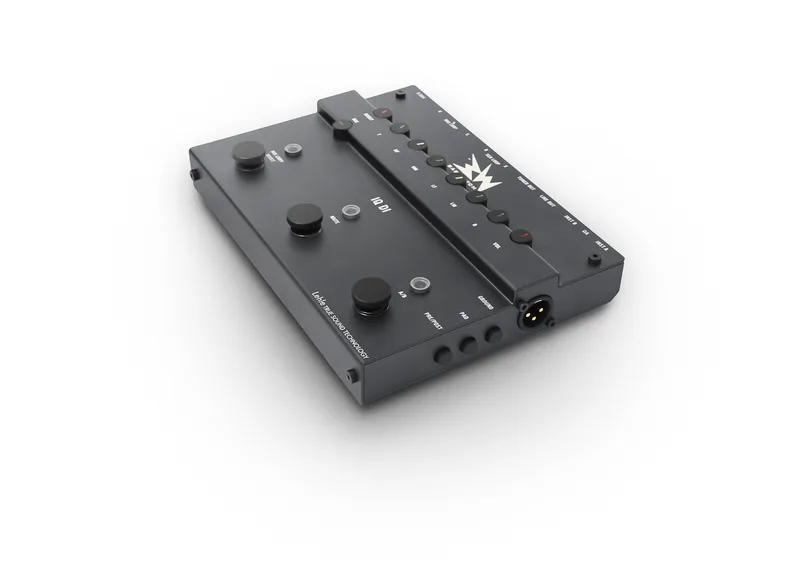
Ruppert Musical Instruments is based at 20a, rue de Bascharage, L-4995 Schouweiler, Luxembourg1. The RMI Basswitch line is built by Lehle in Germany on RMI's behalf; Lehle's own product page for the discontinued Basswitch IQ DI states that "the BASSWITCH IQ DI is manufactured by LEHLE in Germany on behalf of RMI"3. The Classic Boost itself is manufactured, assembled and tested in Germany, according to its manual1.
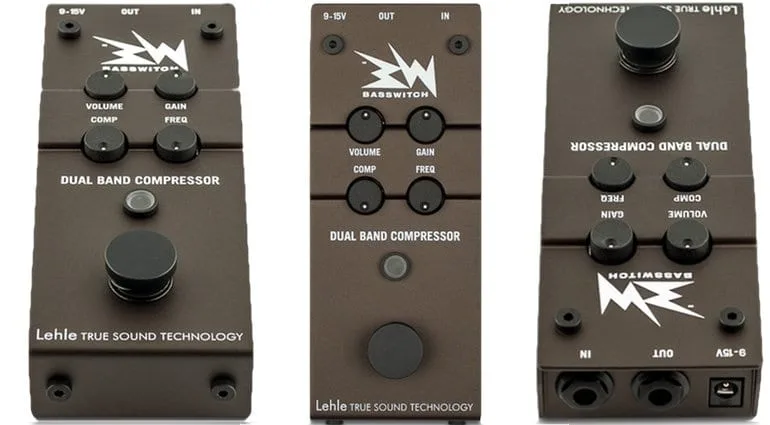
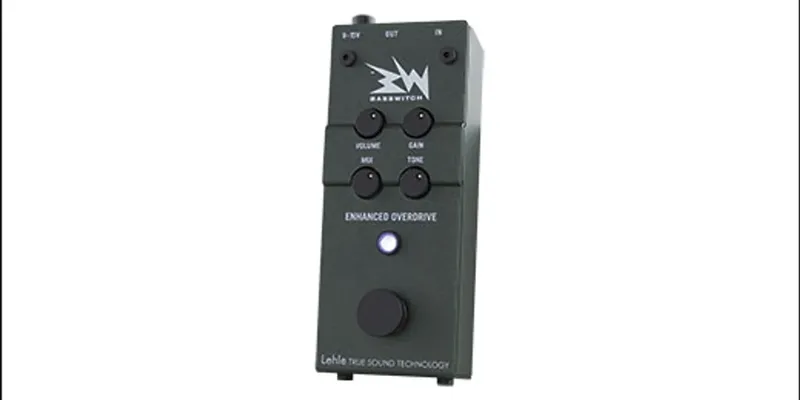
The Basswitch family extends beyond this booster. The RMI Basswitch Dual Band Compressor, a compressor for bass, can be switched between buffered and true bypass when not engaged, a choice Gearnews welcomed in its coverage4. The RMI Basswitch Enhanced Overdrive, an overdrive pedal reviewed by Premier Guitar in 2021, is also completely manufactured in Germany5. The Classic Boost shares its power architecture with both: 9 to 15 V AC or DC, internally rectified, filtered, stabilized and brought to 18 V415.
How it differs from other boosters
Two things set the Classic Boost apart from a typical boost pedal. First, the switching: rather than true bypass, Lehle True Sound Technology routes the signal through gold-plated contact relays and gold-plated switches, an approach Lehle uses across its products1. Second, the power section: the internal conversion to 18 volts from any 9 to 15 V supply gives the headroom figure of 15 dBu, and the indifference to polarity means the pedal works with supplies that would rule out polarity-sensitive pedals1.
For bass players comparing options, the pedal sits in the bass pedals and preamp categories, and its controls reflect its bass-focused design: a single footswitch turns the Classic Boost on or into 'straight through' mode, and its 2 MOhm input impedance and 150 Ohm output impedance suit it to instrument-level signals1.
Videos
Voodoo Factory - il negozio di boxguitar.com
Jacques channel
Questions
Can the Lehle RMI Basswitch Classic Boost run on a battery?
No. The maker states that the power consumption of the Basswitch Classic Boost is too high to run it satisfactorily on batteries, so an external power supply is required. It connects with a standard 5.5 x 2.1 mm connector and needs a supply delivering at least 60 mA.
Is the Basswitch Classic Boost true bypass?
Not in the conventional sense. Lehle True Sound Technology switches the signal through gold-plated contact relays and gold-plated switches instead of a true bypass switch. In straight-through mode the LED shows white, and the maker describes this path as a clean feed of the input signal.
Does power polarity matter on the Basswitch Classic Boost?
No. The unit accepts either alternating (AC) or direct current (DC) sources and the polarity is not relevant. Any supply between 9 and 15 volts works, because the voltage is internally rectified, filtered, stabilized and brought to 18 volts inside the pedal.
Does it work with active and passive basses?
Yes. The manual states the input is designed to accept active and passive instruments, and the maker describes the preamp as gently voiced for passive P, JJ and PJ type basses. The 2 MOhm input impedance keeps passive pickups loaded lightly.
What do the blue and white LEDs mean?
The status LED turns blue when the Classic Boost comes on and white in bypass mode. So blue means the booster with its EQ is active, and white means the pedal is in straight-through mode.
Where is the Lehle RMI Basswitch Classic Boost made?
In Germany. The manual states the Basswitch Classic Boost is manufactured, assembled and tested in Germany. The product comes from Ruppert Musical Instruments of Luxembourg, with Lehle building the RMI Basswitch line on RMI's behalf.
Sources (5)
- Lehle-RMI-Basswitch-Classic-Boost_Manual_EN.pdf, Ruppert Musical Instruments, 2023
- Lehle-RMI-Basswitch-Enhanced-Overdrive_Manual_EN.pdf, Ruppert Musical Instruments, 2023
- RMI BASSWITCH IQ DI (DISCONTINUED), Lehle GmbH
- Lehle RMI Basswitch Dual Band Compressor pedal, gearnews.com, 2016-09-15
- RMI Basswitch Enhanced Overdrive Review, Premier Guitar, 2018-09-12