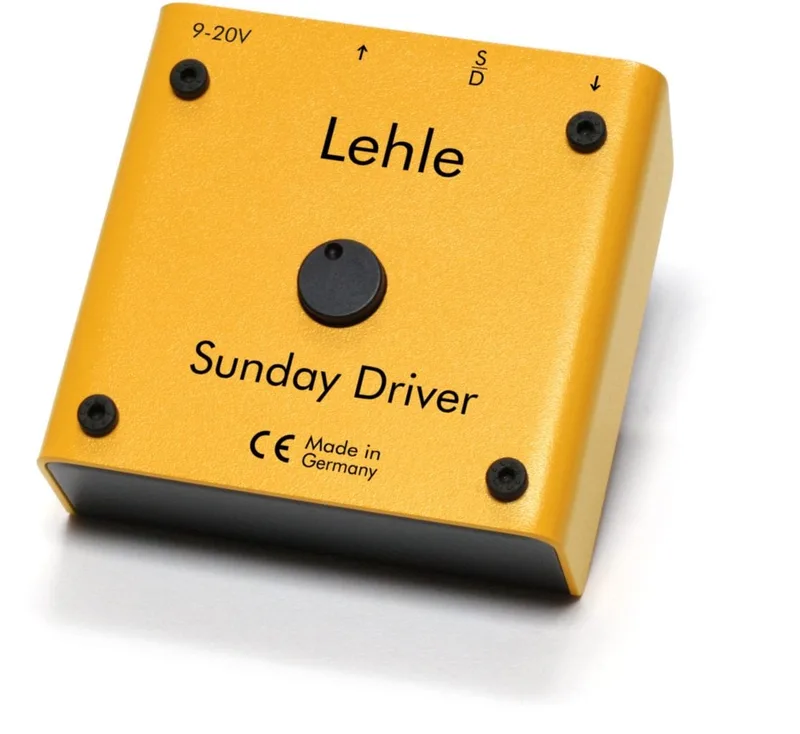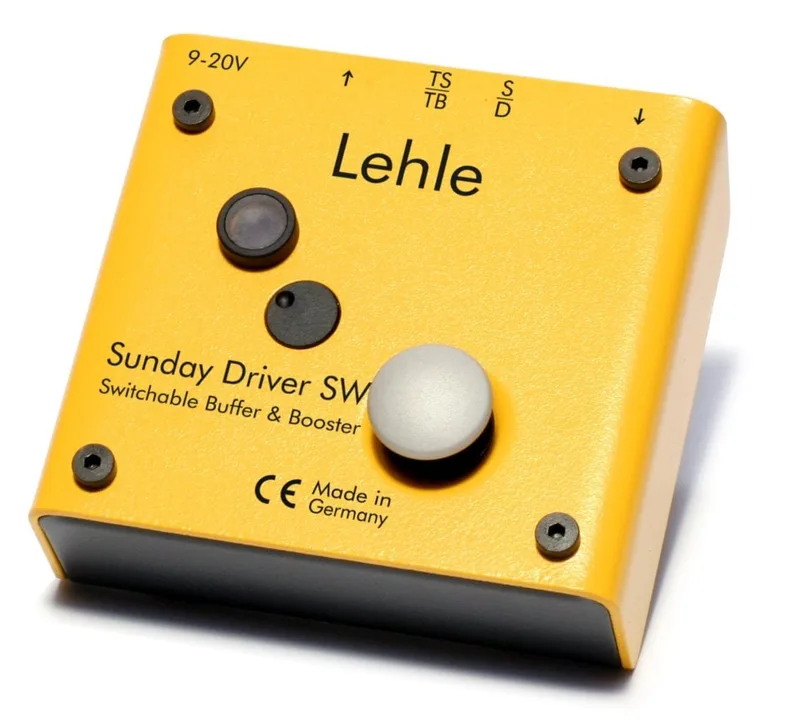


The Lehle Sunday Driver SW is a compact, high-end analog preamp, buffer and booster for electric and acoustic guitars, basses and other stringed instruments such as violins, cellos and double basses1. Built on JFET technology in a discrete Class A circuit, it does two jobs at once: it lowers the signal impedance so long cable runs and effects chains stop eating your tone, and it boosts the signal by up to 15 dB23. It is made and tested in Germany by Lehle1.
The Sunday Driver SW is discontinued3. It was the switchable version of the classic Lehle Sunday Driver, which had no footswitch4. The current pedal in the line is the Lehle Sunday Driver SW II, which Lehle lists as in production and which expands on the Sunday Driver II with a soft-touch footswitch52. This page covers the SW, with the SW II's differences noted where they matter.
What it does for your sound
A buffer's job is to convert the high-impedance signal of a pickup to a low-impedance one that survives long cables and crowded pedalboards. The Sunday Driver SW does that while also giving you clean gain. In D (Driver) mode, the input signal is amplified with zero modification at the input impedance of a guitar amp, eliminating the losses that long cable routings and effects chains cause3. In S (Sunday) mode, the input impedance is multiplied, which Lehle says brings out previously inaudible details and, as gain increases, gives the guitar a characteristic warmth526.
"The second setting „S", as in Sunday, multiplies the input impedance by five, bringing out previously inaudible details and, as gain increases, giving your guitar a characteristic and unmistakable warmth that has given this preamp its name, the result is a sound as mellow as a sunny Sunday afternoon."
That quote describes the SW II, where S mode raises the input to 5 MΩ; on the SW the figure is 4 MΩ1. Lehle says there is no distortion at any stage, and the signal stays clean even at maximum gain1. The maker also credits the SW with a signal-to-noise ratio better than -100 dB, calling it totally free of background noise3.
For players with piezo pickups, Lehle's manual for the SW II notes that in S mode with gain around 11 to 12 o'clock or more, piezo instruments that can otherwise sound harsh and shrill take on a pleasantly warm and silky tone2.
D mode and S mode
The S/D selector switch, with gold-plated contacts, chooses between the two sound modes16:
| Mode | Name | Input impedance | What it does |
|---|---|---|---|
| D | Driver | 1 MΩ1 | Amplifies the input signal with zero modification, at the input impedance of a guitar amp, to eliminate losses from leads and effects13 |
| S | Sunday | 4 MΩ1 | Multiplies the input impedance, bringing out detail and adding warmth as gain rises1 |
D mode is the neutral choice: it is the mode that behaves like a good buffer plus clean boost. S mode is the character setting, and it is the one Lehle points piezo players toward.
The controls and bypass modes
The SW has three main controls1:
- Gain controller: adjusts the preamp from a slight level lift up to a powerful boost. The knob is black anodized aluminum, recessed into the housing so the setting cannot be knocked out of place on stage or in transit1.
- S/D selector switch: selects the Driver or Sunday sound mode1.
- TS/TB selector switch: selects the bypass mode used when the pedal is off1.
- Footswitch (True Bypass switch): selects between the original signal and the signal with more gain, using gold-plated contacts1.
When the pedal is bypassed, the TS/TB switch gives you two behaviors1:
- TB (True Bypass): input and output are linked directly through a switch with gold-plated contacts, with zero losses3.
- TS (True Sound): the pedal stays active as a buffer, without amplifying or modifying the signal, acting as a neutral line driver1.
Lehle's guidance for the SW II, which applies the same idea: True Bypass suits small setups with short cable routings, and situations where a treble booster or old-school fuzz pedal sits after it; TS suits long cables or complex effects boards5. The switching-state LEDs show red when the gain controller and S/D selector are active, green in bypass on a power pack, and nothing in bypass on batteries1.
Power and connections
The SW accepts 9 to 20 V AC or DC, or a 9V PP3 block battery installed by unscrewing the four cover screws, and polarity does not matter1. On battery power it draws 9 mA off and 28 mA on1. If the supply voltage drops below 9 volts, it automatically switches to battery operation via a gold-plated-contact relay1. Internally, the input voltage is rectified, filtered, stabilized and doubled to 18 V3.
The input takes your instrument, and the output drives an amplifier, mixer, stage box or sound card12. The low-impedance 150 Ω output keeps full sound quality even on cable runs of 20 meters and more12.
How the SW II relates to the Sunday Driver SW
The Sunday Driver SW II is the current version, in production as of October 20265. It expands on the classic Sunday Driver II with a soft-touch footswitch to activate and deactivate the pedal2. Its circuit is a discrete Class A JFET design with microcontroller-controlled switching, and its internal voltage is transformed to 30 V rather than the SW's 18 V2. The biggest practical difference for a player is power: the SW II has no battery and needs an external supply of 9 to 15 V DC at 165 mA72.
| Sunday Driver SW | Sunday Driver SW II | |
|---|---|---|
| Status | Discontinued3 | In production5 |
| Max gain | 15 dB3 | 18 dB6 |
| Input impedance, D mode | 1 MΩ652 | 1 MΩ6 |
| Input impedance, S mode | 4 MΩ1 | 5 MΩ6 |
| Output impedance | 150 Ω1 | 220 Ω6 |
| Power | 9 to 20 V AC or DC, or 9V battery1 | 9 to 15 V DC, no battery27 |
| Current draw | 9 mA off, 28 mA on (battery)1 | 165 mA2 |
| Output | Mono1 | Mono, unbalanced TS or balanced TRS6 |
| Weight | 378 g without battery1 | 350 g2 |
The SW II also adds a balanced TRS output option, so it can drive a balanced line to a mixer or sound card directly62, and Lehle credits it with a 130 dB dynamic range, staying clean and free of background noise even at maximum gain2. Its LED shows blue when active and white in bypass2, where the SW's showed red and green1.
Where it sits among buffers
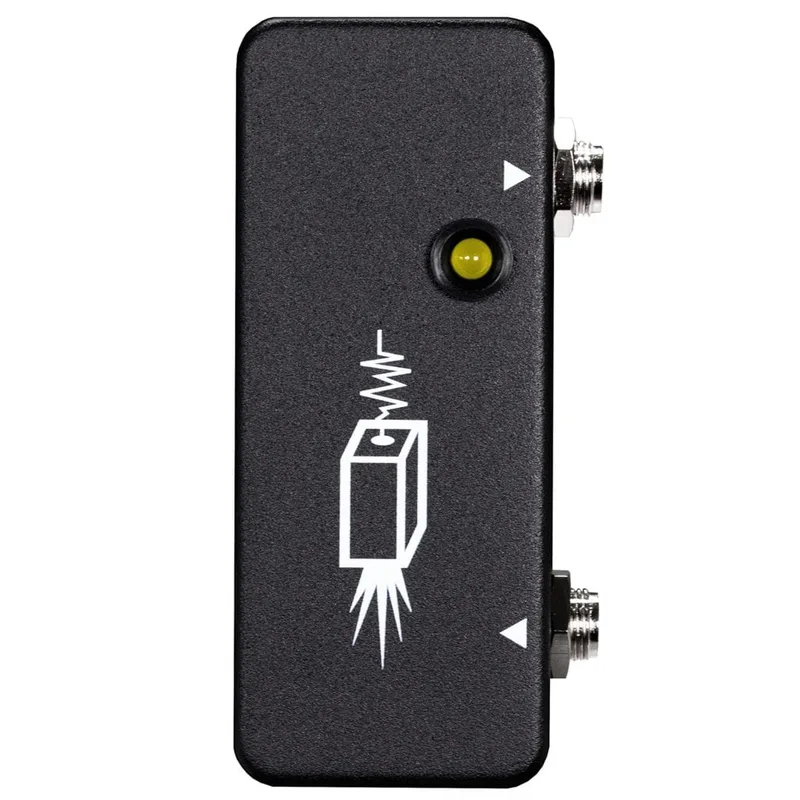
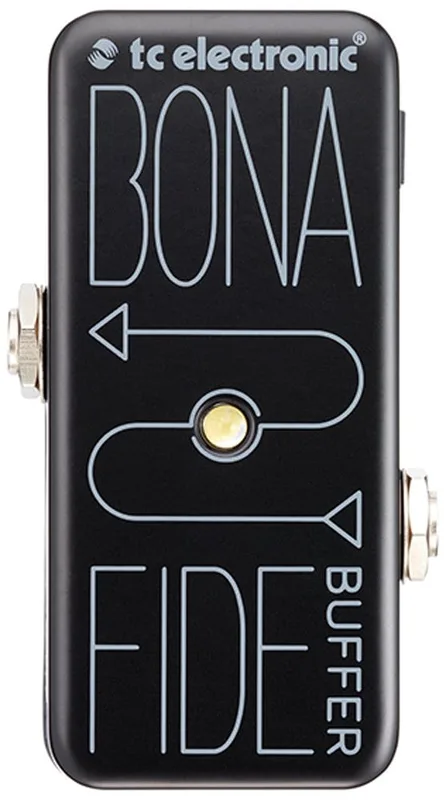
The Sunday Driver line is one take on the buffer idea: a preamp-quality JFET stage with switchable input impedance and a choice of true bypass or always-on buffering. Players comparing it against simpler fixed buffers, such as the JHS Pedals Little Black Buffer or the TC Electronic Bonafide Buffer, are comparing a multi-mode preamp against single-purpose line drivers; the Sunday Driver's S mode and gain control are what set it apart.
Videos
Premier Guitar
Sweetwater
LehleSwitcher
Questions
Does the Lehle Sunday Driver SW II take a battery?
No. The SW II has no battery compartment and runs only from an external power supply of 9 to 15 V DC, drawing 165 mA. The original Sunday Driver SW was different: it ran on a 9V PP3 block battery installed under the cover, or on 9 to 20 V AC or DC, and it switched to battery automatically if the supply voltage dropped below 9 volts.
Is the Sunday Driver SW II true bypass?
Yes, when you want it. A TS/TB selector switch chooses between TB (True Bypass) mode, where input and output are linked by a relay with zero tonal loss, and TS (True Sound) mode, where the pedal stays active as a neutral buffer without amplifying the signal. Lehle recommends TB for small setups with short cable runs, or when a treble booster or old-school fuzz follows it.
Can the Sunday Driver be used with piezo pickups?
Yes. Lehle says that in S mode with the gain control set to around 11 to 12 o'clock or higher, instruments with piezo pickups, which can otherwise sound harsh and shrill, take on a pleasantly warm and silky tone. The 5 MΩ input impedance in S mode is what makes it friendly to piezo sources.
What is the difference between the Sunday Driver and the Sunday Driver SW?
The Sunday Driver is the classic version without a footswitch; the SW is the switchable version, adding a true bypass footswitch so you can kick the preamp in and out. Both are discontinued. The current pedal in the line is the Sunday Driver SW II, which adds a soft-touch footswitch to the Sunday Driver II.
Can the Sunday Driver SW II drive a balanced line to a mixer?
Yes. Its single output can be tapped unbalanced from a TS jack or balanced from a TRS jack, and Lehle lists mixers, stage boxes and sound cards among the things you can connect it to. The output impedance is 220 Ω, and the low-impedance output keeps full sound quality even on cable runs of 20 meters.
What is the difference between Driver mode and Sunday mode on the Lehle Sunday Driver SW?
In D (Driver) mode the input signal is amplified with no modification at the input impedance of a guitar amp, restoring losses from long cables and effects chains. In S (Sunday) mode the input impedance is raised, from 1 MΩ to 4 MΩ on the SW, which Lehle says brings out previously inaudible details and adds a characteristic warmth as gain increases.
Sources (7)
- Lehle-Sunday-Driver-SW_Manual_EN.pdf, Lehle GmbH, 2023
- LEHLE SUNDAY DRIVER SW II, Lehle
- LEHLE SUNDAY DRIVER SW (DISCONTINUED), Lehle GmbH
- LEHLE SUNDAY DRIVER (DISCONTINUED), Lehle GmbH
- LEHLE SUNDAY DRIVER SW II: Preamp, buffer & booster, Lehle GmbH
- LEHLE SUNDAY DRIVER SW II, Lehle (support.lehle.com)
- Lehle-Sunday-Driver-SW-II_Manual_EN_v1.2.pdf, LEHLE GmbH, 2021-07-27