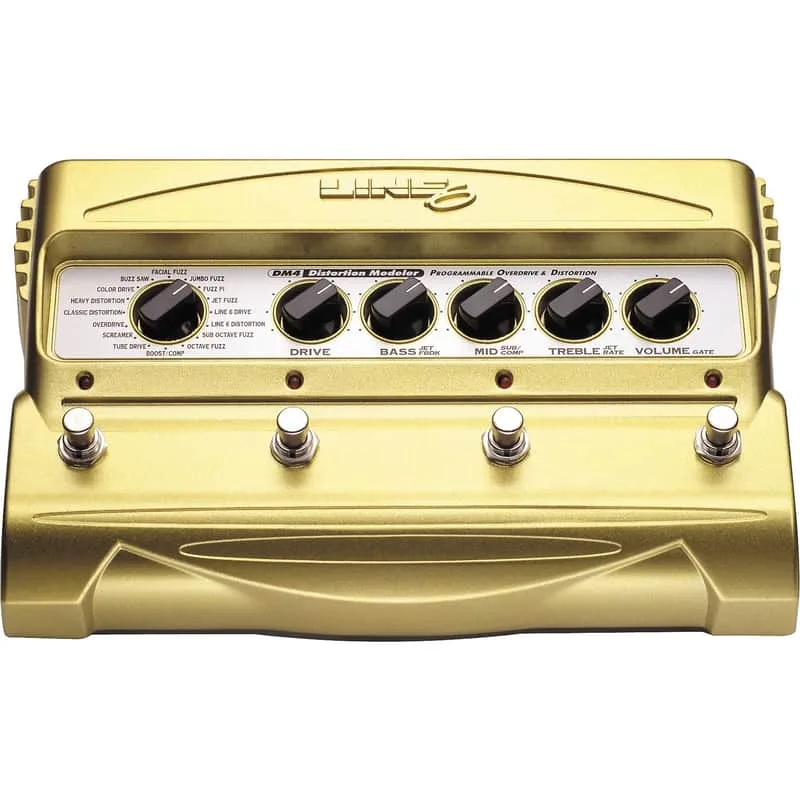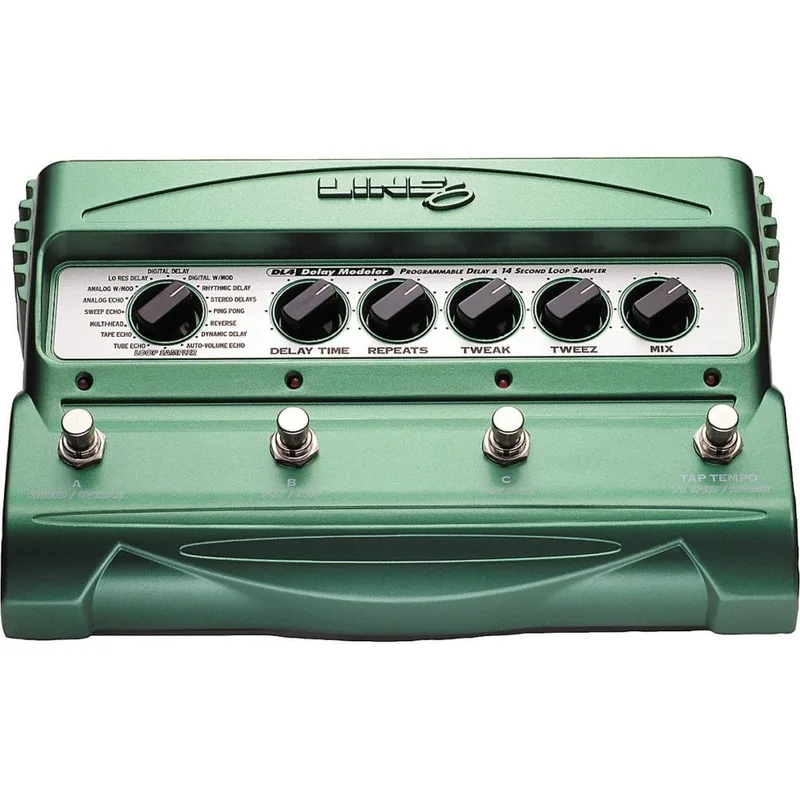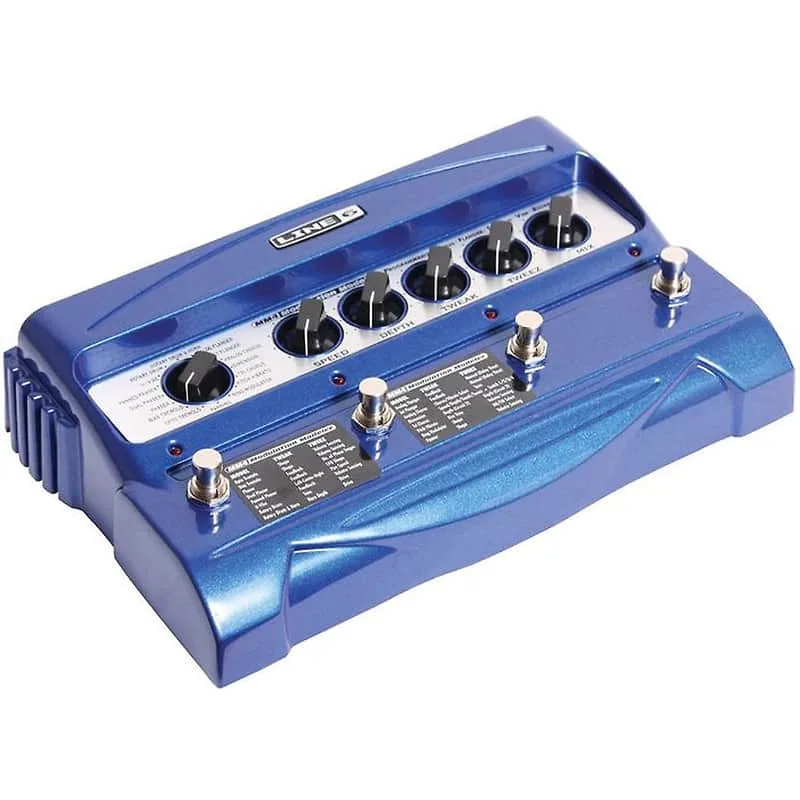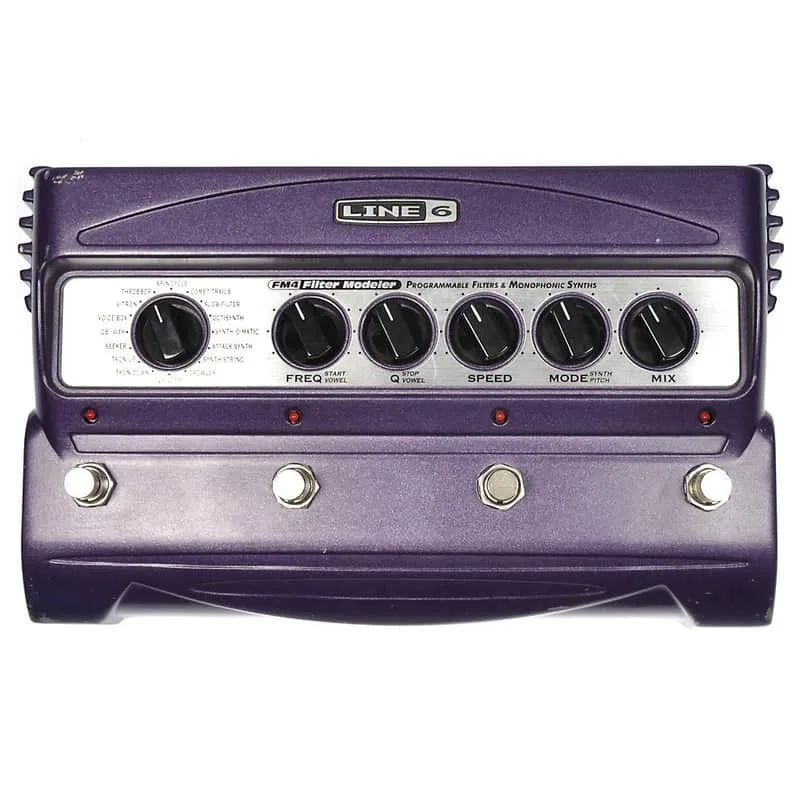


The Line 6 M13 Stompbox Modeler is a floor multi-effects unit that puts a whole pedalboard of modeled stompboxes under one set of footswitches. Announced at Musikmesse in 2008 with 74 modeled stompbox effects1, it combines the models from Line 6's earlier DL4 delay, MM4 modulation, DM4 distortion and FM4 filter pedals into one device2. Line 6 lists it among its legacy products and states that it is no longer made3.
The idea is simple: instead of a menu-driven multi-effects processor, the M13 behaves like a row of individual stompboxes. Each of its four modeler footswitches turns one effect on and off, and each modeler has its own set of six knobs, so tweaking works the way it does on a real pedalboard. Premier Guitar's reviewer found the stompbox-like Autosave feature made the M13 extremely adaptable to differing gig and room acoustic situations, neatly side-stepping one of the main complaints about multi-effects2.
What it is and where it came from
Line 6 announced the M13 at Musikmesse 2008, describing it as a stompbox modeler multi-effects unit carrying 74 modeled stompbox effects, with a US price of $699.99 and a UK RRP of £398.331. The models draw on the company's earlier modeling stompboxes, and the DL4 in particular: MusicRadar notes that all of Line 6's DL4-derived delays appear in the M1325. Premier Guitar's reviewer traced the lineage directly, describing the M13 as a unit that combines the DL4 delay, MM4 modulation, DM4 distortion and FM4 filter modelers into one device2.
The effects themselves benefit from the latest generation of Line 6 R&D for products like POD, Vetta, and TonePort, as Premier Guitar put it2. In the Brady hierarchy of the M line of multi-effects processors, the same publication later called the M13 "the Greg," meaning the oldest and biggest sibling6.
The controls and footswitches
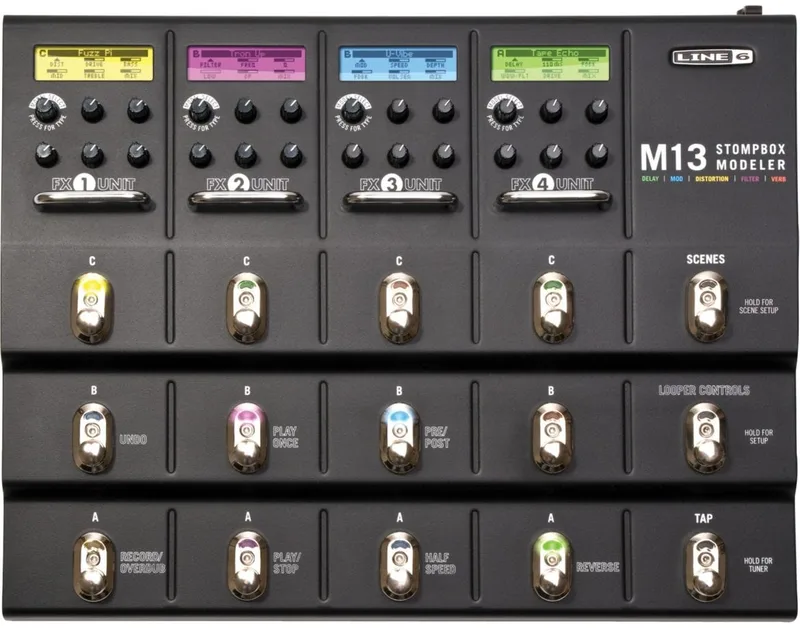
The M13 carries fifteen footswitches, tiered for easy access, with four raised rails protecting the small plastic parameter knobs from clumsy feet2. The layout breaks down like this:
| Control | What it does |
|---|---|
| Four modeler footswitches | Turn the four active effects on and off; only four can be on at a time2 |
| Scenes footswitch | Changes the display to show 12 scenes, selectable with the main modeler footswitches7 |
| Tap tempo switch | Covers tap tempo for all delay effects and a number of modulation effects7 |
| Looper switch | Turns on the looper7 |
| Loop Controls switch | Turns seven of the effect switches into loop controls; stepping on it again returns them to engaging effects while the loop keeps playing2 |
Each modeler has its own set of six controls, five of which vary their functions according to the particular effect in use7. The sixth control is used for setting the effect: you push it to select from the five effect types available, then rotate it to select the desired effect model7. Premier Guitar described the same process from the player's side: pushing down the first control knob selected the family, and turning it selected the effect; once selected, the other five knobs controlled the parameters2.
Choosing a scene, by stepping on one of the three corresponding footswitches in that row, can instantly turn on up to four preset effects2. Each scene is a completely new configuration of the four modelers, and with twelve scenes each holding its own separate set of twelve effects, Premier Guitar counted 144 preset effects at a player's disposal27.
On the back panel, the M13 offers MIDI in/out and two expression pedal jacks. The expression pedals can be assigned to virtually any effect parameter, or to a slew of parameters at once2. The unit is also MIDI-controllable and appears on Disaster Area Designs' list of supported devices4.
The M13 has no input for an external switch under the toe of an expression pedal, according to accessory maker Microdesignum, which matters if you plan to use a switching expression pedal with it8.
The looper
The built-in looper is a major part of the M13's appeal. The maximum loop storage time is 28 seconds in mono, and recorded loops can be played back at half-speed or in reverse7. An undo switch erases the most recent overdub, leaving previous work intact7.
The Loop Controls switch is the key to using it live: it turns seven of the effect switches into loop controls, and stepping on it again sets those switches back to engaging effects while the loop continues playing2. That means a player can record a loop, switch the footswitches over to control the loop, then switch them back to effects without stopping playback.
Premier Guitar's verdict on this side of the unit was blunt:
"The M13 is nearly worth the money for its looping abilities alone."
Connections and stereo operation
The I/Os include mono or stereo inputs, mono or stereo outputs, and a stereo-assignable effects send/return, all 1/4"2. MusicRadar highlighted the full stereo ins and outs as unusual for the format, noting stereo outputs for taking advantage of the various stereo reverb, delay and modulation effects7. The stereo effects loop can be placed in the signal path where the player wants it.
What reviewers said
MusicRadar's overall verdict was that the M13 offers an ingenious concept matched by great sounds, with Line 6 leading the way with a great sounding FX system centerd around its well-known stompbox modelers7. On sound quality, Premier Guitar's reviewer found the modulations and delays were more on a par with analog pedals than the distortion and filter effects, but all were recognizable and useful2.
On ease of use, the same reviewer found it relatively intuitive, but recommended downloading the advanced manual, as the device can operate on a number of levels from simple to complex2. The overall conclusion was that a wealth of great-sounding effects, routing flexibility, easy tweaking, and looping possibilities outweigh the small criticisms: buy if you want an all-in-one pedalboard with extreme versatility and amazing looping powers, skip if you hate modeling2.
The M13, M9 and M5
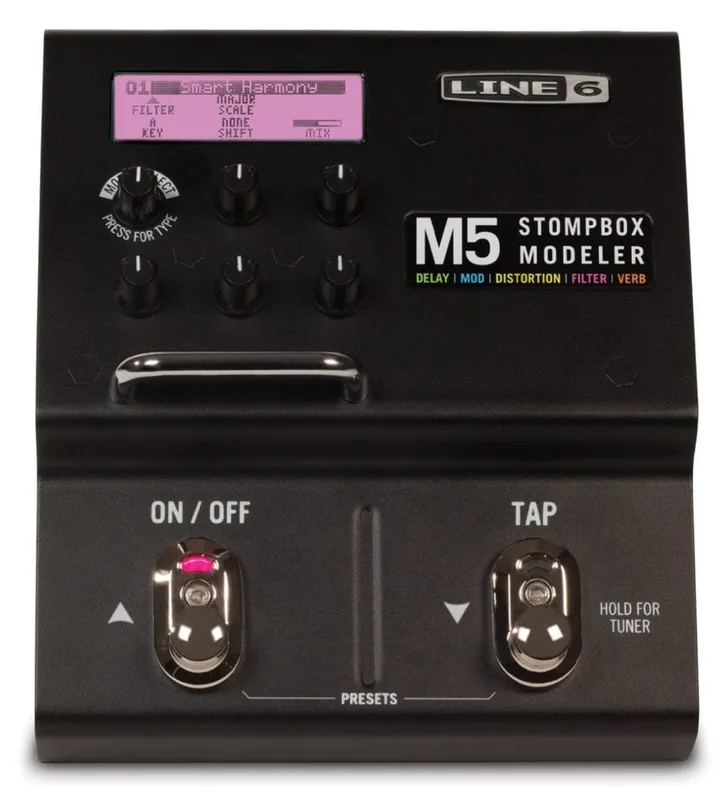
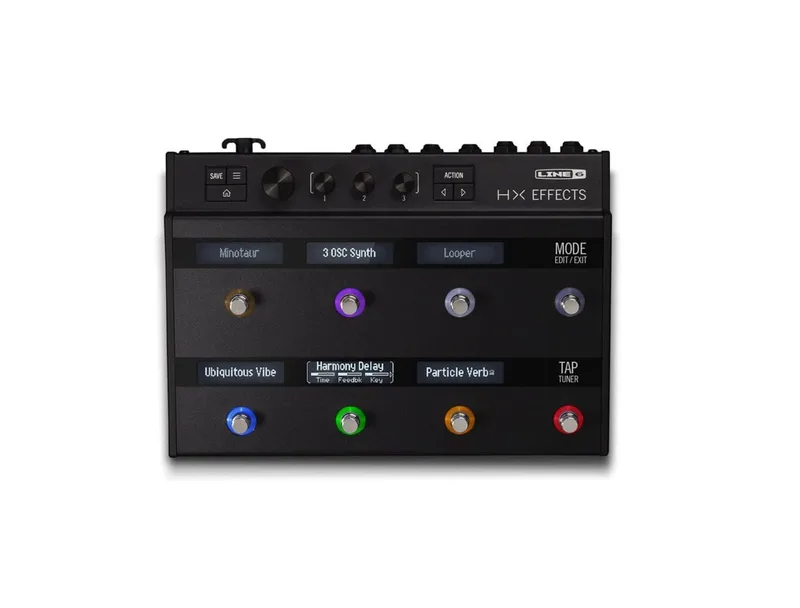
The M13, M9 and M5 Stompbox Modelers share a model gallery, so the smaller units draw on the same pool of effects3. The differences are in the footprint and the control surface: the M13 is the largest, with its fifteen footswitches, twelve scenes and built-in looper, while the M5 offers one effect at a time in a single-pedal enclosure. Premier Guitar's M5 review framed the family relationship with the M13 as "the Greg" of the line6. Players comparing the M13 against modern Line 6 floor units will find its spiritual successors in the HX Effects and the Helix family, which carry the multi-effects idea forward with newer processing.
Videos
Guitar World
Premier Guitar
Simon Smith
Questions
Is the Line 6 M13 still made?
No. Line 6 lists the M13 Stompbox Modeler among its legacy products and states plainly that it is no longer made. It was announced in 2008 with an MSRP of $699.99 in the US, and secondhand units are what a player looking for one today will find.
How long can the M13 looper record?
The maximum loop storage time is 28 seconds in mono. Recorded loops can be played back at half speed or in reverse, and an undo switch erases the most recent overdub while leaving earlier layers intact. Premier Guitar's reviewer felt the unit was nearly worth the money for its looping abilities alone.
Can the Line 6 M13 run in stereo?
Yes. It has mono or stereo inputs and mono or stereo outputs, all 1/4 inch, plus a stereo-assignable effects send/return. MusicRadar highlighted the full stereo ins and outs as one of the unit's more unusual features for its time.
Does the M13 sync to MIDI clock?
Yes. The M13 is MIDI-controllable and can sync to MIDI clock, and it appears on Disaster Area Designs' list of supported devices. It also has MIDI in/out and two expression pedal jacks assignable to virtually any effect parameter.
How many effects can be on at once on the M13?
Only four effects can be on at a time, arranged as four modeller footswitches. But the unit holds twelve scenes, each a completely new configuration of those four modellers, which Premier Guitar described as putting 144 preset effects at a player's disposal.
What is the difference between the M13, M9 and M5?
The three units share the same model gallery of effects. The M13 is the largest of the line, with fifteen footswitches, twelve scenes and a built-in looper. Premier Guitar called it the Greg of the M line in a Brady Bunch hierarchy, with the smaller M9 and M5 offering progressively fewer footswitches and controls.
Sources (8)
- Musikmesse 08: Line 6 announces M13 Stompbox Modeler multi-FX, MusicRadar, 2008-03-17
- Line 6 M13 Stompbox Modeler Review, Premier Guitar, 2009-01-15
- Line 6 | Legacy Products, Line 6
- Supported Devices, Disaster Area Designs, 2021-10-11
- In praise of: Line 6 DL4, MusicRadar, 2014-05-22
- Line 6 M5 Stompbox Modeler Review, Premier Guitar, 2011-10-20
- Line 6 M13 review, MusicRadar, 2008-10-07
- Expression pedal with MIDI toe switch for Line6 M13, Microdesignum