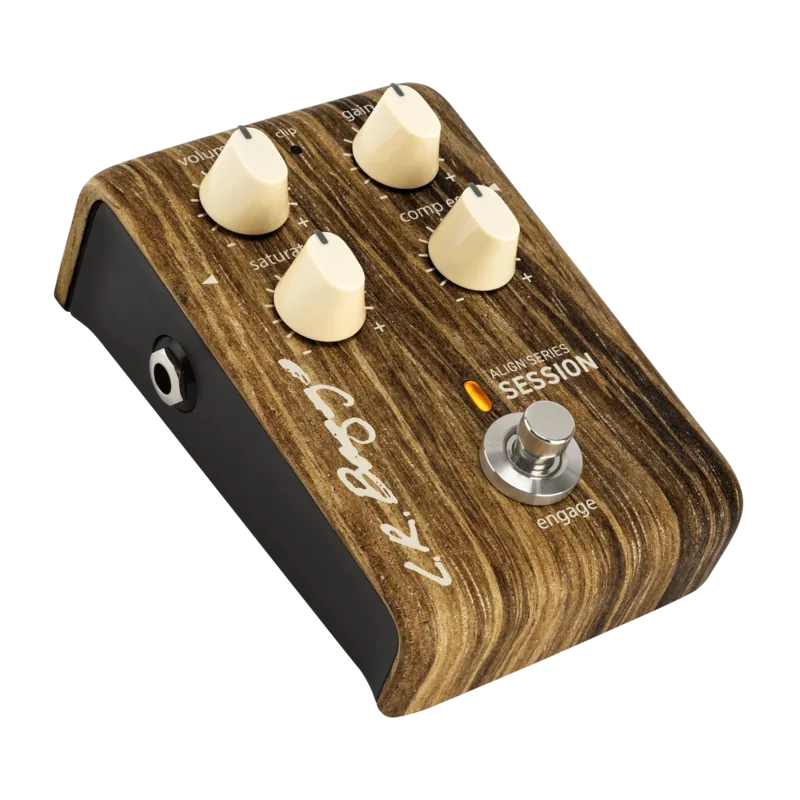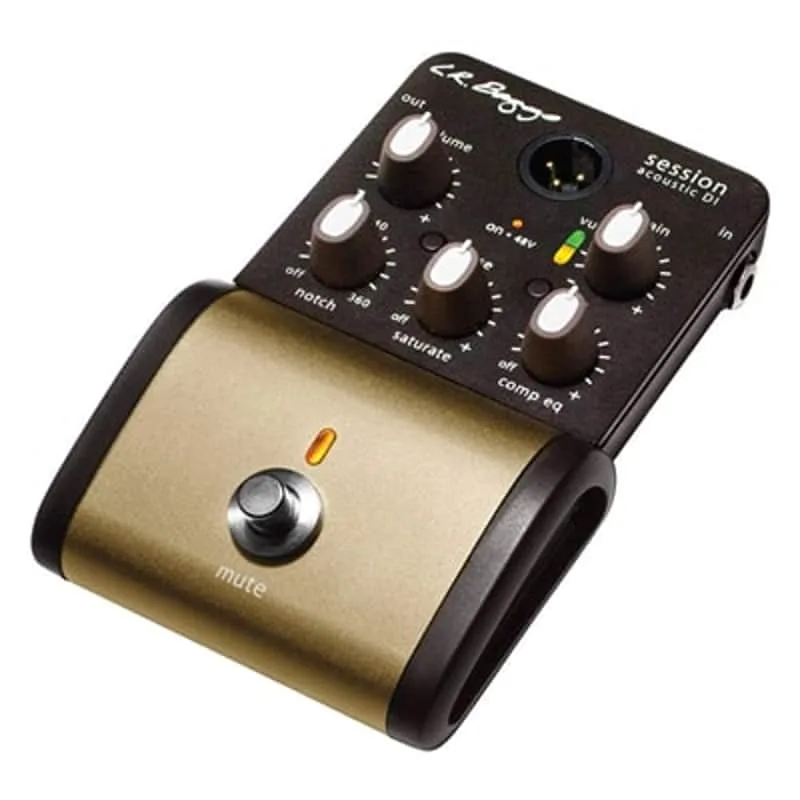


The LR Baggs Session DI is an active acoustic preamp and DI pedal built for live use. LR Baggs describes it as bringing "our signature studio sound to your live rig," saying it "enhances your acoustic pickup and imparts the rich sonic character that you'd expect from an experienced" studio engineer. It sits on the floor or on a pedalboard, takes the output of a steel-string acoustic's pickup, and feeds both a ¼" line output and a balanced XLR output for the PA12.
Power and connections
The Session DI offers three ways to power it: a 9V battery, a 9V DC power supply (not provided), or 48V phantom power through the XLR output. LR Baggs recommends 9V DC and gives a 12V DC maximum for the DC input. The DC input takes a standard 2mm plug, the type commonly used with effects pedals and "floor-box" products1.
"A full battery will give you approximately 125 hours of playing time."
A status light tells you which power source is active: an orange light indicates 9V battery or DC power, and a green light indicates 48V phantom power1.
Plugging a guitar into the ¼" input activates the Session DI, and unplugging turns it off, so there is no separate power switch to forget about before a set1.
Inputs, outputs and signal path
The ¼" input is an unbalanced, mono, all-discrete instrument input. On the top panel sit a ¼" unbalanced line-level output and a balanced XLR (DI) output, so the pedal can drive an amplifier and the PA at the same time1. The circuit is entirely analog: LR Baggs states that "the 100% analog, all-discrete signal path is the high-fidelity foundation the Session DI is built on," with a high-graded FET input preamp2.
Setting the gain
Gain is set with the help of a VU meter. LR Baggs says to "turn the control clockwise as you strum the guitar until the VU meter flashes red slightly at your loudest playing level." The best results come when the yellow flashes consistently; frequent red flashing means the signal is clipping, so the control should be backed off1.
Build and what is in the box
The enclosure is described by LR Baggs as rugged, constructed of aluminum, steel and ABS plastic2. The box includes the Session DI and a carrying case2. LR Baggs notes that it currently ships only to US addresses2.
Where it came from
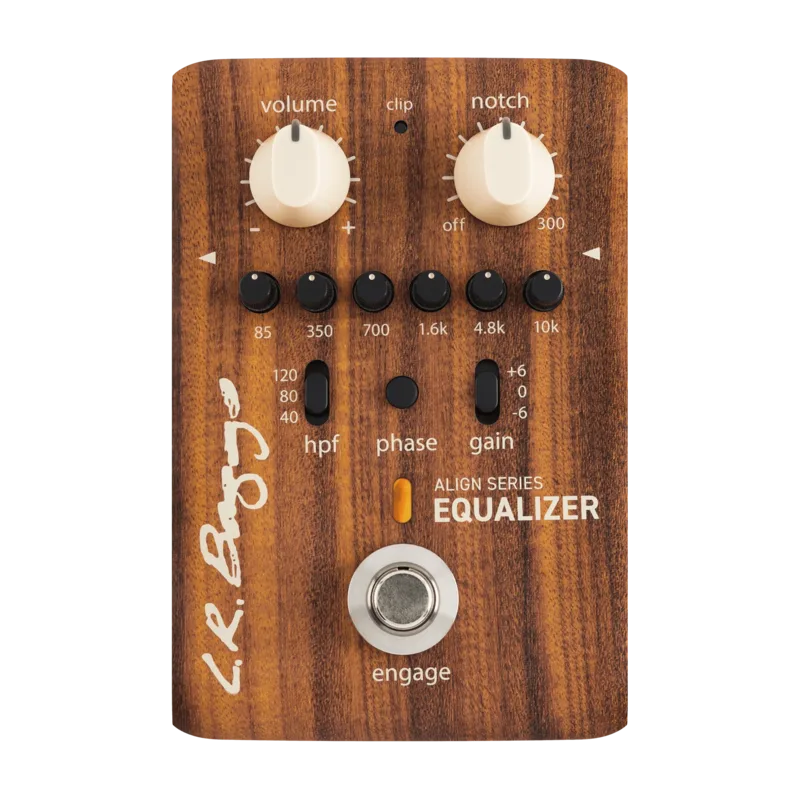
LR Baggs says the Session DI was "born from our acclaimed live video sessions in Nashville," and that it "delivers elite studio tone to any stage"2. The company also makes related acoustic pedals in its Align Series, including the LR Baggs Align Session and the LR Baggs Align Equalizer, for players building out an acoustic pedalboard2.
Videos
Premier Guitar
Baggs | LR Baggs | Obsessive Audio Innovation
Peghead Nation
Questions
Does the LR Baggs Session DI run on a battery?
Yes. The Session DI can be powered by a 9V battery, and LR Baggs says a full battery gives approximately 125 hours of playing time. It can also run on a 9V DC power supply, which is not included, or on 48V phantom power through the XLR output. Plugging a guitar into the input activates the unit, and unplugging turns it off.
Does the Session DI need phantom power?
No. The Session DI accepts 48V phantom power through its balanced XLR output, but it does not require it. LR Baggs gives three power options: a 9V battery, a 9V DC power supply, or 48V phantom power. A green light shows phantom power is in use, while an orange light shows battery or DC power.
What does the orange light on the Session DI mean?
The orange light indicates that the Session DI is running on 9V battery power or on a DC power supply. A green light, by contrast, indicates that the unit is being powered by 48V phantom power through the XLR connection.
Is the Session DI analog or digital?
The Session DI is fully analog. LR Baggs describes it as having a 100% analog, all-discrete signal path, built around a high-graded FET input preamp. There is no digital processing or modeling in the circuit.
How do I set the gain on the Session DI?
LR Baggs says to turn the gain control clockwise as you strum the guitar, watching the VU meter, until it flashes red slightly at your loudest playing level. The best results come when the yellow flashes consistently; frequent red flashing means the signal is clipping, so back the control off.
Sources (2)
- Session DI Support, LR Baggs
- Session DI Preamp + DI by LR Baggs, LR Baggs