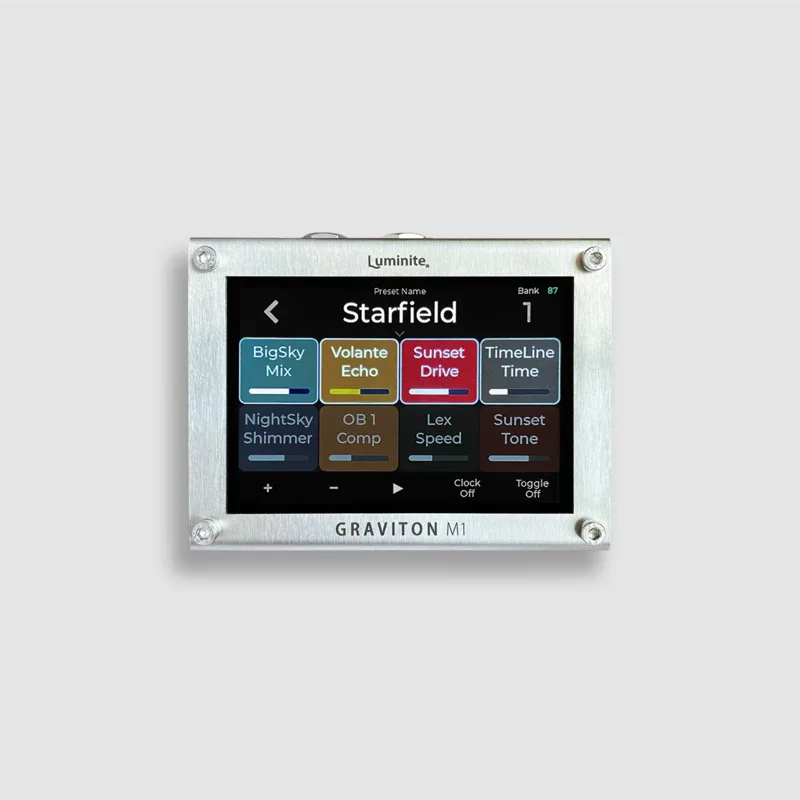


The Luminite Effect Pedals Graviton M1 is a MIDI controller pedal designed for guitarists and bassists, built to send program changes and control messages to MIDI-equipped gear from the floor. Luminite describes it as a next-generation controller, and its headline feature is editing without a computer: presets are programmed on a 3.5-inch color touchscreen, so no PC editor is needed1. It sits in the wider family of MIDI pedals used to run amp modelers, multi-effects units and rack gear.
Controls and connections
The M1 is built around its touchscreen, which Luminite specifies as an IPS panel with a wide viewing angle, sunlight readable, behind a capacitive touch layer1. Around and behind the display, the connections cover both classic and modern MIDI:
| Connection | What it does |
|---|---|
| MIDI In / MIDI Out | Standard 5-pin MIDI In and Out with a standard MIDI cable1 |
| TRS 1 and TRS 2 | MIDI out, or footswitch and expression pedal inputs, using 1/4-inch (6.35mm) stereo cables1 |
| TRS 3 | MIDI out using a 1/8-inch (3.5mm) stereo cable1 |
| Reset | Factory reset1 |
The two TRS jacks that double as footswitch and expression pedal inputs are the practical hook for players running expression-capable gear: the same socket can carry a pedal one day and a second MIDI output the next, depending on the cable and configuration1.
Power
The Graviton M1 can be powered two ways, which matters on a crowded pedalboard1:
- 9VDC input: center-negative power adapter, 250mA minimum. Luminite lists power consumption at 9V at 500mA on the DC input1.
- USB Type C: the pedal runs as a USB bus-powered device at 5V at 1000mA1.
On the 9V input the pedal draws up to 500mA, which is well above what most daisy-chain supplies give a single output. A dedicated outlet on a supply rated for it, or the USB-C connection, is the safer route1.
Presets and modes
The M1 holds 120 presets across 12 banks, and it runs in two modes: Preset Mode and Setlist Mode1. Preset Mode addresses patches one at a time; Setlist Mode is for organizing those presets into a running order for a gig or session. Because editing happens on the touchscreen, changes can be made at the pedal rather than back at a computer1.
Availability and related gear
Luminite's product page listed the Graviton M1 as sold out as of 26 October 2026, at a regular price of £118.00 GBP1. Separately, AMT Electronics lists its own M1 controller as available now on its product page2. The two share the M1 name but come from different makers.
Videos
Luminite
Luminite
Ross Gallagher Music
Questions
Does the Luminite Graviton M1 need a computer to program it?
No. Luminite says the Graviton M1 offers effortless MIDI programming on its large 3.5-inch touchscreen LCD, with no PC editor needed. Presets are built and edited directly on the pedal itself.
How many presets does the Graviton M1 have?
The Graviton M1 holds 120 presets arranged across 12 banks, and it can be used in Preset Mode or Setlist Mode depending on how you want to organize a gig or session.
Can the Graviton M1 run on USB power?
Yes. The pedal accepts a 9VDC center-negative adapter or draws power over its USB Type C connection, where it runs as a USB bus-powered device at 5V at 1000mA.
Can I connect expression pedals to the Graviton M1?
Yes. TRS 1 and TRS 2 accept footswitches or expression pedals using 1/4-inch (6.35mm) stereo cables, and the same jacks can alternatively be used as MIDI outputs.
Is the Graviton M1 still available?
As of 26 October 2026 the Graviton M1 was listed as sold out on Luminite's own product page, so availability is limited to whatever stock the maker restocks or dealers still hold.
Sources (2)
- Graviton M1 MIDI Controller, Luminite Effect Pedals
- AMT M1 | AMT Electronics official website, AMT Electronics, 2026