

Classic and Harmonic tremolo in one pedal
The Mariner's main draw is its two modes, chosen with a Harmonic/Classic toggle switch2. Delicious Audio describes the pairing as "two pedals in one" functionality1, and Guitar World's reviewer Alex Lynham explained the difference between them: Classic is "based on a more standard amplitude tremolo," while Harmonic mode has "a woozy phasiness mixed in with the cyclic volume change"4. Delicious Audio calls the Classic mode "the Fender amp-style tremolo (aka BIAS) that we all know and love"1.
For a player, that means one side of the switch gives the familiar pulse of an amp's tremolo section, and the other gives the more complex, swirling character associated with vintage Fender tube amps. MusicRadar's Rob Laing noted that the depth and range controls let you explore "a wide range from subtle textures to thumping pulsations"5.
The controls
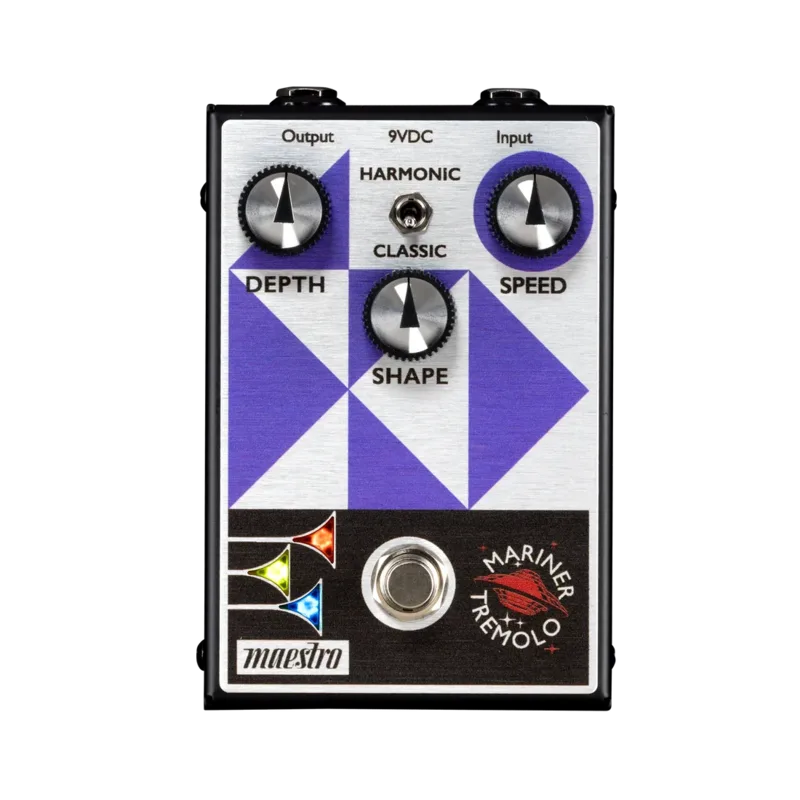
The Mariner keeps things simple: three knobs and one toggle switch1. Gibson describes the layout as intuitive, letting you set the effect quickly2.
| Control | What it does |
|---|---|
| Speed | Adjusts the speed of the tremolo effect2 |
| Shape | Controls the shape of the waveform, from a triangle wave to a square wave26 |
| Depth | Sets the intensity of the tremolo effect2 |
| Harmonic/Classic toggle | Selects between the two tremolo modes2 |
The Shape control is worth a second look for anyone new to tremolo. A triangle wave gives a smooth, even rise and fall in volume, while a square wave chops the signal on and off more abruptly, producing a harder, more percussive pulse26.
The true bypass footswitch also triggers LED lights in the bugles of the Maestro logo when the pedal is on, in red, yellow and blue, so you always know its status at a glance2.
Power and connections
The Mariner runs on a 9V battery or a regulated 9V DC power supply with a 5.5 x 2.1 mm plug wired center-negative2. Current draw is 41.9 mA2.
The power switch is built into the input jack, so the battery circuit is live whenever a cable is plugged in. Unplug the input when the pedal is not in use to prevent battery drain2.
Input impedance is 320 kOhms and output impedance is 1 kOhm2. The enclosure measures 5.04 in x 3.45 in x 2.50 in (128.0 mm x 87.6 mm x 63.5 mm) and weighs 1.19 lb (539.8 gm) net2.
Where it came from
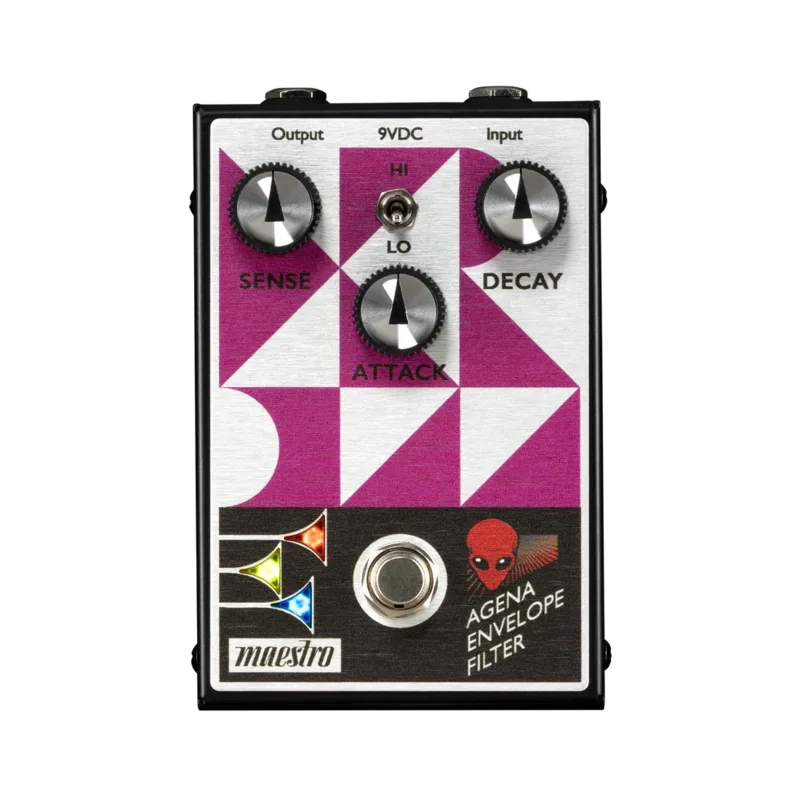
The Mariner shares its list price with two other pedals in the relaunched Maestro line: Delicious Audio reported that the Mariner Tremolo, Titan Boost and Agena Envelope Filter each list for $15931. Like the rest of the range, it comes in a pedalboard-friendly enclosure and, for a limited time, included a free three-month subscription to the Gibson App with purchase2.
What reviewers said
Guitar Player's Art Thompson reviewed the Mariner alongside its four siblings and found the Harmonic/Classic switch opened up a wide range of tremolo sounds, concluding72:
"The versatility of the Mariner makes it a good choice if you're looking for a basic tremolo pedal that has something extra."
Price
At launch the Mariner listed for $159 USD3. Gearnews reported a Thomann street price of $107.00 / £103.00 / 119.00€ in November 20228. Gibson's own product page currently shows a UK price of £115, including VAT, with free shipping2.
Videos
Pedal of the Day
Guitar Village
PJ and the Beard
Questions
Is the Maestro Mariner true bypass?
Yes. Gibson lists the Mariner's switching type as True Bypass, with a true bypass footswitch that also lights up the red, yellow and blue bugles in the Maestro logo when the pedal is active, so you can see at a glance whether it is on.
Can the Maestro Mariner run on a 9V battery?
Yes. It runs on a 9V battery or a regulated 9V DC power supply with a 5.5 x 2.1 mm plug wired center-negative. Power switches on through the input jack, so you need to unplug the input when you are not using the pedal to keep the battery from draining.
What is the difference between harmonic and classic tremolo?
Classic mode is a standard amplitude tremolo, the cyclic volume dip of a Fender-style amp. Harmonic mode keeps that cyclic volume change but adds a woozy, phasey quality to it, a sound MusicRadar compared to classic 1960s Fender tube amps such as the Bandmaster and Vibrasonic.
How much does the Maestro Mariner Tremolo cost?
At launch in November 2022 the Mariner listed for $159 USD. Gibson's own page currently shows a UK price of £115 including VAT with free shipping, and Gearnews reported a Thomann street price of $107.00 / £103.00 / 119.00€ in November 2022.
Is the Maestro Mariner analog or digital?
It is all-analog. Delicious Audio lists its signal processing as all-analog, and the pedal was part of a batch of five new analog pedals Maestro released in November 2022 alongside the Agena, Arcas, Orbit and Titan.
Sources (8)
- Maestro Mariner Tremolo, Delicious Audio, 2023-01-30
- Maestro Mariner Tremolo, Gibson (gibson.com)
- Filter, tremolo, phaser and more: Maestro launches five new pedals, Guitar.com, 2022-11-08
- Maestro Agena, Arcas, Mariner and Orbit review, Guitar World, 2023-02-08
- Our 11 favourite effects pedals of 2022, MusicRadar, 2022-12-22
- It sounds like Gibson's new Maestro pedals are good for grunge and alt rock tones, MusicRadar, 2022-11-09
- Maestro Agena Envelope Filter, Arcas Compressor Sustainer, Mariner Tremolo, Orbit Phaser and Titan Boost Reviews, GuitarPlayer (www.guitarplayer.com), 2023-01-05
- Maestro releases second wave of effects pedals, gearnews.com, 2022-11-08