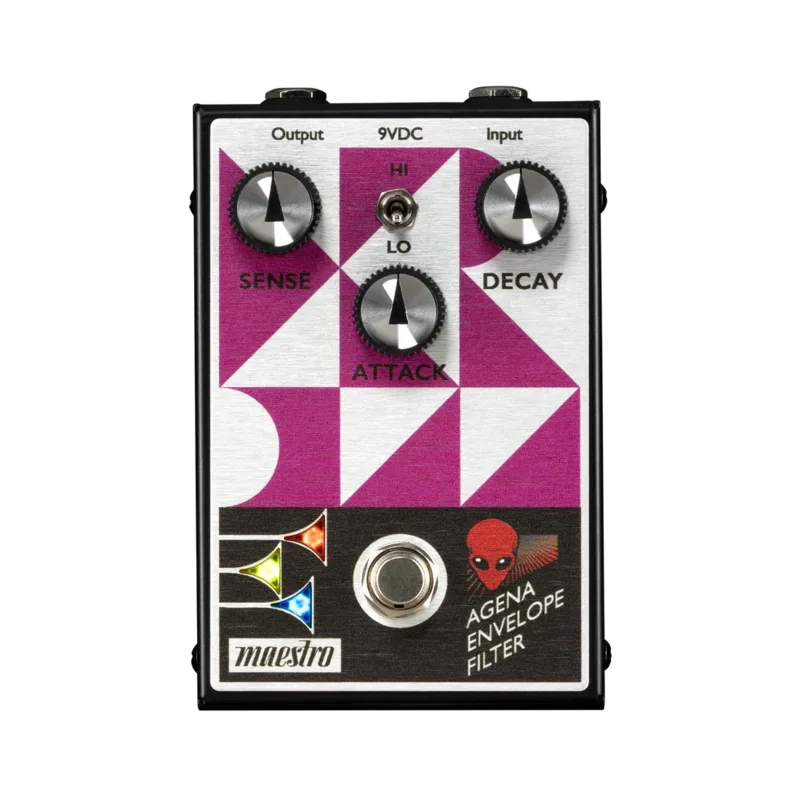


The Maestro Agena Envelope Filter is an all-analog envelope filter pedal from Maestro, the effects brand Gibson brought back to the market in early 2022. An envelope filter listens to how hard you pick and uses that signal to sweep a filter, giving the quacky, vocal auto-wah sounds associated with funk rhythm playing, without a wah pedal's footwork. Maestro describes the Agena as "designed for ease of use and is tailored for optimized dynamic control"12.
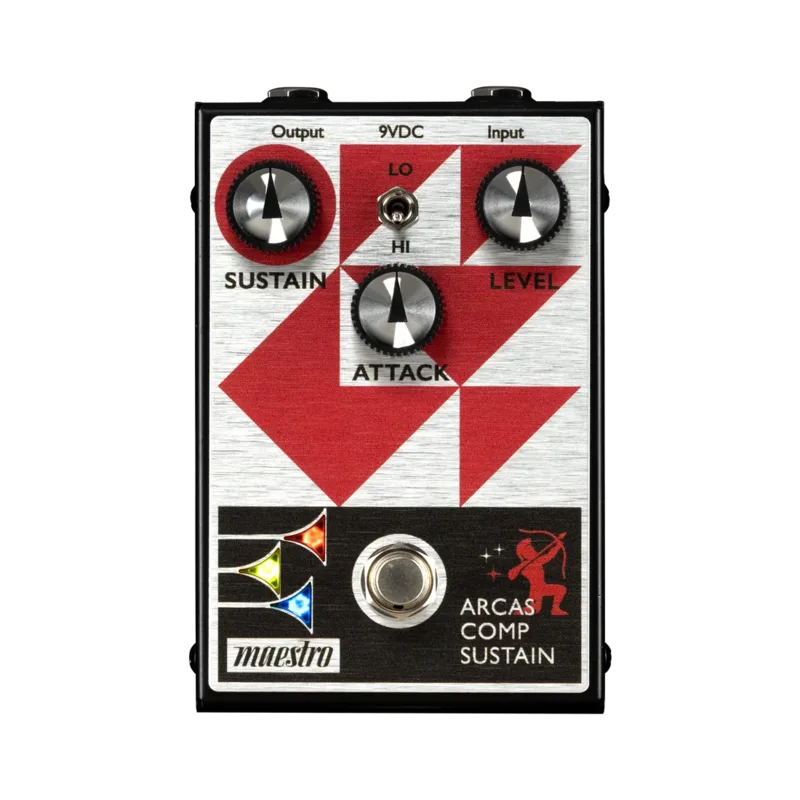
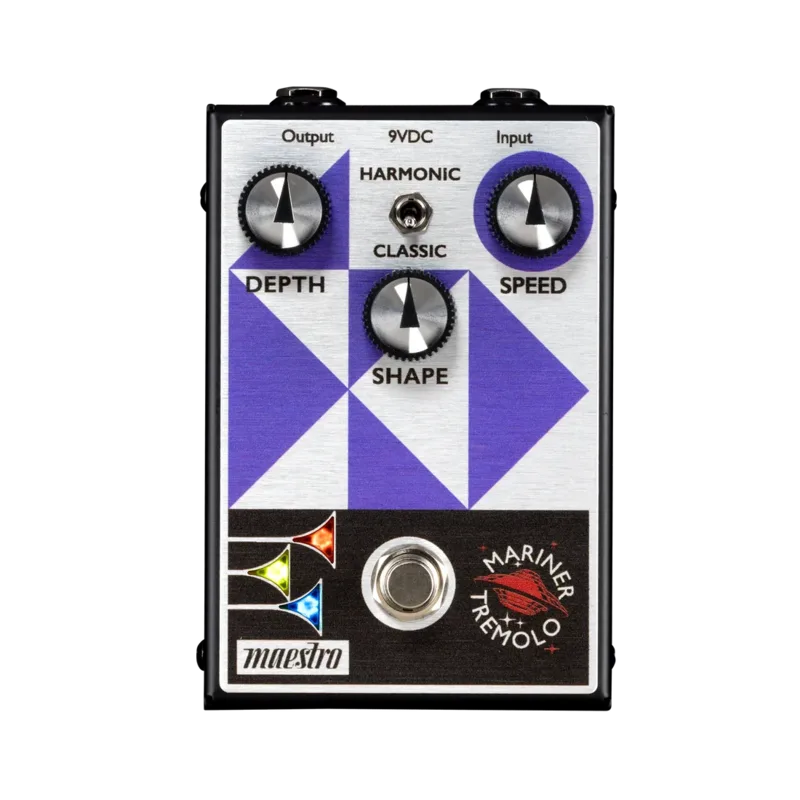
The Agena arrived in November 2022 as part of a second wave of five Maestro pedals, alongside the Arcas Compressor Sustainer, Mariner Tremolo, Orbit Phaser and Titan Boost, all in the same pedalboard-friendly format as the first batch3. Delicious Audio called it "great for funk rhythm section or quirky auto-wah tones"4.
What it does to your sound
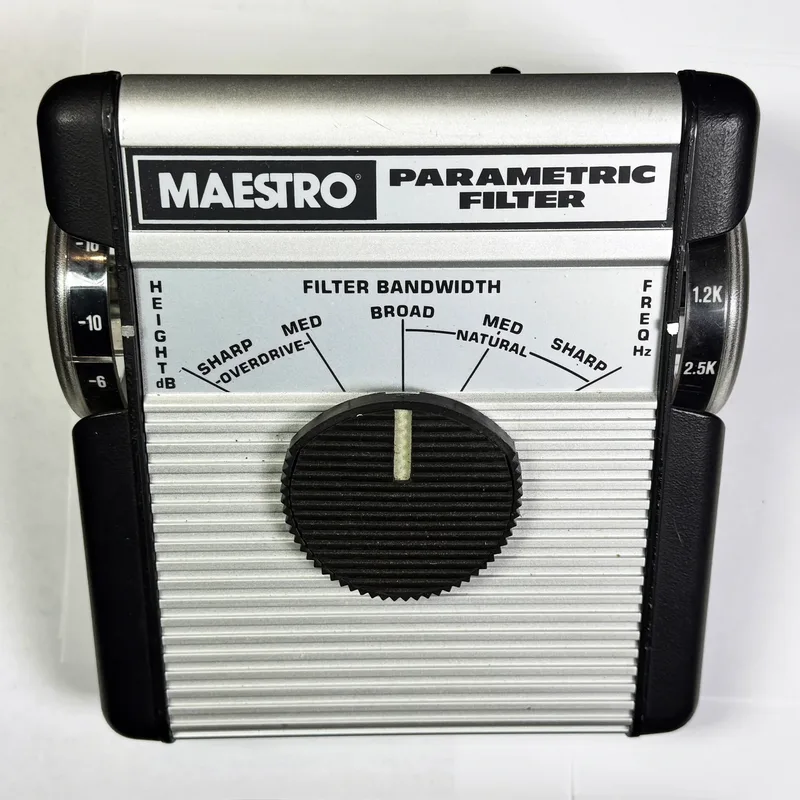
Instead of a fixed tone control, the Agena's filter opens and closes in response to your attack. Play harder and the filter sweeps further; back off and it settles down. Maestro calls it an "All-analog envelope filter, which includes three controls and LO and HI modes"1. The effect sits in the same family as the vintage Maestro filter pedals, though the Agena is a modern design rather than a reissue of the Maestro Filter Sample/Hold or the MPF-1.
Guitar World's reviewer, Alex Lynham, found the two modes give the pedal a two-in-one character: "Hi being nicely bright with Lo's mellower range having a deeper woof that still works well with a standard six-string but could also function with lowered tunings or bass guitars"6. That Lo mode is what makes the pedal a candidate for bass players, a point covered below.
The controls: Sense, Decay, Attack and Hi/Lo
The Agena keeps the format shared across this Maestro batch: three knobs and a mini-toggle, plus a bypass footswitch7. Here is what each control does:
| Control | What it does |
|---|---|
| Sense | Sets the envelope's sensitivity and response to your picking attack1. At the lowest setting the pedal responds only to hard picking; at maximum it responds to all but the softest touch6. |
| Decay | Sets how long the filter stays open6. |
| Attack | Increases the "quack" of the effect6. |
| Hi/Lo toggle | Two-position mode switch. LO focuses the filter in a lower frequency range; HI emphasizes a higher range of frequencies1. |
| Bypass footswitch | Activates the effect6. |
On That Pedal Show's demo, Mick and Dan walked through the same layout: "the sense is the sensitivity to the pick attack"2. Getting Sense right is the practical starting point for any envelope filter, since it decides whether the pedal reacts to every note evenly or only the accents you want to feature.
Housing, switching and power
The Agena uses the wedge-shaped steel housing shared by the second Maestro batch, with vintage-style brushed-aluminum decal graphics and a lighted "three bugles" on/off indicator7. The input, output and adapter jacks sit on the front panel rather than the sides, which lets these pedals sit close together on a pedalboard7. The true bypass footswitch triggers red, yellow and blue LED bugles in the Maestro logo when the pedal is on, so you always know its state1.
Power comes from a 9V battery or a regulated 9V DC supply with a 5.5 x 2.1 mm plug wired center-negative1. The battery clip is reached by loosening four screws, and neither battery nor adapter is included7. Power-on switching is incorporated into the input jack1.
Maestro advises removing the battery when the pedal will be stored for long periods, to prevent leakage and damage1. If you run it on a supply, it needs the common center-negative 9V DC standard, and at 26.6 mA it is light on current draw1.
Where it came from
The Agena is one of the second batch of five analog Maestro pedals, which like the first batch feature true bypass in the same pedalboard-friendly form factor3. It lists at $1596, and is an all-analog, true-bypass design built in China15.
What reviewers said
GuitarPlayer's Art Thompson reviewed the Agena alongside its four siblings and summed it up as "a sweet-sounding pedal that tracks picking dynamics very well", finding it warm and natural and fun to play with, with no faults listed7. Guitar World's review highlighted the Hi/Lo toggle as the pedal's two-in-one functionality and noted the Lo mode's usefulness for bass and lowered tunings6.
That Pedal Show gave the Agena a demo in their new-pedal-day video, introducing it at 3:30 and playing sounds from 4:33, with Mick and Dan covering the Sense control's response to pick attack28.
Agena at a glance against the batch
The Agena shares its chassis, control count and price tier with the other four pedals in the second Maestro wave75:
| Pedal | Effect | List price at launch |
|---|---|---|
| Agena | Envelope filter | $1595 |
| Arcas | Compressor sustainer | 37 |
| Mariner | Tremolo | $1595 |
| Orbit | Phaser | 5 |
| Titan | Boost | 5 |
All five are true-bypass analog designs in the same pedalboard-friendly form factor3.
Videos
Pedal of the Day
PJ and the Beard
American Musical Supply
Questions
Does the Maestro Agena take a battery?
Yes. It runs on a 9V battery or a regulated 9V DC power supply with a 5.5 x 2.1 mm plug wired center-negative. The battery clip is reached by loosening four screws, and neither the battery nor an adapter is included. Maestro advises removing the battery before storing the pedal for long periods to prevent leakage damage.
Is the Maestro Agena true bypass?
Yes. Maestro lists true bypass switching, and GuitarPlayer's review confirms all five pedals in this batch are true-bypass analog designs. The footswitch also lights up the red, yellow and blue bugles in the Maestro logo when the pedal is on, so the active state is easy to see on a dark stage.
Where is the Maestro Agena made?
It is built in China. Both Guitar World's review and GuitarPlayer's review of the five-pedal batch list China as the country of origin for the Agena and its siblings, the Arcas, Mariner, Orbit and Titan.
Does the Maestro Agena work with bass?
It can. The Hi/Lo mode toggle sets where the filter action sits: Hi is brighter, while Lo focuses on a lower, mellower range. Guitar World's reviewer found the Lo mode still works well with a standard six-string but could also function with lowered tunings or bass guitars.
How much current does the Maestro Agena draw?
Maestro lists a current draw of 26.6 mA. That is modest by modern standards, so it is easy to power alongside other 9V center-negative pedals on a typical isolated supply.
Sources (8)
- Maestro Agena Envelope Filter, Gibson (www.gibson.com)
- Maestro Agena, Mythos Cestus, Aclam Woman Tone, TC Bucket Brigade New Pedal Day, That Pedal Show (YouTube), 2022-12-13
- Maestro Knocks Out Another Batch of Classic Analog Stompboxes, GuitarPlayer, 2022-11-09
- 5 New Maestro Pedals, Delicious Audio, 2022-12-06
- Filter, tremolo, phaser and more: Maestro launches five new pedals, Guitar.com, 2022-11-08
- Maestro Agena, Arcas, Mariner and Orbit review, Guitar World, 2023-02-08
- Maestro Agena Envelope Filter, Arcas Compressor Sustainer, Mariner Tremolo, Orbit Phaser and Titan Boost Reviews, GuitarPlayer (www.guitarplayer.com), 2023-01-05
- New Pedal Day Maestro Agena, Mythos Cestus, Aclam Woman Tone, TC Bucket Brigade, That Pedal Show, 2022-12-13