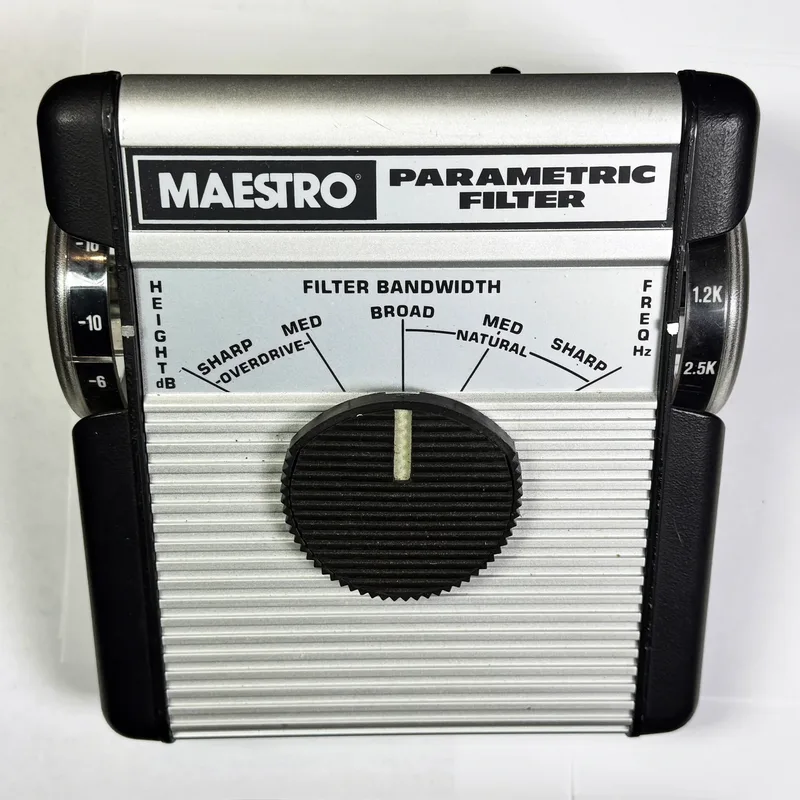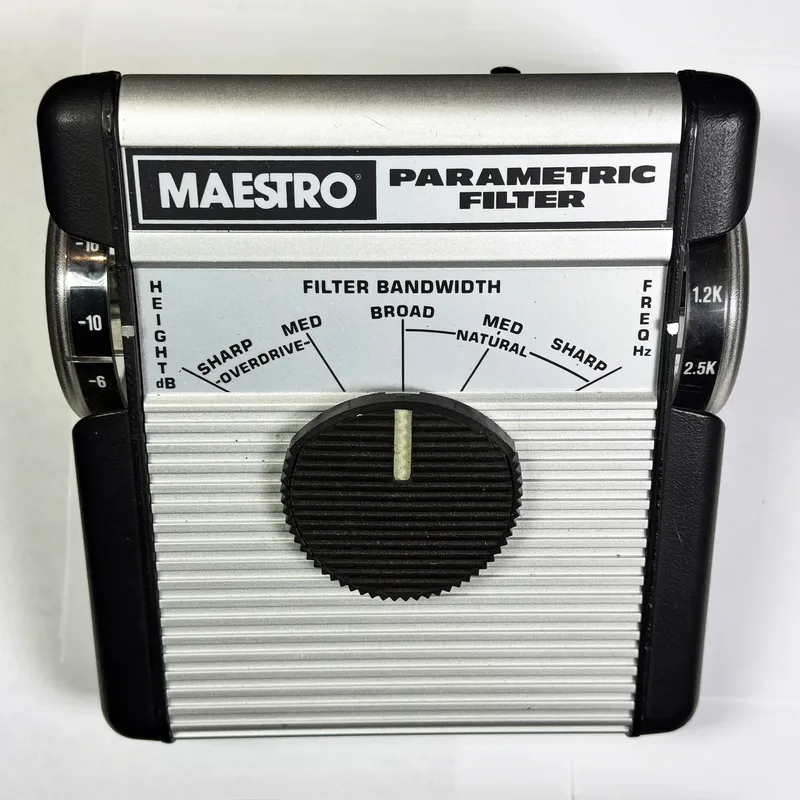

The Maestro MPF-1 is a parametric filter pedal with an overdrive stage, designed by Bob Moog for Gibson in the 1970s1. It is a filter pedal in the same family as the Maestro Parametric Filter and the Maestro Filter Sample/Hold, built around a band-pass filter that a player can sweep across the spectrum and boost, with a drive circuit alongside it23.
What it does
The MPF-1 works by selecting a band of frequencies and boosting it. Three controls set the character of that band2:
| Control | What it does |
|---|---|
| Freq | Controls the center frequency of the filter |
| Height | Controls the amount of boost of the selected frequency |
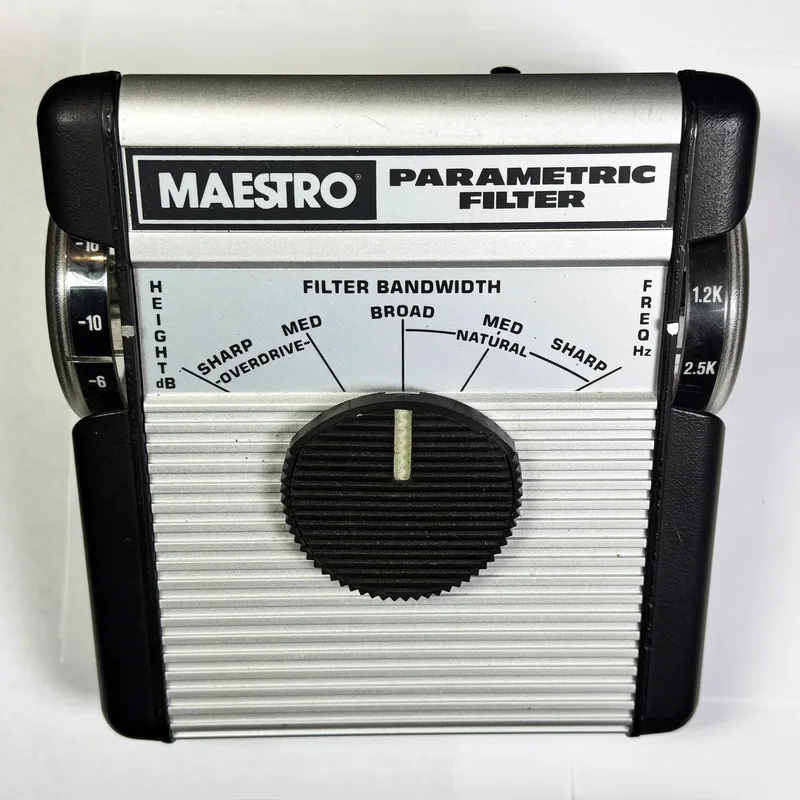
| Filter Bandwidth | Selects the width of the band-pass filter, with Overdrive settings Sharp and Med and Natural setting Broad |
In practice, Freq sweeps the boosted band up and down the spectrum, Height sets how pronounced that band becomes, and Filter Bandwidth decides whether the effect is a narrow, focused peak or a wider one. The Bandwidth control's Sharp and Med settings apply when the overdrive is engaged, while Broad is the Natural setting2. The overdrive side makes this a two-part pedal: a sweepable filter plus a drive stage in one box3.
Where it came from
MusicRadar's Jonathan Horsley describes the MPF-1 as having been "designed by Bob Moog for Gibson in the 1970s"1. That places it among the Maestro units of that era, alongside the Filter Sample/Hold and the Ring Modulator, which came from the same period of Maestro's history.
For builders
The MPF-1 is no longer in current production, and examples change hands as used or secondhand units. One retailer listed a B-stock pedal, described as in good condition but with no box, at £766.00 GBP, marked sold out32. For players interested in the circuit, that scarcity is worth knowing:
- The Height control uses a 10k linear pot where the original schematic called for an S-taper pot, which affects how the control sweeps3.
- One builder found that replacing the 5k6 resistor with a 20kb pot in series with a low ohm resistor to ground acts as a usable gain control for the overdrive side3.
- The Frequency pot is misnumbered and backwards compared to the offboard wiring guide; swapping terminals 1 and 3 and 4 and 6 corrects it3.
The listing checked on 26 October 2026 was for a B-stock example, described as a pedal in good condition with no box, and it was sold out. The listed price was £766.00 GBP2.
Videos
Florian Z
501chorusecho
Questions
Who designed the Maestro MPF-1?
According to MusicRadar, the MPF-1 was designed by Bob Moog for Gibson in the 1970s. It pairs a parametric band-pass filter with an overdrive circuit, and its controls let the player choose the center frequency, the amount of boost at that frequency, and the width of the filtered band.
What do the MPF-1's controls do?
The Freq control sets the center frequency of the filter. The Height control sets how much boost is applied to the selected frequency. The Filter Bandwidth control selects the width of the band-pass filter, with Sharp and Med settings used with the overdrive and a Broad setting for the Natural mode.
Sources (3)
- Stone Deaf unveils updated hybrid boost, drive and EQ pedal inspired by Josh Homme, MusicRadar, 2019-09-18
- Maestro MPF-1 Parametric Filter (B-STOCK), Godlyke Distributing, Inc.
- Guitar FX Layouts: Maestro MPF-1, Guitar FX Layouts (tagboardeffects.blogspot.com), 2015-10-10