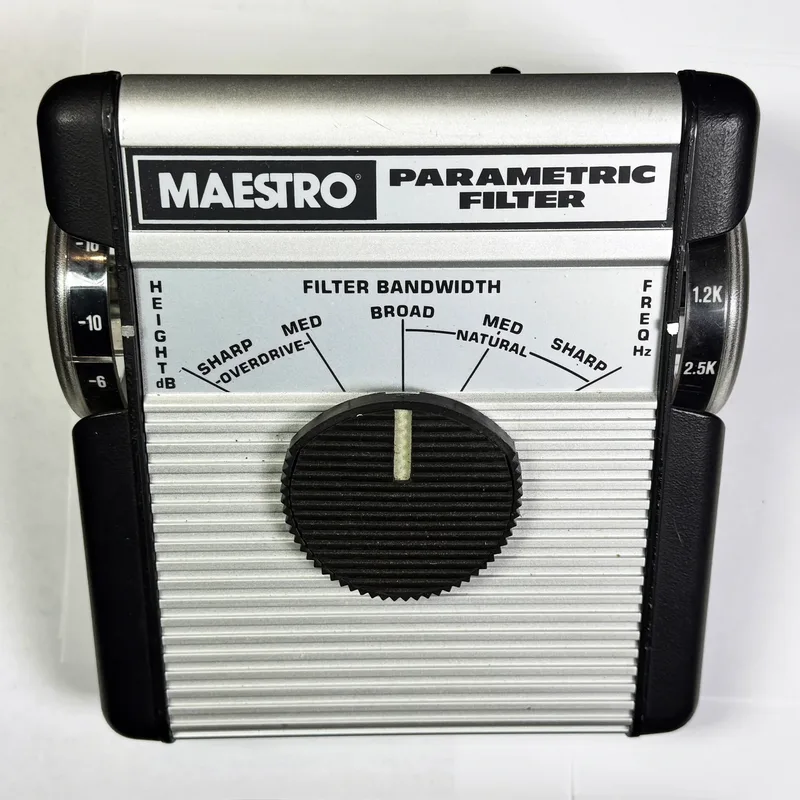

The Maestro MPF-1 is a parametric filter pedal with a mild overdrive stage, designed by Bob Moog for Gibson in the 1970s and sold under Gibson's Maestro line1. Its most distinctive feature is a wheel-driven EQ section rather than conventional knobs: MusicRadar describes it as having "a hugely expressive, wheel-driven EQ"1, while gearnews notes that the wheel layout "allowed for all manner of great tones, but it wasn't exactly an easy to use control interface, especially with your foot"2.
The pedal is best known today for its association with Josh Homme: MusicRadar calls the MPF-1 "a favourite of Josh Homme"1. It sits in a family of 1970s Maestro filter pedals that also includes the Maestro Filter Sample/Hold and the Maestro Parametric Filter, and its spirit lives on in the wider world of filter pedals.
The controls: frequency, height and the wheel-driven EQ
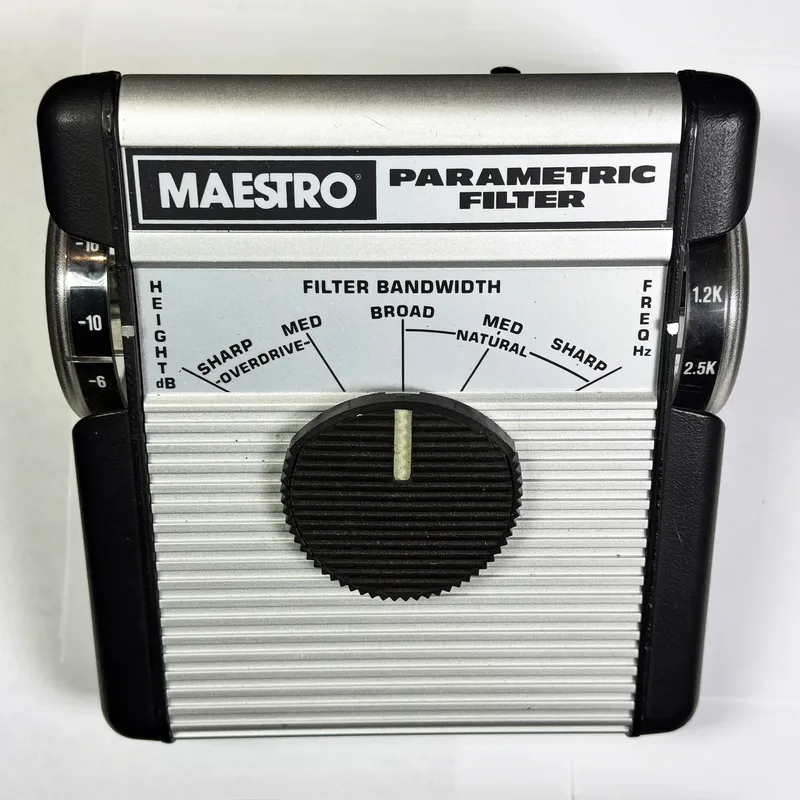
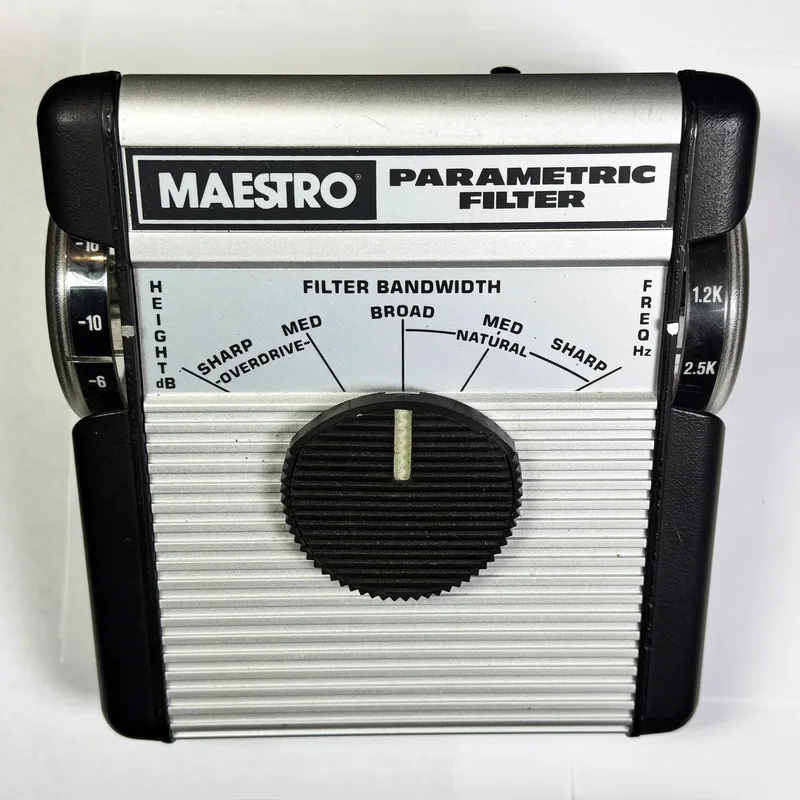
The MPF-1's control set is built around a band-pass filter whose center point, amount of boost and width are all adjustable. Godlyke Distributing, which listed the reissue, describes the three controls this way4:
| Control | What it does |
|---|---|
| Freq | Controls the center frequency of the filter |
| Height | Controls the amount of boost of the selected frequency |
| Filter Bandwidth | Selects the width of the band-pass filter, with Overdrive settings Sharp and Med and Natural setting Broad |
The Filter Bandwidth switch ties the filter to the pedal's two personalities: tighter bandwidth settings (Sharp and Med) sit alongside the overdrive mode, while the Natural setting opens the filter up to a broad band. The wheel-driven interface that carries these controls is the pedal's signature, and its awkwardness underfoot is part of why players tend to set it and leave it, or adjust it by hand mid-song421.
Filter or overdrive?
Both, in unequal measure. The technical analysis at Guitar FX Layouts, working from the service manual schematic, treats the MPF-1 as a parametric filter with an overdrive stage3. On the overdrive side, the discussion is clear about its intent:
"It's not supposed to be a strong overdrive. It's supposed to be used after a fuzz or an overdrive (like in the video)."
That places the MPF-1 after dirt in the signal chain, where its filter shapes an already-driven or fuzzed signal rather than adding grit of its own. One builder in the same discussion reported that it pairs especially well with heavy fuzz: "It really takes my Fuzz Factory to a new level..."3. Players looking for a dirt pedal to feed it can read more on overdrive pedals and fuzz pedals.
From Bob Moog to the Gibson Maestro line
MusicRadar's Jonathan Horsley credits the design to Bob Moog, writing that "the MPF-1 was designed by Bob Moog for Gibson in the 1970s"1. That puts the pedal among the handful of foot-pedal designs associated with Moog's work for Gibson's Maestro brand.
The MPF-1 dates from a different era of the Maestro name: it was designed by Bob Moog for Gibson in the 1970s21. Players who track one down should also know the pedal's wheel-driven EQ section, which allowed for all manner of great tones, was not an easy control interface to use, especially with your foot2.
Building one: the stripboard layout
For players who want the circuit without hunting a vintage unit, Guitar FX Layouts published a stripboard (vero) layout for the MPF-13. The layout was updated on 17 October 2015, when the IC was specified as a CD4007UBE rather than the CD4007N, with the note that the original schematic calls for a CD4007AE and the CD4007UBE is the easier part to find3. Builders have also shared a mod for the overdrive side: replacing the 5k6 resistor with a 20kb pot in series with a low ohm resistor to ground acts as a usable gain control3.
Builders in the layout's comments have documented a few practical points worth knowing before starting:
- The height control uses a 10k linear pot in the layout, where the original schematic called for an S-taper pot, which changes the control's response3.
- The frequency pot is misnumbered and backwards compared to the offboard wiring guide; swapping terminals 1 and 3 and 4 and 6 fixes it3.
- The switches are wired 1-4, 2-5, 3-6 and 1-4-7, 2-5-8, 3-6-9 with the holes facing up3.
- A usable gain control for the overdrive side can be added by replacing the 5k6 resistor with a 20kb pot in series with a low ohm resistor to ground3.
Videos
Florian Z
Questions
Who designed the Maestro MPF-1?
According to MusicRadar, the MPF-1 was designed by Bob Moog for Gibson in the 1970s. It appeared under Gibson's Maestro line, which also produced other filter pedals of the era such as the Filter Sample/Hold.
Is the Maestro MPF-1 an overdrive or a filter?
It is both, but the filter is the main event. Technical analysis on Guitar FX Layouts describes it as a parametric filter with an overdrive stage, and notes that the overdrive is not supposed to be a strong one. The pedal is meant to be placed after a fuzz or an overdrive, with the filter shaping the sound.
Where does the MPF-1 go in the signal chain?
After dirt. The Guitar FX Layouts discussion says the overdrive side is not meant to be a strong overdrive in its own right, and that the pedal is supposed to be used after a fuzz or an overdrive, so the parametric filter can sculpt an already-driven signal.
Is the Maestro MPF-1 still being made?
No. The original 1970s pedal is long out of production, and even the reissue sold under the Maestro name is listed as sold out at Godlyke Distributing as of October 2026. Gibson revived the Maestro brand in 2022 with new pedals, but the MPF-1 is not part of that current line.
Can you build a Maestro MPF-1 clone?
Yes. Guitar FX Layouts published a verified stripboard layout for the MPF-1 in October 2015, updated a week later. The layout uses a CD4007UBE IC, and builders in the comments share fixes and mods, including a gain control for the overdrive side and wiring corrections for the switches and frequency pot.
Sources (4)
- Stone Deaf unveils updated hybrid boost, drive and EQ pedal inspired by Josh Homme, MusicRadar, 2019-09-18
- Stone Deaf Effects limited edition PDF-1X, gearnews.com, 2019-09-18
- Guitar FX Layouts: Maestro MPF-1, Guitar FX Layouts (tagboardeffects.blogspot.com), 2015-10-10
- Maestro MPF-1 Parametric Filter (B-STOCK), Godlyke Distributing, Inc.