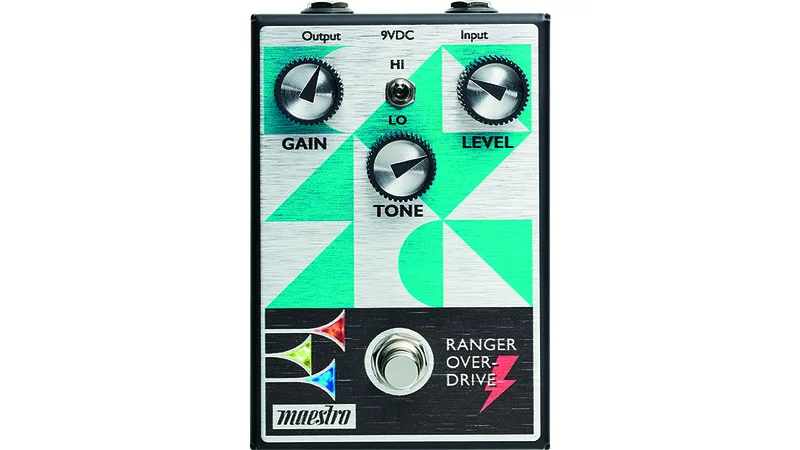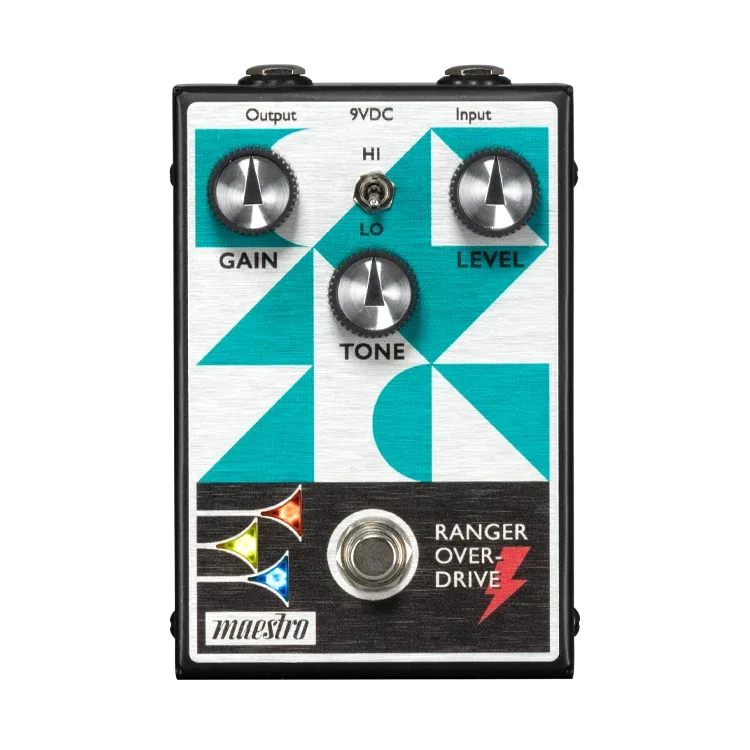


The Maestro Ranger Overdrive is a modern, all-analog overdrive pedal from Maestro, the effects brand Gibson originally launched in 1962 and revived in early 2022. Gibson describes it as "Overdrive Inspired By Legendary Tube Amps," and the pedal is built around two voices selected by a toggle switch: one warm, expressive and amp-like, the other slightly cleaner, exceptionally touch-sensitive, and blended with some of your clean signal12.
It is a simple three-knob, two-mode pedal3, but it also works as a boost. As Gibson puts it, "You can easily use the Ranger Overdrive as a boost to hit the input of your tube amp harder for even more grit and dirt"1. With plenty of volume on tap to go well beyond unity gain3, it can push an amp rather than replace its character.
What it does to your sound
Gibson says the Ranger is inspired by the overdriven tones of some of the world's most cherished vintage tube amps1, and Premier Guitar characterized its two settings the same way: "the first setting perfectly captures the essence of a cranked-up and screaming tube amp tone," while the second covers low- to mid-gain sounds that respond to touch and your guitar's volume control7.
MusicRadar's review team took a broader view of what the pedal does to a signal8:
"This pedal is an effective thickener for guitars, basses and synths, adding/enhancing harmonics without overly compressing" the dynamic range of the midrange and low end.8
That last point matters for bass players: the Ranger held up as a thickener on bass without squashing the low end, which is where many guitar-oriented overdrives fall short8.
The controls
The front panel is three knobs and a toggle, which keeps the pedal quick to dial in3.
| Control | What it does |
|---|---|
| Gain | Sets the amount of overdrive1 |
| Tone | Shapes the EQ of the driven signal3 |
| Level | Sets output volume, with enough range to go well beyond unity gain3 |
| Hi/Lo toggle | Selects between the pedal's two tonalities3 |
The true bypass footswitch triggers LED lights in the bugles of the Maestro logo when the pedal is on: red, yellow and blue bugles illuminate to show the pedal is active1.
Hi and Lo modes
The Mode toggle is where the Ranger's two personalities live. Delicious Audio describes the switch as offering "Hi and Lo modes that deliver high and lo-gain tones"3.
- Hi mode is the warm, expressive, amp-like overdrive9. GuitarPlayer's Art Thompson found that with the mode switch set to High and the gain cranked, the pedal reaches vintage British amp with treble booster territory2.
- Lo mode blends a bit of the clean signal into the driven signal10. Performer Mag's Chris Devine found this adds up to "a very rich" sound10, and Gibson positions it as a great choice for an always-on effect that can be controlled with pick attack and your guitar's volume knob1.
GuitarPlayer's review put the two modes to practical use: with the switch set to Low, you can leave the Ranger on full-time and get tones that react organically to your playing, cleaning up for quieter passages2. The pedal's clipping is symmetrical, according to Maestro's Craig Hockenberry in a MusicRadar interview11.
Power and the battery
The Ranger runs on a 9V battery or a regulated 9 to 12VDC power supply with a 5.5 x 2.1 mm plug wired center-negative1. Running it at 12V provides increased headroom1, which GuitarPlayer flagged as a plus for boost use2. Current draw is 30.4 mA1.
Power switches on through the input jack, so the input should be unplugged when the pedal is not in use to prevent battery drain; Gibson also recommends removing the battery before long storage to prevent leakage and damage1. The housing opens clamshell-style to make the battery easy to change2.
The center-negative 9 to 12VDC requirement means the Ranger fits standard pedalboard power supplies. The 30.4 mA draw is modest, so it shares an isolated output or daisy chain without straining most supplies1.
History: named after a vintage Gibson amp
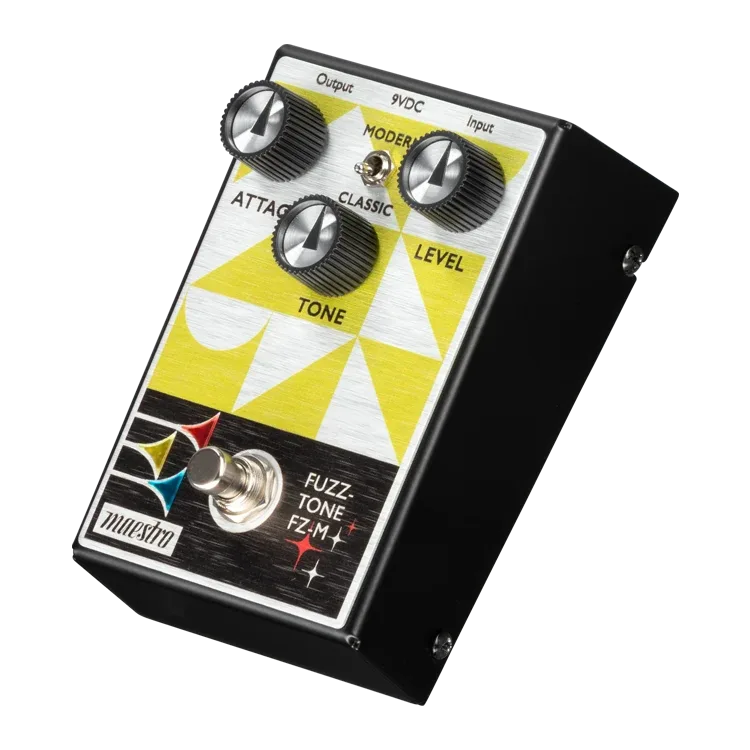
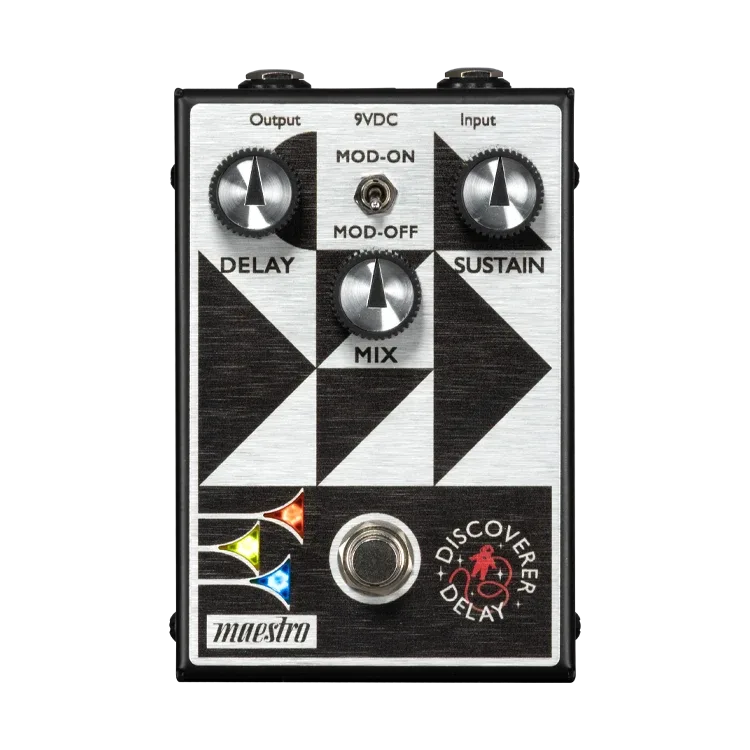
Gibson launched the Maestro brand in 1962 and set the stage for stompbox effects with the FZ-1 Fuzz-Tone2. Sixty years on, Gibson revived the long-retired brand name with the Original Collection, a series of five new all-analog pedals announced in January 2022: the Fuzz-Tone FZ-M, Invader Distortion, Ranger Overdrive, Comet Chorus and Discoverer Delay64.
The Ranger's name comes from Gibson's own past. In a MusicRadar interview, Maestro's Craig Hockenberry explained that "the Ranger, Invader, Discoverer and Comet are all names of vintage amps"11. So the overdrive pedal carries the name of an old Gibson amplifier, alongside its stablemates in the collection.
What reviewers said
Published reviews of the Original Collection were broadly positive about the Ranger.
- GuitarPlayer (Art Thompson, April 2022) called it "a great choice for those who like to turn up the heat on a tube amp without changing its vibe," and listed no reasons to avoid it2.
- Premier Guitar described the first Mode toggle setting as capturing a cranked-up tube amp tone, and the second as covering low- to mid-gain sounds that respond to touch and volume control7.
Videos
Gibson TV
Pedal of the Day
Buddy Blues
News
Questions
Is the Maestro Ranger true bypass?
Yes. Gibson lists the Ranger Overdrive's switching type as true bypass, so with the pedal off your signal passes through without active buffering. The footswitch also lights up the red, yellow and blue bugles in the Maestro logo when the pedal is engaged.
How do you change the battery in the Maestro Ranger?
The Ranger runs on a 9V battery, and the housing opens clamshell-style to make the battery easy to swap. Gibson advises unplugging the input jack when the pedal is not in use to prevent battery drain, and removing the battery entirely before long storage to avoid leakage damage.
Does the Ranger Overdrive work on bass?
Yes. MusicRadar's reviewers found it an effective thickener for guitars, basses and synths, adding harmonics without overly compressing the midrange and low end. That makes it a workable option for bass players who want grit without losing their low frequencies.
How much did the Maestro Ranger Overdrive cost at launch?
The Ranger Overdrive launched at $149 in the United States in early 2022, as one of five pedals in the Maestro Original Collection. Guitar World later listed its price as $149, while UK pricing has appeared as £139 and £110 including VAT.
Sources (11)
- Maestro Ranger Overdrive, Gibson (gibson.com)
- Maestro Ranger Overdrive Review, GuitarPlayer, 2022-04-06
- Maestro Ranger Overdrive, Delicious Audio, 2022-02-08
- Maestro Knocks Out Another Batch of Classic Analog Stompboxes, GuitarPlayer, 2022-11-09
- Maestro Comet Chorus, Delicious Audio, 2022-01-20
- Gibson revives Maestro as a fully-fledged pedal brand with five new stompboxes, Guitar.com, 2022-01-18
- Gibson Launches Maestro Original Collection 2023, Premier Guitar, 2022-01-18
- Maestro Original Collection pedals review, MusicRadar, 2022-05-25
- Gibson revives legendary Maestro pedals brand with five new stompboxes, including the Fuzz-Tone FZ-M, MusicRadar, 2022-01-18
- REVIEW: Maestro Original Collection Guitar Effect Pedals, Performer Mag, 2022-07-07
- Interview: "It's arguably the first guitar effects pedal ever", MusicRadar, 2022-02-21